
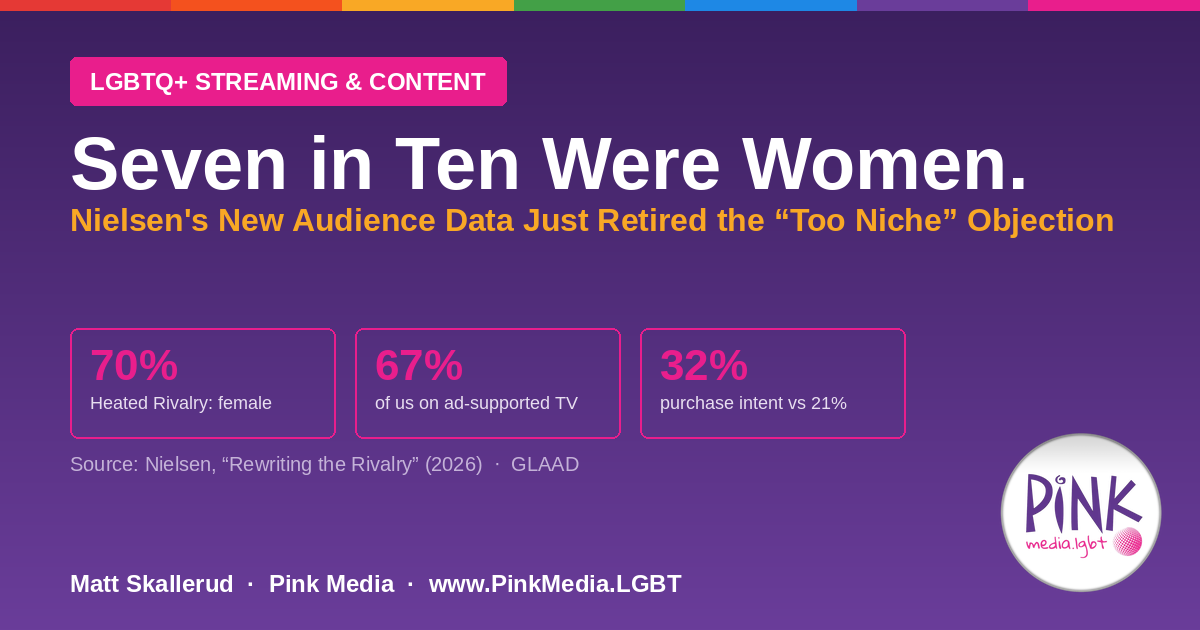
My feed spent most of this week on the Heated Rivalry discourse. Plenty of smart takes about what the show's reception says about where queer storytelling has landed culturally.
Almost none of them cited the research sitting directly underneath the moment — which is a shame, because the numbers are more interesting than the takes.
Nielsen's Rewriting the Rivalry does something the LGBTQ+ marketing conversation has needed for about fifteen years: it measures who actually watches queer content. Not who it's for. Who watches.
The answer reorganizes a lot of media plans.
The Composition Data
| Title | Audience Composition | What It Tells a Buyer |
|---|---|---|
| Heated Rivalry | 70% female | A gay male romance delivering seven in ten women |
| The Hunting Wives | 68% female | Consistent skew across a very different genre and setting |
| Call Me by Your Name | 68% female, nearly half under 35 | Age and gender skew stacking in the same title |
| A League of Their Own | 81% female | Composition most women's-category advertisers would pay a premium for |
| Harlem | 81% female | Same skew, with the multicultural audience layered in |
| Red, White & Royal Blue | 61% women | Even the broadest title in the set is majority female |
Read those as a set rather than one at a time. Six titles, six genres, one consistent pattern. This isn't a quirk of one show's marketing — it's a structural fact about who queer storytelling reaches.
And Nielsen supplies the behavioral explanation: 44% of women aged 18–34 say they actively seek out content featuring identities different from their own. That's not tolerance, and it isn't allyship as a buzzword. It's a stated content preference in the single most contested demographic in advertising.
The Category Error That Has Cost This Market Years
Here's the sentence I've heard in more rooms than I can count, usually said kindly, usually by someone who thinks they're being realistic:
"We love it, but the audience is just too small."
That objection has always rested on an assumption nobody says out loud — that the audience for LGBTQ+ content is the LGBTQ+ community, and therefore the reach ceiling is the community's population share.
The Nielsen data retires that assumption. If A League of Their Own delivers an 81% female audience, a buyer placing against it isn't making a targeted community buy with limited upside. They're making a broad reach buy against a demographic they were already chasing — one that happens to also over-deliver against the LGBTQ+ viewers who respond to advertising more strongly than anyone else in the room.
The LGBTQ+ community is the loyal core of these audiences. It is not the ceiling. Sizing the opportunity by community share rather than by viewership isn't conservatism — it's arithmetic applied to the wrong number.
Where the Audience Sits — and Why That's Good News
A finding is only useful if you can act on it, so here's the part that makes this immediately buyable.
Free ad-supported streaming reaches 67% of the LGBTQ+ community, against 55% of all adults.
Sit with the commercial implication of that for a second. This audience isn't concentrated behind ad-free subscription walls where no inventory exists. It's over-indexed in exactly the environments that carry advertising — FAST channels and ad-supported tiers, which happen to be the fastest-growing part of the television business.
That's an unusually clean alignment. Usually the audience you most want is the one hardest to reach. Here, the audience with the strongest documented ad response is disproportionately sitting in the inventory that's easiest to buy.
The Number That Should Change How You Brief
And then there's the finding I'd put on the first slide.
When diverse content surrounds an ad, 32% of LGBTQ+ respondents report intent to purchase — against 21% of all adults.
That's roughly a 50% relative difference, and note carefully what's producing it. Not the creative. Not the offer. Not the targeting. The surround. The same spot generates a materially different response depending on the content it runs inside.
We've argued the contextual case at Pink Media for years, usually on principle. This is the version with a number attached — and it lands at a moment when context has quietly become one of the only levers left. The major platforms no longer offer orientation-based targeting, and Google's personalized advertising policy restricts advertiser-curated audiences in this category. I've written about that structural gap and about the creator-side version of the same effect, where Nielsen found a 52% purchase-intent lift for brands advertising in content featuring diverse creators.
Same mechanism, two studies, two channels. Environment is a media variable. Plan it like one.
For twenty years we've had to argue that LGBTQ+ content reaches a real audience. Nielsen has now measured that audience, and it turns out to be larger, younger and more female than the people declining to buy it ever assumed. The argument is over. What's left is the planning.
— Matt Skallerud, Pink Media
The Crossover Argument — and Why It Belongs in Your 2027 Deck
GLAAD's President and CEO Sarah Kate Ellis, quoted in the Nielsen piece, supplies the line that does the most work in a boardroom. LGBTQ+ inclusion, she says, is "a proven growth engine" and "should no longer be considered a niche play."
She backs it with the index figures that matter most to anyone whose 2027 targets are written in multicultural and young-adult terms. Inclusive brands over-index with:
This is the part I'd underline for anyone still positioning LGBTQ+ work as a standalone line item to be defended on its own merits. It doesn't sit alone. The same positioning that reaches LGBTQ+ consumers correlates with strength across the exact segments most brands have already named as their growth priorities — which means it can be funded out of the growth conversation rather than the values conversation.
That's a meaningfully easier internal sell, and it's now sourced to GLAAD and Nielsen rather than to the agency proposing the spend.
What to Do With This in Planning Season
1. Move the line item. Take LGBTQ+ content out of the Pride allocation and put it in the reach allocation. The composition data supports that reclassification on its own, and it changes who has to approve it.
2. Size from viewership, not population. Build your reach estimate from the audience the content actually delivers. That single change is usually worth more than any negotiation you'll have on rate.
3. Buy the ad-supported environments. That 67% figure tells you where the audience is concentrated. FAST and ad-supported tiers, not just the prestige subscription placements.
4. Treat the surround as a planned variable. If context produces a 50% relative swing in purchase intent, it deserves a line in the brief — not a footnote in the post-buy report.
5. Don't let the content buy stand alone. A title runs for a season. Pair it with LGBTQ+ publishers and creators so the presence continues after the finale — that's the difference between a moment and an audience strategy.
6. Put Ellis's line in the deck verbatim. "A proven growth engine," not a niche play, with the +19 / +18 / +15 index figures beneath it. Third-party validation from GLAAD and Nielsen does work that your own slide never will.
The Takeaway
A show about two hockey players became a cultural moment this month, and the marketing world responded by posting about the moment rather than reading the measurement.
The measurement is the more valuable artifact. It says the audience for queer storytelling is majority women, meaningfully young, broadly mainstream, concentrated in ad-supported inventory, and demonstrably more responsive when the surrounding content reflects them.
Every one of those is a media-planning fact, not a cultural one. And together they mean the conversation has finally moved past whether this audience is worth reaching — to the far more useful question of how well you're reaching it.
Our 2026 LGBTQ+ Marketplace Guide maps the LGBTQ+ media landscape in depth, and the LGBTQ+ B2B Market Guide covers the business-audience side.
- Rewriting the Rivalry — Nielsen, 2026. The audience composition figures for Heated Rivalry, The Hunting Wives, Call Me by Your Name, A League of Their Own, Harlem and Red, White & Royal Blue; the 44% of women 18–34 finding; the 67% vs. 55% ad-supported streaming reach; the 32% vs. 21% purchase-intent gap; and the Sarah Kate Ellis quotes with the Gen Z, Black and Hispanic index figures.
- Reconnecting with LGBTQ+ Audiences — Nielsen, June 2025. The companion study: 63% feeling misrepresented, and the 47% / 52% creator purchase-intent findings.
- Marketing to the LGBTQ+ Community — Association of National Advertisers, June 2026. Only about 34% of marketers include LGBTQ+ media in their plans, against $1.4 trillion in US spending power.
- Sexual Orientation in Personalized Advertising — Google Ads policy. Why contextual placement carries more weight than it used to.
- Nielsen Gave Brands Two Creator Numbers. Most Only Buy the First. — Pink Media. The creator-channel version of the same context effect.
- Campaigns End. Audiences Compound. — Pink Media. Where a content buy fits inside a three-layer audience strategy.
- The Targeting Is Gone. The Audience Isn't. — Pink Media. The platform-policy backdrop that makes context load-bearing.
- Pink Media's 2026 LGBTQ+ Marketplace Guide · LGBTQ+ B2B Market Guide