
I get a version of this call every few months, and it's usually a media buyer who has just discovered the problem in real time.
They've been asked to build an LGBTQ+ campaign. They open Ads Manager, go looking for the interest selections they used four or five years ago, and find nothing there. Then they ask me whether it's a bug, or a permissions issue, or something regional.
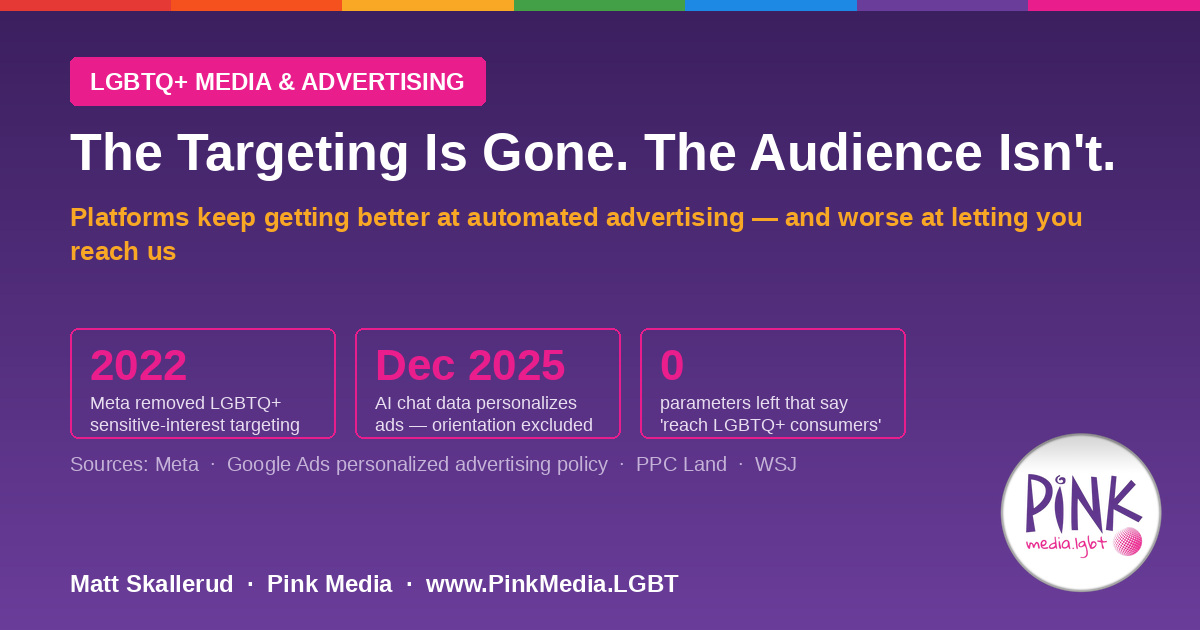
It isn't. It's policy, it's been policy since January 19, 2022, and the direction of travel since then has been consistently away from advertisers ever getting it back.
This is, in my view, the single most important structural issue in LGBTQ+ digital media right now — more consequential than any individual brand's Pride decision, because it changes what's mechanically possible rather than what's currently fashionable.
What Actually Happened, in Order
Let me lay out the sequence, because the individual events get reported separately and the pattern only shows up when you line them up.
| When | What Changed | What It Meant for Us |
|---|---|---|
| Jan 19, 2022 | Meta removed detailed targeting options referencing causes, organizations and public figures tied to sensitive topics — sexual orientation, health, religion, political beliefs | The interest selections advertisers used to reach LGBTQ+ audiences on Facebook, Instagram, Messenger and Audience Network stopped existing |
| 2022 → 2026 | Continued consolidation of manual targeting controls, with Advantage+ and AI-driven broad delivery pushed as the default | Even the indirect proxies people used as workarounds have been thinned out. Campaigns built on older interest-targeting assumptions are increasingly obsolete |
| Ongoing | Google classifies sexual orientation as a sensitive interest category; advertiser-curated audiences are prohibited for promoting content in it | You can't use your own customer list or a lookalike built from it to promote LGBTQ+-related products. "Gay travel" is one of Google's stated examples |
| Oct 2025 → Dec 16, 2025 | Meta began using AI assistant conversations to personalize content and ads, excluding sensitive subjects including sexual orientation | Ad personalization expands significantly — and routes around our category by design |
Read down that last column. The platforms have spent four years building the most sophisticated automated advertising systems in the history of the medium, and across every one of those steps, our category has been carved out of the part advertisers can direct.
Let Me Be Fair About Why
I want to handle this part carefully, because it would be easy to write this piece as a grievance and I don't think that's honest.
The platforms have a real reason. A targeting parameter that identifies people by sexual orientation can be used against them — for discriminatory exclusion in housing or employment advertising, for hostile political messaging, and in some countries for something considerably worse than either. A platform can't reliably sort the advertisers with good intentions from the ones without them at the scale these systems operate.
Meta's AI carve-out follows the same logic, and I'd argue it's the right call. If an AI assistant infers someone's orientation from a private conversation and that inference flows into an ad system, you've built an outing machine. Excluding it is correct.
So I'm not arguing the policy is wrong. I'm arguing that being right about the risk doesn't make the commercial consequence disappear, and the consequence lands almost entirely on the community's own media economy. The advertiser loses a checkbox and moves on. LGBTQ+ publishers, creators and organizations lose the revenue that used to flow through it.
"The platforms removed the ability to target us for good reasons. They did not replace it with anything. That gap is the whole business story of LGBTQ+ media in the 2020s."
The Google Detail Almost Everyone Gets Wrong
Here's the part I most often have to walk clients through, because the standard industry advice is half wrong.
When detailed targeting went away, every marketing publication ran the same recommendation: shift to first-party data. Build from your customer list. Use lookalikes. Own your audience.
That advice is sound in general — and on Google it hits a wall in this specific category. Google's personalized advertising policy prohibits advertiser-curated audiences — customer match lists, your own data segments, audience expansion, lookalike segments — when you're promoting content in a sensitive interest category, on the reasoning that those lists may inadvertently carry sensitive signals about users. Predefined Google audiences stay available, because Google strips the sensitive signals out of them itself.
And the restricted content isn't limited to advocacy or politics. Google's documentation gives "gay dating" and "gay travel" as examples. Gay travel. An entirely ordinary commercial category with billions of dollars of annual spend behind it, sitting inside the same policy fence as genuinely sensitive material.
So the tidy answer — just use your first-party data — doesn't fully hold. First-party audiences remain genuinely valuable, and I'll come back to why. But they are not a complete substitute, and any strategy that treats them as one is going to run into a policy wall it didn't plan for.
Three Assets Just Got More Valuable
Now the constructive half, because I think this situation is genuinely better for the specialist end of our industry than the alternative — and I want to be precise about why rather than just optimistic.
When a capability disappears from a platform, the value it held doesn't evaporate. It relocates to whatever can still do the job. Three things can.
1. First-party LGBTQ+ audiences
Email lists, subscribers, event registrations, loyalty members, community memberships — audiences an advertiser or publisher owns outright rather than renting from a platform. Their value has risen sharply for the obvious reason: they're the only audience data that doesn't disappear when a policy page gets updated. The caveat above applies to how you can activate them on some platforms, but owned channels — email, newsletters, direct — have no such restriction, which is precisely why LGBTQ+ newsletters have quietly become some of the most efficient media in this category.
2. LGBTQ+ publishers and creators with known audience composition
This is the one I'd put the most weight on, and the reasoning is structural rather than sentimental. When you advertise with an LGBTQ+ publication or an LGBTQ+ creator, the audience composition is a property of the medium, not a parameter attached to a user. There's no interest selection to be deprecated, no inferred signal to be restricted, no policy page that can take it away. The publisher's readers are who they are. A creator's following is who it is. That's the definition of a durable asset, and it's why local LGBTQ+ press and creator partnerships have gotten more defensible over the past four years, not less.
3. Contextual LGBTQ+ media environments
Contextual placement — buying based on what the content is about rather than on inferred data about the reader — was written off as primitive during the behavioural-targeting boom. It has aged extremely well. It requires no user-level data, so it's untouched by every privacy and policy change of the past five years, and in our category it carries a benefit behavioural targeting never had: appearing inside LGBTQ+ content is itself a signal of intent to the reader. Being present in the environment says something that being algorithmically delivered to an individual never did.
What Platform Policy Can Take Away
- Interest and behavioural targeting parameters
- Inferred audience signals of every kind
- Some uses of your own customer-match data
- Any workaround built on a proxy interest
- The assumptions underneath your last media plan
What It Can't Touch
- Who reads an LGBTQ+ publication
- Who follows an LGBTQ+ creator
- Your own email list and owned channels
- The context a piece of content sits inside
- A direct relationship with a community audience
"But Broad Targeting Works Now"
I hear this a lot, and it deserves a straight answer rather than a defensive one, because it's partly true.
Meta's automated delivery is genuinely very good. Give it a strong conversion signal and creative that qualifies the audience, and it will find responsive people more efficiently than most manual targeting ever did. If you're running direct-response with a clean purchase event, broad delivery plus LGBTQ+-specific creative is a reasonable approach and I'd tell you so.
The problems show up in three places.
It struggles without a conversion signal. Awareness, brand-building, community-facing work — anything where there's no strong event to optimize toward — gives the system nothing to aim at. It will optimize for cheap attention, which is not the same as the right attention.
It has no instruction to prioritize us. The system optimizes for whoever converts most cheaply. If a broader audience converts at a lower cost, that's where your budget goes, whatever your creative depicts. You didn't ask to reach LGBTQ+ consumers, because you can't — you asked for conversions.
It can't be evidenced. This one gets underrated and it's the one that costs real budgets. When a CMO or a board asks whether the LGBTQ+ investment actually reached LGBTQ+ consumers, broad delivery gives you nothing to show. Media placed in named LGBTQ+ publications and with named LGBTQ+ creators produces a line-item answer. Investments that can't be demonstrated are the first ones cut in a tight year.
The clean way to think about it: use automated delivery for the part it's good at — finding responsive people at efficient cost, with creative doing the qualification. Use LGBTQ+ publishers, creators and contextual environments for the part automation structurally cannot do — reaching this community deliberately, verifiably, and in a place where the context itself carries meaning. Those aren't competing approaches. They're different tools, and the second one is the only half you can actually prove.
What I'd Do With a 2027 Plan
1. Audit what your plan assumes. If there's a line item that depends on interest targeting you haven't verified since 2021, check it. I still see media plans circulating with selections that have been gone for four years.
2. Stop treating owned audiences as a fallback. Email lists, subscriber bases and community memberships are the most durable assets in this category now. Build them deliberately — and check the platform rules before you activate them in a sensitive category.
3. Move budget toward known composition. LGBTQ+ publishers and creators deliver something no platform can any longer: certainty about who you reached. Price that certainty in rather than benchmarking it against broad-reach CPMs, which are measuring a different thing.
4. Take contextual seriously again. It's not a legacy tactic. It's the only major buying method that has been strengthened rather than weakened by every privacy and policy change since 2020.
5. Let creative do the qualifying. Where you are running broad delivery, the creative has to signal who it's for in the first second. That's the only targeting instrument you have left in that channel.
6. Build for AI discovery. More people are now asking assistants which brands and destinations are genuinely welcoming. Those answers are assembled from published content — editorial coverage, structured data, community media presence — not from your ad account. Visibility in LGBTQ+ publishing is becoming an input to a recommendation layer that didn't exist three years ago.
The Takeaway
The thing I keep returning to is how simple the underlying situation is once you strip out the ad-tech vocabulary.
The audience didn't move. Nobody left. The same tens of millions of LGBTQ+ consumers are reading, watching, travelling and buying exactly as they were in 2021. What disappeared was a convenient shortcut for locating them from inside a self-serve ad platform — and it disappeared for reasons that are, on balance, defensible.
What's left is the older and frankly more reliable version of this business: go where the audience actually is, work with the people who have built a relationship with it, and put your message in a context that means something. That's how this market was reached before the targeting parameters existed, and it's how it's reached now that they don't.
The platforms will keep getting better at automation. They are not going to get better at letting you name us. Plan accordingly — and stop waiting for a checkbox that isn't coming back.
Our 2026 LGBTQ+ Marketplace Guide covers the media landscape, categories and year-round calendar in depth, and the LGBTQ+ B2B Market Guide covers the business-audience side.
- Sexual orientation in personalized advertising — Google Ads policy. The prohibition on advertiser-curated audiences in this category, and the "gay dating" / "gay travel" examples.
- Restricted targeting in Personalized advertising — Google Ads policy. The full sensitive interest category framework.
- How To Target LGBTQ+ Consumers on Facebook & Instagram — OUT loud. The January 19, 2022 Meta removal and the alternatives that followed.
- Meta plans to use AI chat data for ad targeting starting December — PPC Land. The December 16, 2025 start date and the excluded sensitive categories.
- Meta Removes Detailed Targeting: Impact on Ad Campaigns & Strategy — Marketing S'mores. The continued 2026 consolidation toward Advantage+ and broad delivery.
- When Platforms Take Over: The Power Shift in LGBTQ+ Influencer Marketing — Pink Media. The creator-side view of the same structural shift.
- Hyper-Local Is the Hedge — Pink Media. Why city-level community media has become the more defensible buy.
- Pink Media's 2026 LGBTQ+ Marketplace Guide · LGBTQ+ B2B Market Guide