A post from the team at OUT loud came across my LinkedIn feed last week with exactly one reaction on it.
One. For a post citing Nielsen data that has direct budget implications for anyone buying LGBTQ+ media.
I've been doing this long enough to know that engagement and importance are barely related, and this is a clean example. So credit where it belongs — OUT loud surfaced it, and I'd rather amplify a competitor's good research than watch it disappear into the feed. What follows is my read of the same Nielsen numbers, restated for the person who actually has to build the media plan.
The Two Numbers
From Nielsen's Reconnecting with LGBTQ+ Audiences, published June 2025 and built on the company's work on ad attitudes:
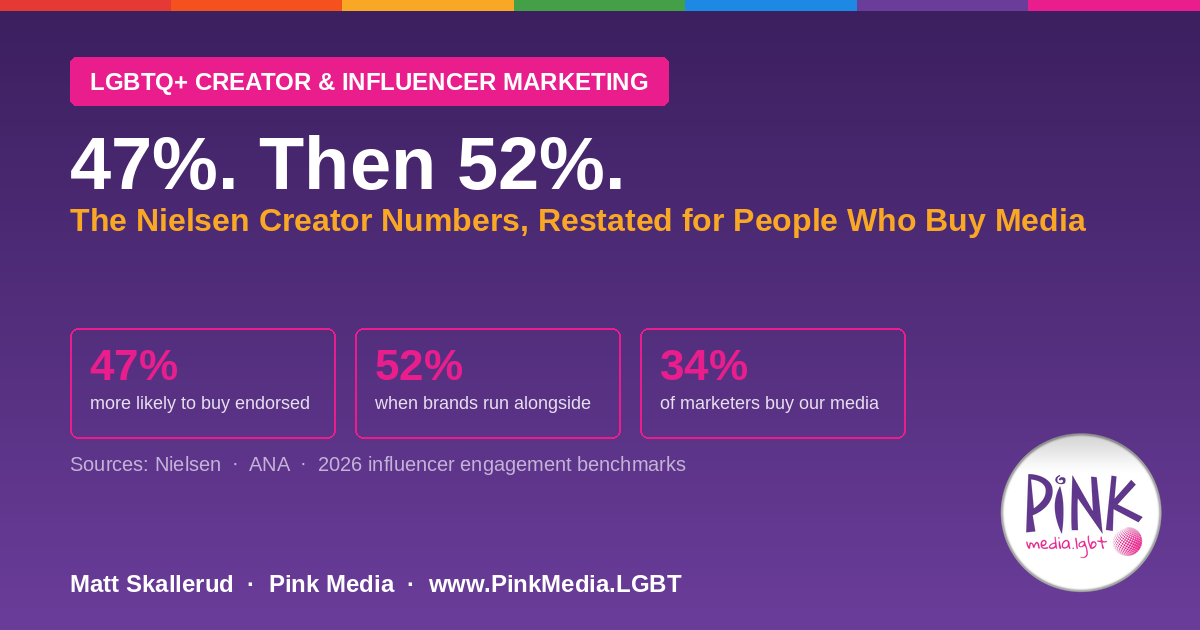
LGBTQ+ audiences reached through influencer media are 47% more likely to buy products endorsed by influencers.
They are 52% more likely to buy a product when a brand advertises in content featuring diverse creators.
Read quickly, those look like the same finding stated twice. They're not. They describe two entirely different mechanisms, they cost very different amounts to capture, and the industry has spent three years acting almost exclusively on the smaller one.
The 47% is what happens when a creator vouches for you. The 52% is what happens when you simply show up in their content environment. One requires a negotiation with every individual. The other is a media buy.
Restating Both for a Media Plan
Here's the same data with the columns a buyer actually needs.
| Nielsen Finding | What You're Actually Buying | How It Scales |
|---|---|---|
| 47% — more likely to buy influencer-endorsed products | An endorsement. A named person putting their credibility behind your product | Linearly, at best. Every additional creator is another negotiation, another rate, another approval cycle, another set of usage rights |
| 52% — more likely to buy when a brand advertises in content with diverse creators | Adjacency. Your message inside content the audience already trusts — no endorsement required | Across the whole network at once. One buy can sit alongside dozens of creators without contracting any of them individually |
Now sit with the arithmetic for a second. The mechanism that is harder to buy, slower to execute and more expensive per unit tested five points lower than the one you can purchase as straightforward media.
That's not an argument against creator partnerships. I'd run both, and most good plans do. But if a brand only has budget for one motion this year, the research points at the one most brands treat as the afterthought.
Most brands enter this category by trying to sign the biggest LGBTQ+ creator they can afford. The data says the better first move is to be reliably present across the content environment those creators have built — and that you can do at a fraction of the cost, starting this quarter.
— Matt Skallerud, Pink Media
Why the Creator Channel Works Here At All
Three things stack, and they're all in the same body of research.
The audience is disproportionately there. Nielsen found LGBTQ+ audiences are 50% more likely than the general population to spend three or more hours a day on social media. Whatever your view of that as a lifestyle matter, as a media fact it's decisive.
There's a deficit to correct. 63% of LGBTQ+ audiences say they feel misrepresented in media and advertising, and 60% want more representation. That's a credibility gap brand-produced creative struggles to close on its own — and one that content made by people inside the community closes almost automatically.
The alternatives have narrowed. The major platforms no longer offer orientation-based targeting, and Google's personalized advertising policy restricts advertiser-curated audiences in this category. I've written about that structural gap at length. Creators and LGBTQ+ publishers are now among the few remaining ways to reach this audience deliberately rather than hoping automated delivery stumbles into it.
Put those together and the creator channel isn't a nice-to-have in this market. It's one of the load-bearing options left.
The KPI Problem
Which brings me to the part of OUT loud's argument I want to underline hardest, because it's the one that gets nodded at and then ignored on the actual brief: community-building, not follower count, is the non-negotiable creator KPI.
I'd go further. Follower count isn't a weak KPI. It's a misleading one, and the engagement data shows it inverting.
Across every major platform, engagement rates fall as audience size rises. 2026 benchmarks put micro creators (10K–100K followers) at two to three times the engagement of macro creators on every platform measured. On Instagram static posts, nano accounts run roughly 3.5–6% while mega accounts sit at 0.5–1%. On TikTok the spread is 9–15% down to 1–3%.
So a buyer optimizing for followers is, with impressive consistency, optimizing away from the thing Nielsen actually measured. The 47% and the 52% both describe a response — people acting on something they saw. Response comes from relationship. Relationship is what a community has and an audience doesn't.
The Follower-Count Brief
- "Minimum 100K followers"
- Reach estimated from audience size
- One or two large partners, concentrated risk
- Success measured in impressions delivered
- Audience composition assumed, never evidenced
- Relationship ends when the contract does
The Community Brief
- "Documented LGBTQ+ audience composition"
- Reach estimated from engaged audience, not raw followers
- A roster of mid and micro creators, distributed risk
- Success measured in response — comments, saves, shares, clicks
- Composition asked for and verified up front
- Relationship renews, because the creator wants it to
How We Actually Vet This
These are the questions we run before we'll put a creator in front of a client across the #ILoveGay network. None of them is exotic. All of them are more predictive than audience size.
1. What share of the audience is actually LGBTQ+ — and can you show me? This is the first question and it disqualifies more candidates than anything else. A large general audience with queer-adjacent content is a different product from a genuinely LGBTQ+ community, and it should be priced differently.
2. Does the creator reply? Open the comments. A creator who answers is running a community. A creator who broadcasts is running a channel. Both can be worth buying; only one produces the response effect the research is measuring.
3. Do the same names keep showing up? Recurring commenters are the single most underrated signal in this business. They mean people come back, which means the audience is real and the trust is durable.
4. What happens on the unsponsored posts? Compare engagement on paid content against organic. If it falls off a cliff, the audience is tolerating the brand work rather than accepting it — and the endorsement effect you're paying for isn't there.
5. How many brands this year? A creator running a partnership every week has trained their audience to scroll past sponsorships. Scarcity is part of what you're buying.
6. How long have they held this community? Tenure matters in a market that has watched a lot of people arrive for a Pride cycle and leave. Creators who were here in 2019 are a different proposition from creators who arrived last June.
A note on the numbers you'll be given. Ask for screenshots of audience insights, not a summary. Ask for the last three unsponsored posts alongside the last three sponsored ones. A creator genuinely building a community will hand these over without hesitation — the ask itself is a useful filter.
The Part That Makes This a Buying Opportunity
Here's the number that reframes everything above. Industry figures cited by the ANA put LGBTQ+-targeted media in only about 34% of marketers' plans — against a consumer base representing roughly $1.4 trillion in annual US spending power and $4.7 trillion globally.
Two-thirds of the market isn't competing with you for this inventory. In a media environment where every efficient channel gets arbitraged within about eighteen months, that's an unusually durable gap — and it exists mostly because the category still gets filed under "Pride planning" instead of "audience reach."
It won't stay open forever. It's been open longer than I expected already.
The Takeaway
A post with one reaction was carrying research that should change how brands build creator briefs. That's the media environment we're all working in, and it's why I keep restating good numbers rather than chasing new ones.
So, restated one more time, for the plan:
Buy the environment before you buy the endorsement. It tests higher, it costs less, and it doesn't depend on any one person's calendar.
Then buy the endorsement — from creators chosen on community, not size. Composition, reply behavior, repeat commenters, tenure. Put those four in the brief and the follower minimum will start to look like what it is: a proxy somebody reached for because it was easy to count.
And do it while two-thirds of the industry still isn't in the room.
Our 2026 LGBTQ+ Marketplace Guide maps the LGBTQ+ media and creator landscape in depth, and our influencer and content marketing work covers how we build and vet these rosters.
- Reconnecting with LGBTQ+ Audiences — Nielsen, June 2025. The 47% and 52% figures, the 63% misrepresentation finding, the 60% wanting more representation, and the 50% higher likelihood of heavy social media use.
- Marketing to the LGBTQ+ Community — Association of National Advertisers, June 2026. The 34% of marketers including LGBTQ+ media, the $1.4 trillion US / $4.7 trillion global spending figures, and creator partnership examples.
- Influencer Engagement Rates by Follower Tier (2026) — Nowadays Media. Engagement benchmarks by tier across TikTok, Instagram, YouTube and X, and the 2–3x micro-over-macro finding.
- Sexual Orientation in Personalized Advertising — Google Ads policy. The advertiser-curated audience restriction in this category.
- The Targeting Is Gone. The Audience Isn't. — Pink Media. Why creators and LGBTQ+ publishers became load-bearing channels.
- Campaigns End. Audiences Compound. — Pink Media. Where creator media sits inside a three-layer audience strategy.
- When Platforms Take Over: The Power Shift in LGBTQ+ Influencer Marketing — Pink Media. The creator-side view of the same economics.
- Pink Media's 2026 LGBTQ+ Marketplace Guide · LGBTQ+ B2B Market Guide