I've sat in a lot of these meetings, and they tend to go the same way.
Someone on the brand side likes the idea. They believe the market is real, they've seen the numbers, and they're not nervous about the community — they're nervous about the shape of what's being proposed. Because what they think they're being asked to approve is twelve months of rainbow-themed creative, a standing line item with a flag on it, and a commitment they'll have to re-defend every quarter to someone who wasn't in the room.
And honestly? I wouldn't approve that either.
The idea isn't wrong. The packaging is. We've spent twenty years teaching the industry to think about this work as a campaign, and a campaign is precisely the wrong container for it.
A Campaign Is a Project. An Audience Is an Asset.
Here's the distinction I keep coming back to, and it's not a semantic one.
A campaign has a start date, an end date, and a creative theme. It's judged on whether it ran and what it returned inside that window. When it's over, what's left behind is a deck.
An audience strategy is a standing relationship with a defined group of people. It's judged on whether that audience knows you, trusts you, and considers you. When a given quarter ends, what's left behind is familiarity — plus owned assets and media relationships that make the next thing cheaper and better.
Every brand you work with already runs audience strategies. They have one for Gen Z, one for parents, one for the small-business buyer, one for whatever segment their category cares about. Nobody calls those campaigns. Nobody asks whether the Gen Z strategy is going to be renewed in June.
We don't ask brands to fund an LGBTQ+ campaign. We ask them to add an audience to a list they already maintain — and then we tell them, in three layers, exactly how that audience gets reached.
Why the Reframe Matters More in 2026 Than It Did in 2016
The community data has moved, and it's moved in a direction that makes the campaign model look increasingly strange.
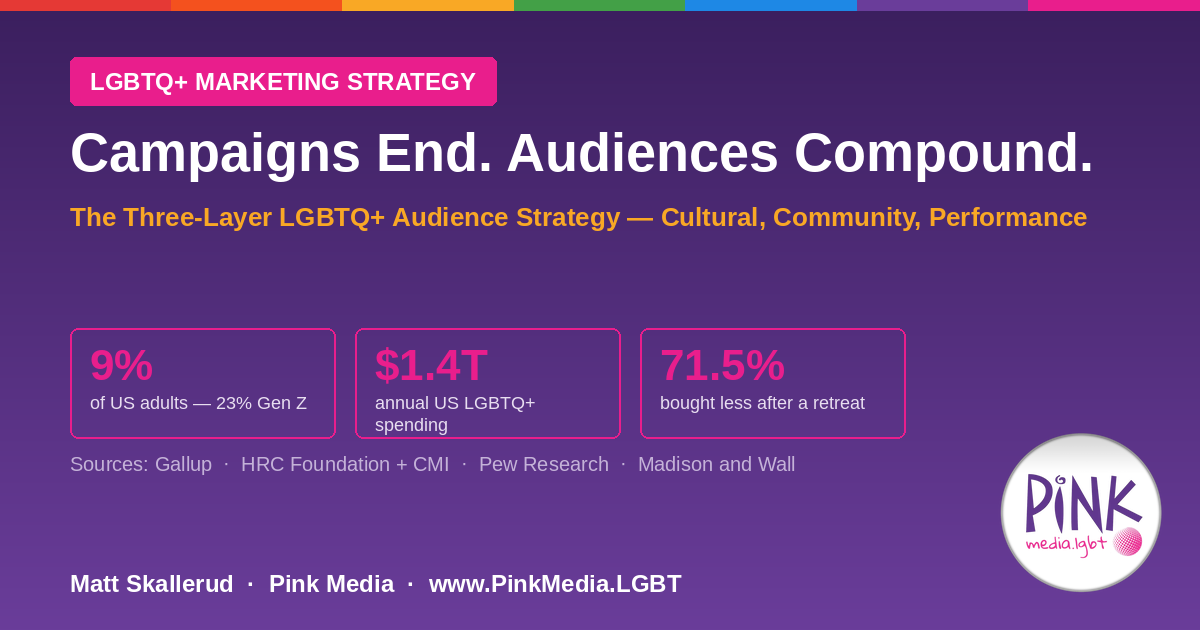
Gallup has LGBTQ+ identification at 9% of US adults, more than double a decade ago — and at 23% among Gen Z. That's not a niche you visit in June. At that scale, LGBTQ+ consumers are already inside the customer base of essentially every consumer category in America, whether or not anyone has written a strategy about them.
And the spending behavior is unusually deliberate. Research from the HRC Foundation with Community Marketing & Insights, released in June 2026, put US LGBTQ+ spending power at $1.4 trillion annually and found that 71.5% bought fewer products from companies they saw as reducing inclusion commitments, while 69.5% increased spending with companies they saw as supportive. LGBTQ+ consumers were more than twice as likely as other consumers to move their money on that basis.
Now here's the line in that research that I think every marketer should sit with: the findings reflect perceptions, not corporate records. People were reacting to what they had seen, not to what the company had actually done.
Perception is a running total, not an event. It's assembled from everything a person has encountered about you over years — and a campaign, by definition, is a brief interruption in a much longer silence. You cannot launch your way into being trusted. You can only accumulate your way there.
— Matt Skallerud, Pink Media
That's also why the skepticism is where it is. A January 2025 Pew Research survey reported by EMARKETER found 68% of US LGBTQ+ adults believe all or most companies participate in Pride Month to boost business, and only 16% read it as genuine support. That's not cynicism about brands in general. It's an accurate reading of a pattern the industry created by showing up on a schedule.
The Three Layers
This is the part that turns a philosophy into something a media director can actually build, budget and defend. Three layers, three different jobs, three different ways of being measured.
1. Cultural — Participate Where the Intersection Already Exists
The cultural layer is about showing up in the spaces where LGBTQ+ culture and your brand genuinely overlap. Not where you'd like to overlap. Where you already do.
A running brand has a real intersection with queer run clubs and LGBTQ+ sport. A publisher has one with queer literature, which has been one of the most resilient growth categories in books. A financial services brand has one with the very practical realities of queer family formation and small-business ownership. A hotel group has one with travel, obviously — but more specifically with the parts of travel where safety and welcome are the deciding factors.
The failure mode here is inventing an intersection that isn't there, which is exactly what produces the creative everybody is tired of. The discipline is subtraction: find the one or two places where your brand has a legitimate reason to be in the conversation, and stay out of the rest.
Done properly, this layer is also the cheapest of the three, because participation is not the same as production. You don't need a campaign to sponsor a queer book prize, show up at a community sports league, or put real LGBTQ+ voices in content you were making anyway.
2. Community — Borrow Trust From the People Who Earned It
The community layer is distribution through the LGBTQ+ publishers, creators, events and organizations that already hold this audience's attention and credibility.
I want to be precise about why this works, because it's often described as a values argument when it's really a mechanics argument. Trust in this market is transitive. It moves from the outlet to the brand that appears in it. When your message arrives inside a publication someone has read for eight years, or through a creator whose judgment they've come to rely on, it inherits a credibility that no amount of your own media spend can generate on its own.
That transfer is the entire product. It's also the reason this layer can't be rushed or bought in a single flight — and the reason it holds up when a brand is having a difficult news cycle. If the only place your audience has ever encountered you is your own advertising, you have no character witnesses.
Practically, this is the layer where money actually moves: advertising and content distribution across LGBTQ+ media properties and creator channels, event and organizational partnerships, and editorial presence that earns coverage rather than renting attention.
3. Performance — Let Each System Do What It's Good At
The performance layer is where I see the most confusion, so let me state the division of labor plainly.
The mainstream platforms are excellent at conversion optimization. Not adequate — excellent, and getting better fast. AI-directed campaign types like Advantage+ and Performance Max accounted for roughly 12% of US ad spend in 2026, up from about 2% in 2023, with forecasts putting them at 27% by 2030. If your objective is a measurable action at the bottom of the funnel, use them. That's the right tool and it isn't close.
What those systems cannot do is take an instruction. You can't tell them to prioritize LGBTQ+ consumers, because the parameter doesn't exist — Meta removed sensitive-interest targeting in 2022, and Google's personalized advertising policy restricts advertiser-curated audiences in this category, naming "gay travel" among its own examples. I've written about that structural gap in detail. Automated delivery optimizes toward whoever converts; it has no view on who you meant.
It also can't tell you afterward. Media buyers have described these systems as a black box that reveals very little about where the money went — which is a manageable problem for a shoe sale and a fatal one when a stakeholder asks whether the LGBTQ+ budget actually reached LGBTQ+ people.
So: mainstream platforms for broad conversion optimization, LGBTQ+ media for intentional reach and context. Those aren't competing recommendations. They're two halves of one plan, and the reason to run both is that neither one covers the other's blind spot.
| Layer | What It Does | How You Measure It |
|---|---|---|
| Cultural | Participation where LGBTQ+ culture and the brand already intersect — sport, books, travel, nightlife, film, wellness, business | Earned coverage, share of conversation, creative resonance in the specific spaces you chose |
| Community | Distribution through publishers, creators, events and organizations that already hold trust | Documented reach, engagement and audience composition — numbers you can show a board |
| Performance | Mainstream platforms for broad conversion optimization; LGBTQ+ media for deliberate reach and context | Conversion and efficiency for the platform half; verified placement and reach for the media half |
Keep those three measurement columns separate. Collapsing them into one number is what makes LGBTQ+ programs look unaccountable, and separating them is most of what makes them defensible.
Why This Is an Easier Yes
Put the two pitches side by side and the difference in the room is immediate.
The Campaign Pitch
- One creative idea carrying the entire commitment
- A single seasonal window — miss it and the year is gone
- Approve it all or approve none of it
- Sits in the first budget line reviewed when things tighten
- Ends with a report and starts from zero next time
- Reads as a statement, which is what makes people nervous
The Audience Strategy Pitch
- Three independent layers with three different jobs
- Runs year-round, so no single moment carries the weight
- Scale a layer up or down instead of cancelling the program
- Sits alongside every other audience investment the brand makes
- Compounds — familiarity and relationships carry forward
- Reads as business strategy, because that's what it is
That second column is the one that survives a leadership change. It's also the one a marketing director can take to their CFO without translating it first.
Where to Start
1. Find the real intersection before you spend anything. One honest sentence — "our brand and LGBTQ+ culture already meet here" — is worth more than a quarter of creative development. If you can't finish that sentence, that's the work.
2. Build the community layer first, not last. It's the slowest to accumulate and the one everything else leans on. Relationships with publishers, creators and organizations take time that a Q2 start date doesn't give you.
3. Separate your performance budget in two. One line for platform conversion work, one for LGBTQ+ media reach. Different objectives, different reporting, no arguing about which one underperformed.
4. Own something. A segmented list, a content hub, a partnership you renew. Owned assets are what stop you from rebuilding the audience every single year.
5. Publish where the answers get assembled. A growing share of people ask an AI assistant which brands are genuinely worth supporting, and those answers get built from published content — editorial coverage, structured data, community media presence — not from your ad account. What lives only in your campaign deck is invisible there.
6. Report by layer, every quarter. Three sets of numbers, four times a year. That cadence is what turns "the LGBTQ+ thing" into a standing part of how the brand measures itself.
The Takeaway
The community hasn't gotten harder to reach. If anything it's larger, younger, more commercially deliberate and more concentrated in identifiable media than it has ever been.
What's gotten harder is getting the work approved — and a meaningful share of that difficulty is self-inflicted, because we keep presenting a long-term audience relationship in the packaging of a short-term promotional event. Then we act surprised when it gets treated like one.
Cultural, community, performance. Three layers, three jobs, three ways to prove it worked. It's a more honest description of how this market actually gets reached, it's more resilient when conditions change, and it's a far easier thing to say yes to than twelve months of rainbow-themed creative.
Campaigns end. Audiences compound. Build the one that's still there next year.
Our 2026 LGBTQ+ Marketplace Guide maps the media landscape, categories and year-round calendar in depth, and the LGBTQ+ B2B Market Guide covers the business-audience side of the same approach.
- LGBTQ+ Identification Holds at 9% in U.S. — Gallup, February 2026. Overall identification and the 23% Gen Z figure, from 13,454 interviews.
- Companies Viewed as Retreating from Inclusion Risk Losing LGBTQ+ Customers at Twice the Rate — HRC Foundation with Community Marketing & Insights, June 2026. Pride in the Marketplace 2026: the $1.4 trillion figure, the 71.5% / 69.5% spending shifts, and the perception framing.
- LGBTQ+ Adults See Self-Interest in Corporate Pride — EMARKETER, on Pew Research Center data. The 68% / 16% split on why companies participate in Pride.
- AI Campaign Types to Take 27% of US Ad Spend by 2030 — on Madison and Wall estimates. The 2% → 12% → 27% trajectory and the transparency problem.
- Sexual Orientation in Personalized Advertising — Google Ads policy. The advertiser-curated audience restriction and the "gay travel" example.
- The Targeting Is Gone. The Audience Isn't. — Pink Media. The full platform-policy timeline behind the performance layer.
- Every DMO Now Has an LGBTQ+ Travel Strategy. Almost None Have an LGBTQ+ Travel Audience. — Pink Media. The same execution gap, seen from the destination side.
- Pink Media's 2026 LGBTQ+ Marketplace Guide · LGBTQ+ B2B Market Guide