You know how it goes in influencer marketing — a brand pays a creator to post, the post goes out, and if everything works, the audience engages and the campaign delivers. That model has driven the creator economy for the better part of a decade. But a new forecast from EMARKETER, covered recently by Business Insider, is telling us something pretty important: that model is shifting — and the platforms, not the creators, are increasingly the ones cashing in.
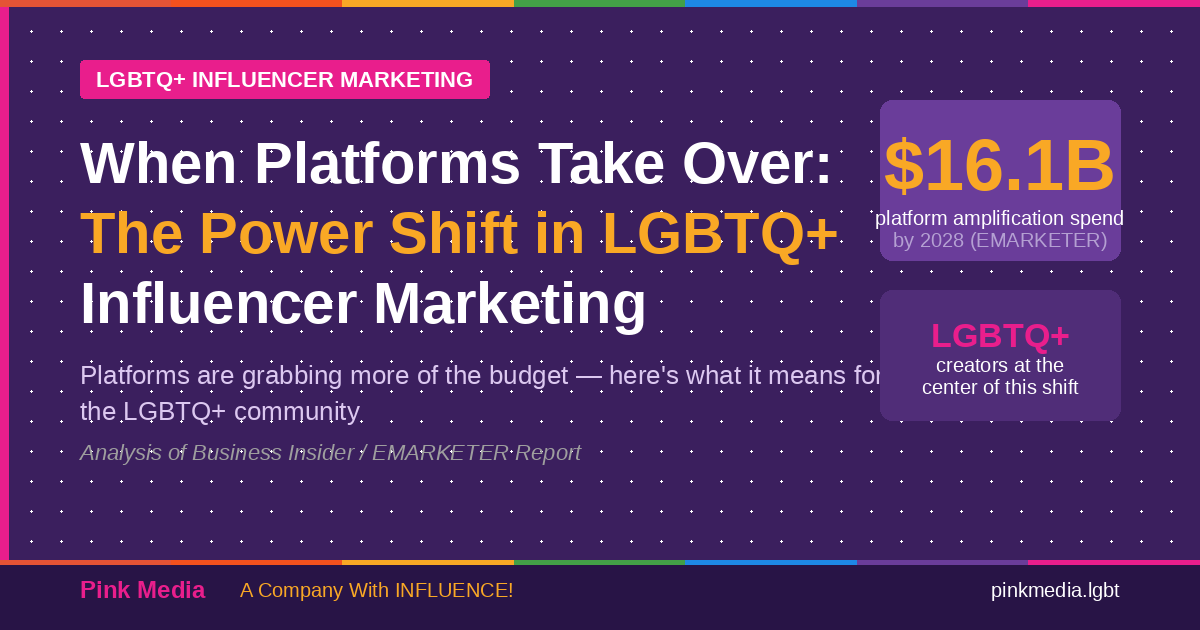
Here's the short version: EMARKETER now projects that by 2027, the amount brands spend amplifying creator content through paid social ads will equal what they spend actually paying creators for that content — roughly $14.2 billion each. And by 2028, the amplification spend ($16.1 billion) will surpass the content creation spend ($15.71 billion). The pendulum is swinging, and it's swinging toward TikTok, Meta, and the other platforms that collect the boosting fees. For LGBTQ+ creators — who have always faced extra hurdles in the organic reach game — this is a shift worth understanding.
I've been watching the organic-to-paid shift happen in real time in the LGBTQ+ space since we started building the #ILoveGay Content Marketing Ad Network back in the early 2010s. The trajectory has always been: platforms give you organic reach to build your audience, then they quietly throttle it and sell you back that same reach at a premium. For most content creators, this plays out as a gradual tightening. For LGBTQ+ creators, it's often been more abrupt — because our content was frequently the first to get suppressed when the algorithms started making judgment calls.
LGBTQ+ Creators Face a Unique Version of This Challenge
Let's be direct about something the mainstream marketing press doesn't always acknowledge: LGBTQ+ creators have been dealing with algorithmic discrimination for years. Shadow-banning of queer content. Hashtag suppression. Demonetization of videos that include the word "gay." Content warnings applied to LGBTQ+ health information. This is documented, experienced by the community, and largely unaddressed by the platforms that profit from queer audiences while quietly filtering queer voices.
So when EMARKETER says that organic reach is declining and brands need to pay more to amplify... for LGBTQ+ creators, that's not a new trend. That's a Tuesday. The power shift toward platforms is, in many ways, an acceleration of a dynamic the LGBTQ+ creator community has lived with for years. What changes now is that it's become mainstream enough that the whole industry is noticing.
Pink Media and the #ILoveGay Network built over 250 profiles and 1 million+ followers on X (Twitter) — and lost every single one of them on July 4, 2024, when the platform permanently suspended our entire network. One day you have a million LGBTQ+ followers; the next day, you don't. We've been rebuilding on platforms we actually trust since then. This is exactly why platform diversification — and owned channels — matter so much.
LGBTQ+ Creators Who Are Getting This Right
The good news? There are LGBTQ+ content creators who have been building the right way — developing genuine audiences, diversifying across platforms, and treating their influence as something bigger than their follower count on any single app. Here are a few who stand out as models for navigating the platform power shift:
What these creators share isn't just follower counts — it's community depth. They've built audiences that are genuinely invested in them as people, not just as content delivery vehicles. That's harder to replicate through paid boosting alone... and that's the real lesson the platform power shift is teaching.
What the Shift Means for LGBTQ+ Brands and Advertisers
Here's where I want to give you the Pink Media take, because I think there's an opportunity hidden inside this trend that a lot of brands are going to miss.
Yes, the platforms are grabbing more of the budget. Yes, organic reach is dead. And yes, if your LGBTQ+ marketing strategy is built entirely around paying an influencer to post and hoping the algorithm picks it up — you're going to be writing bigger checks to TikTok and Meta and seeing diminishing returns. That's the problem the EMARKETER data is describing.
But here's what it doesn't fully account for: LGBTQ+-specific distribution channels aren't subject to the same algorithmic bias as mainstream social platforms. When we place your content in the #ILoveGay Content Marketing Ad Network — across LGBTQ+ publications, partner sites, email lists, mobile apps, and targeted social environments — we're not fighting the TikTok algorithm for scraps of organic reach. We're putting your brand in front of a real, verified, engaged LGBTQ+ audience through channels built specifically for this community.
That's what Content as Advertising has always meant to us — start with your brand's authentic story, then amplify it through the right channels, not just the biggest ones. And in a world where mainstream platforms are increasingly expensive gatekeepers, LGBTQ+-specific distribution becomes more valuable, not less.
The Creator Toolkit Is Changing — Build Yours Accordingly
Build your email list. Build your community off-platform. Build relationships with media partners — like Pink Media — who can distribute your content to the right LGBTQ+ audiences without routing everything through algorithms that weren't designed with you in mind.
In addition, the overall pie is growing. The question is whether LGBTQ+ creators and the brands that want to reach queer audiences are positioned to claim their share of it.
I've been in the LGBTQ+ digital space since 1995 — since the early days of GayWired.com, before most of today's platforms even existed. I've watched every platform cycle: the land grab, the golden age of organic reach, the throttle, the paywall. The pattern repeats. What doesn't change is that authentic LGBTQ+ community content — real stories, real voices, real representation — retains its power regardless of what the algorithm is doing this quarter. That's what we've built our whole model around at Pink Media, and it's exactly what this moment in influencer marketing is affirming.
Is your LGBTQ+ marketing strategy built for the world as it is now, or as it was five years ago? If you want to talk through what this platform power shift means for your specific campaign — whether you're a brand, a destination, a healthcare organization, or a content creator looking to reach a targeted LGBTQ+ audience — reach out to us at Pink Media. We've been navigating these shifts for 30 years. We know where the audience actually is.
Reach the LGBTQ+ Community. Leverage the Power of Social Relationships. That's what we do — BROADER yet TARGETED, 24/7, 365 days a year. Pink Media: A Company With INFLUENCE.