Every few weeks someone shows me a media plan with a line item that reads “LGBTQ+ audience — programmatic.” It’s a reasonable thing to buy. But when you look at where those ads actually run, it’s usually general-market sites and apps, with a data segment laid on top that guesses who might be LGBTQ+.
That’s not the same thing as showing up in LGBTQ+ media. And the difference matters more than most plans account for, because a large share of the media our community actually trusts was never on the exchanges in the first place.
That gap is the reason we built the #ILoveGay Network, and this week we published a new page that lays it all out in one place. Here’s the thinking behind it.
Where LGBTQ+ Attention Actually Lives
Think about where LGBTQ+ people spend time with media that’s made for them. A travel couple whose videos they’ve watched for years. A podcast hosted by people who sound like their friends. A regional magazine they pick up at brunch. A local LGBTQ+ radio station. The dating and social apps they open every day.
Very little of that is bought through a demand-side platform:
What Programmatic Usually Buys
- General-market sites and apps
- An inferred “LGBTQ+ interest” segment on top
- Little control over context or adjacency
- Creative that has to signal relevance on its own
- Scale, but not necessarily community trust
What Direct Partnerships Reach
- Creators and podcasts, negotiated person to person
- Independent and regional LGBTQ+ publishers, print and radio
- Apps that have removed programmatic entirely
- Content made by people the audience already follows
- Context that tells people the message is for them
Some of the largest LGBTQ+ apps now reach advertisers only through direct partners, having eliminated programmatic advertising to keep low-quality placements off their platforms. Creators negotiate host-reads, reels and licensed content directly. Community publishers and regional media sell sponsorships, editorial and print the old-fashioned way — often in markets a national buy never touches.
None of that is a criticism of programmatic. It’s simply a description of where the inventory is.
From “PR Refugees” to a Network
The network didn’t start as a network. For years we worked with what I call PR refugees: companies that sent out a press release, collected millions of potential impressions, and saw almost no sales, clicks or new followers come back.
What we did was simple. We took that content and put it in front of LGBTQ+ people who had already shown interest in the subject, through targeted social placements and select LGBTQ+ media. It worked for authors selling books, musicians driving streams and destinations bringing in LGBTQ+ visitors.
Eventually the obvious next step was to formalize it. In 2024 we opened what became the network to LGBTQ+ media, influencers and creators, and in 2026 it spans every channel we work in. The through-line goes back further than that — to banner ads and email on GayWired.com in 1995 — but the idea is the same one: authentic content, in front of the right people, for longer.
Content as Advertising
The core of the network is an approach we call Content as Advertising. Instead of commissioning a polished brand ad and hoping it feels relevant, we recruit LGBTQ+ creators to make content about a destination, product or service — then license the best-performing pieces to run as paid media.
Tapping into the best of authentic LGBTQ+ content and using it as Content as Advertising lets you have relevant, community-rooted content to promote 24/7, 365 days a year.
— Matt Skallerud, President, Pink Media
The content feels native because it is native. And it doesn’t expire when the original post scrolls out of the feed. We’ve written before about how brands measure creator work and why the second half of that value is so often left on the table; licensing is how you collect it.
For Visit Palm Springs, we refreshed recent content from travel creators, promoted it through their own blogs, social, email and video, and ran it as targeted paid social alongside the organic work. The program has since expanded to more creators, with their content reused as fresh ad creative. For BearCruise.com, a content promotion with Bear World Magazine plus creators and influencers reached the bear community directly for LGBTQ+ river cruises in Europe — proof that the right partner signals exactly which community a message is for.
How a Campaign Comes Together
1. Match the audience
Bears, gamers, queer women, Black gay men, travelers, rugby fans. We pick partners whose communities match the customer — not just “the LGBTQ+ market” as one block.
2. Create or license content
Partners produce editorial, video, reels and photos, or we license the strongest existing creator content for paid use.
3. Distribute everywhere
Partner blogs, newsletters, social feeds and podcasts carry it organically, while banners, app placements, email and CTV amplify it.
4. Measure and extend
Tracked links, impressions and engagement reporting — and the top performers keep running as ads long after the posts leave the feed.
That last step connects to something I’ve been writing about all year: campaigns end, but audiences compound. The more of the plan that’s built on content you can keep running, the more each campaign leaves behind for the next one.
Every Format, One Plan
Content is the core, but our partners also give us the traditional inventory to carry it further:
| Format | What it looks like |
|---|---|
| Banner & display | Leaderboards, MRECs and site takeovers on partner sites, plus programmatic display |
| Dedicated sends and newsletter sponsorships to opted-in LGBTQ+ lists, with open rates as high as 59% | |
| Social | Creator posts, reels and stories, boosted with targeted paid social |
| Mobile apps | Full-screen interstitials, inbox messages, pop-ups and push notifications, geo-targeted to the city |
| Video | Short-form creator video, UGC and paid-ready cutdowns the brand owns |
| Podcasts & radio | Host-read pre- and mid-rolls, sponsored segments, and spots on KGAY 106.5 Palm Springs |
| Editorial, print & events | Sponsored articles, syndicated travel features, magazine ads and Pride activations |
| Connected TV | Non-skippable :06 to :90 spots in LGBTQ+ programming, via Revry and PrismRiot |
Why Layering Changes the Numbers
Creators and publishers bring trust, context and engaged audiences — usually in the hundreds of thousands to low millions. The LGBTQ+ dating and social apps bring something different: daily, full-screen, geo-targeted reach at a far larger scale, in some cases across more than 190 countries.
Put them together and the creator content becomes the creative inside the apps. That’s the point where a plan’s total impressions and people reached stop growing gradually and start to climb. Add connected TV and it climbs again.
Creators earn the trust. Apps deliver the frequency. Connected TV puts it on the biggest screen in the house. Each layer does a job the others can’t — and the same piece of content can run through all three.
LGBTQ+ Television, Bought Like Programmatic
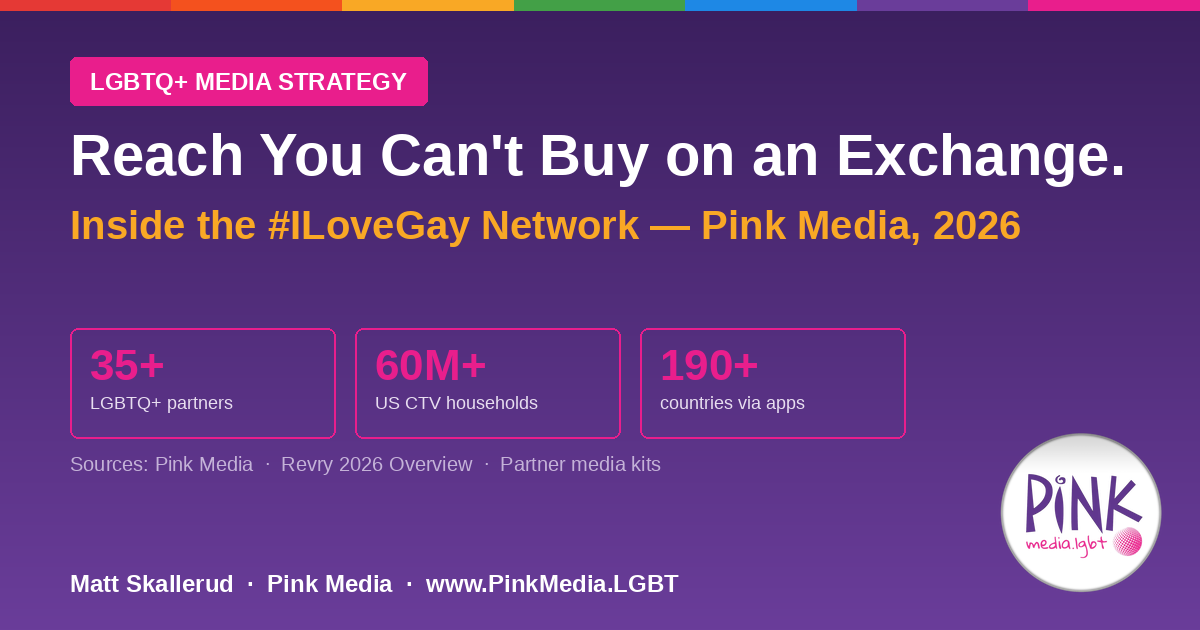
Connected TV is the one place where programmatic and LGBTQ+ media meet cleanly. Revry, the largest streaming platform for LGBTQ+ and allied audiences, reports availability in 60M+ US households, 7.2M+ monthly viewers and 1,000+ hours of LGBTQ+ originals, films and documentaries. Its sister company PrismRiot is a programmatic CTV exchange with 15M+ matched households, non-skippable video and guaranteed 95%+ completion.
Two things stand out to me here. First, brands don’t need LGBTQ+-specific creative to run on Revry — showing up around queer programming is the signal. Second, it’s measurable. In a DISQO outcomes study of Carnival’s Q1 2026 campaign on Revry, with roughly 12,000 exposed and 12,000 control panelists, exposed viewers showed statistically significant lifts in branded search and site visits. Branded search among ages 35–44 rose from 0.28% to 1.00%.
We’ve also looked at who’s actually watching LGBTQ+ streaming content — and the answer is broader than most media plans assume.
Who’s in It
The full roster is on the network page, organized by category, with each partner’s own reported figures. In broad strokes:
- Dating and social apps — daily, full-screen, geo-targeted reach for gay, bi, lesbian, trans and queer users, including apps built specifically for queer women and for queer people of color.
- Streaming and CTV — Revry, PrismRiot and Revry Originals.
- Publishers — including Bear World, Gayming, The Pink Pulse, Metrosource, GoQueer, Pride Journeys and DailyJocks.
- Regional, print and radio — including GED Magazine, Gay Desert Guide, KGAY 106.5, OutClique and The Pride LA.
- Travel creators — including Two Bad Tourists, Couple of Men, Nomadic Boys and Janine & Gen.
- Creators and podcasts — including Dylan Goodrich, The Zach Sang Show, The Gay Rugby Podcast and Out Loud & Laughing, plus our own #ILoveGay Today video podcast.
We’re also opening the door wider. If you’re an LGBTQ+ publisher, app, podcaster or creator, the network page explains how to join: a media kit or platform summary, what you can offer clients, and a fixed price for coverage and distribution. You always choose which clients fit your platform.
About the numbers. Partner figures in this post come from each partner’s own media kit or platform analytics, as published on the #ILoveGay Network page, and may have changed since. Revry and PrismRiot figures are from Revry’s 2026 overview and PrismRiot materials. The Carnival result is from a DISQO outcomes study of Carnival’s Q1 2026 Revry campaign; the 3.6× figure is the change in branded-search rate among exposed viewers aged 35–44 (0.28% to 1.00%). Reach growth from layering channels depends on targeting, markets and budget.
The Takeaway
If an LGBTQ+ line item on your plan is entirely programmatic, it’s worth asking where those impressions actually land. The creators, podcasts, community publishers, regional radio and apps that LGBTQ+ people trust most are, for the most part, reached through relationships — not auctions.
That’s what the #ILoveGay Network is: those relationships, organized into one plan and one report, with content that keeps working long after the campaign flight ends.
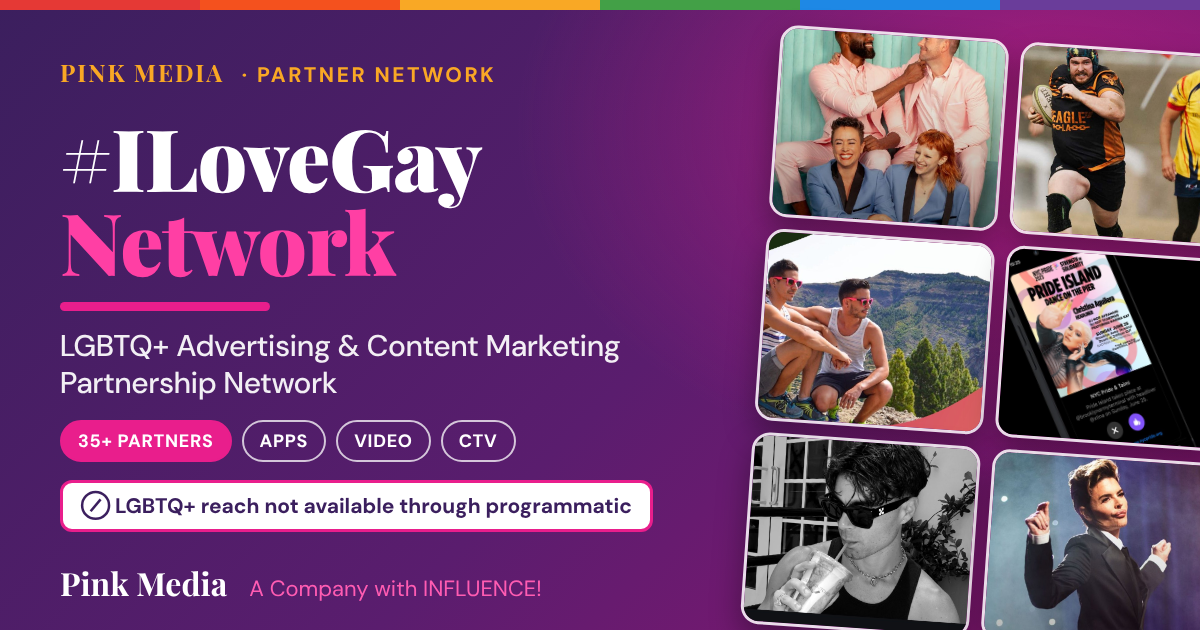
See every partner, format and case study on the #ILoveGay Network page.
- #ILoveGay Network — Pink Media. The full partner roster, formats, case studies, partner-reported figures and source notes.
- Content as Advertising — Pink Media. The approach behind licensing creator content as paid media.
- Revry — Free Queer TV. LGBTQ+ streaming across CTV, FAST and OTT.
- Nielsen Gave Brands Two Creator Numbers. Most Only Buy the First. — Pink Media. On measuring and extending creator value.
- Campaigns End. Audiences Compound. — Pink Media. The three-layer LGBTQ+ audience strategy.
- Seven in Ten Heated Rivalry Viewers Were Women. — Pink Media. Who watches LGBTQ+ streaming content.
- Additional figures as cited on the network page: Revry Overview 2026; PrismRiot Overview; DISQO / Revry Carnival Q1 2026 report; MRI-Simmons Revry Consumer Index Report 2025; partner media kits.