A few days ago I got one of my favorite kinds of email: a client sending over a sales report.
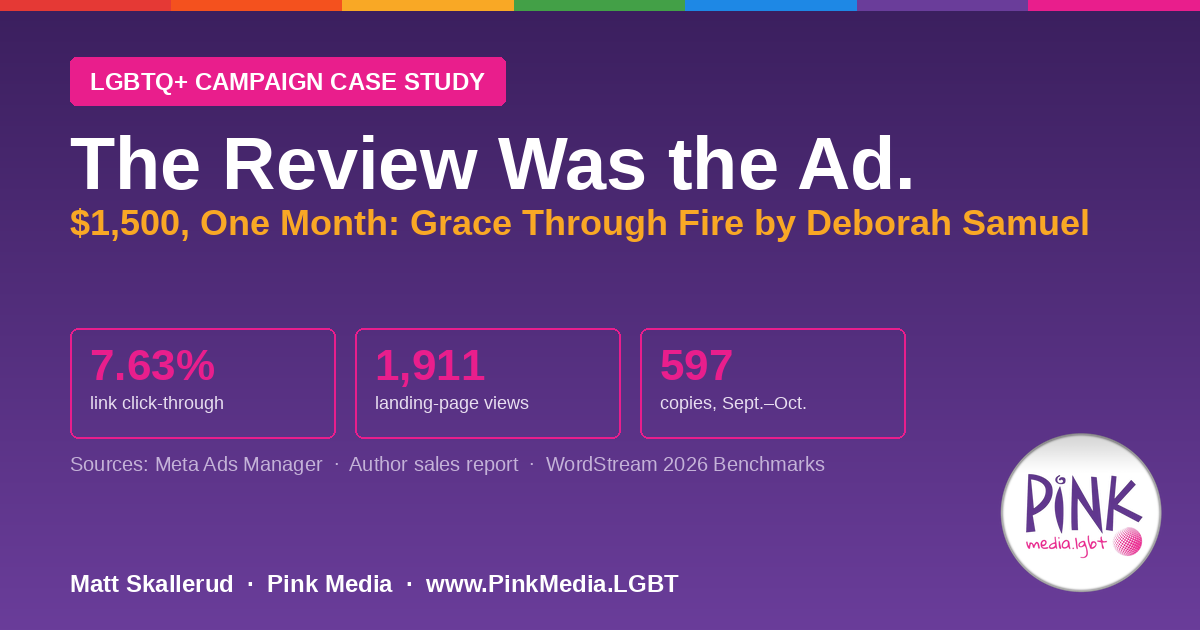
It was from the team behind Grace Through Fire, Deborah Samuel’s debut memoir, and it showed 597 copies reported across September and October. That landed right as our one-month campaign for the book wrapped up. So this is a good moment to open the ad report next to it and walk through what happened — because the most useful thing in this case study isn’t the click-through rate, strong as it is. It’s which ad earned it.
The Book
Grace Through Fire: A Memoir of Murder, Tragedy, and Resilience was published by She Writes Press, distributed by Simon & Schuster, on October 6, 2026. As the Santa Barbara Independent recounts, it begins in October 2008, when Deborah’s elderly mother shot her abusive father in their Arkansas home — and Deborah was pulled into a media storm and a murder trial while caring for her wife after a paralyzing accident.
At its heart, as our feature on ILoveGay.net puts it, is a queer love story, told from midlife and set partly in the conservative South. It ends somewhere unexpected: a new life on a boat in Santa Barbara Harbor. Stories like that — LGBTQ+ people rebuilding at 50, not 25 — are still rarer on the shelf than they should be, and readers notice. Our look at the LGBTQ+ literature market covers why this has become one of publishing’s most resilient categories.
The release also landed at a natural moment: during LGBTQ+ History Month, five days before National Coming Out Day.
The Setup
The campaign was simple by design. One month, September 28 to October 29. A $1,500 budget. Three single-image ads on Facebook and Instagram, running together in one ad set, each sending people to a page about the book.
Here’s the decision that mattered: none of the three ads asked readers to take the author’s word for it. Each one was built around a different outside voice:
Kirkus Reviews
The book-trade review that agents, librarians and serious readers recognize instantly. Kirkus called the book “a detailed and intimate account of making it through very hard times.”
Paul Brickman
A personal endorsement of the book, carried as its own ad.
Mary Morrissey
Founder of the Brave Thinking Institute, who called the memoir “a radiant example of what it means to transform adversity into grace.”
What Came Back
Here’s the full month from Meta Ads Manager:
| Metric | Result | What it tells you |
|---|---|---|
| Impressions | 27,820 | Total ad views across Facebook and Instagram |
| Reach | 15,447 people | Unique accounts — a frequency of about 1.8 over the month |
| Post engagements | 11,943 | Reactions, comments, shares and clicks on the ads |
| Link clicks | 2,124 | People who left the feed to read about the book |
| Link click-through rate | 7.63% | About 2.8 times the 2.71% Arts & Entertainment benchmark |
| Landing-page views | 1,911 | Clicks that fully loaded the page — 90% follow-through |
| Cost per landing-page view | $0.78 | $1,500 across 1,911 page views |
For context, WordStream’s 2026 Facebook Ads benchmarks put the median click-through rate for traffic campaigns at 1.93% across all industries, and at 2.71% for Arts & Entertainment, the category closest to books (PPC Land’s breakdown lists the industry figures). This campaign ran 7.63% — about 2.8 times the category and roughly four times the all-industry figure.
Two other numbers deserve a mention. Nearly 12,000 post engagements on fewer than 28,000 impressions tells you people weren’t just scrolling past — they were stopping, reacting and sharing. And 90% of the people who clicked stayed for the page to load. In our first small-budget case study, two-thirds follow-through was a healthy result. When the ad makes a clear promise and the page keeps it, people stick around.
Which Voice Readers Trusted Most
Running three ads side by side is what turns a good result into a useful one. Here’s how each endorsement performed:
| Ad | Impressions | Link clicks | Landing-page views | Link CTR |
|---|---|---|---|---|
| Kirkus Reviews | 15,762 | 1,246 | 1,138 | 7.91% |
| Paul Brickman | 9,297 | 716 | 628 | 7.70% |
| Mary Morrissey | 2,761 | 162 | 145 | 5.87% |
| Total | 27,820 | 2,124 | 1,911 | 7.63% |
Kirkus won, and not narrowly. It had the highest click-through rate at 7.91%, and it delivered 1,138 of the campaign’s 1,911 landing-page views — 60% of the total.
Here’s the part I like most: we didn’t hand Kirkus that share. All three ads sat in the same ad set, sharing one budget, and Meta’s delivery system moved spend toward the ad people responded to. By the end of the month the Kirkus ad had received 57% of all impressions. Readers voted, and the budget followed them.
The Paul Brickman ad was a close second at 7.70%, with 628 landing-page views. The Mary Morrissey ad saw the least delivery and the lowest rate — but its 5.87% is still more than twice the category benchmark. There was no weak ad in this set, only a strongest one.
The “losing” ad in this campaign still beat the Arts & Entertainment benchmark by more than two to one. That’s what happens when every version of the ad leads with someone else’s word.
Why the Review Was the Ad
Think about how people actually choose a book. They don’t take the author’s word for it, and they shouldn’t have to. They look for a sign that someone they trust has already read it and thought it was worth the time.
A memoir like this has an extra hurdle. The subject is heavy — murder, a trial, illness, loss. An ad that just describes the plot can feel like a lot to take on from a stranger in a social feed. An ad that says, in effect, Kirkus read this, and here’s what they thought, changes the question from “Is this too much for me?” to “What did they see in it?” That’s a question people click to answer.
The Author Pitch
- The author describes her own book
- Readers have to take the claim on faith
- Heavy subject matter can feel like a big ask
- One message, no way to learn what works
- Budget spread evenly whether it’s working or not
The Endorsement Pitch
- A trusted third party makes the case
- Readers borrow someone else’s confidence
- A hard story arrives with a vote of trust
- Several voices tested at once
- Budget follows the voice readers believe
Readers will rarely take an author’s word for how good her book is. They’ll take Kirkus’s. The best thing a book ad can do is step aside and let the people who’ve already read it do the talking.
— Matt Skallerud, President, Pink Media
What the Sales Report Shows
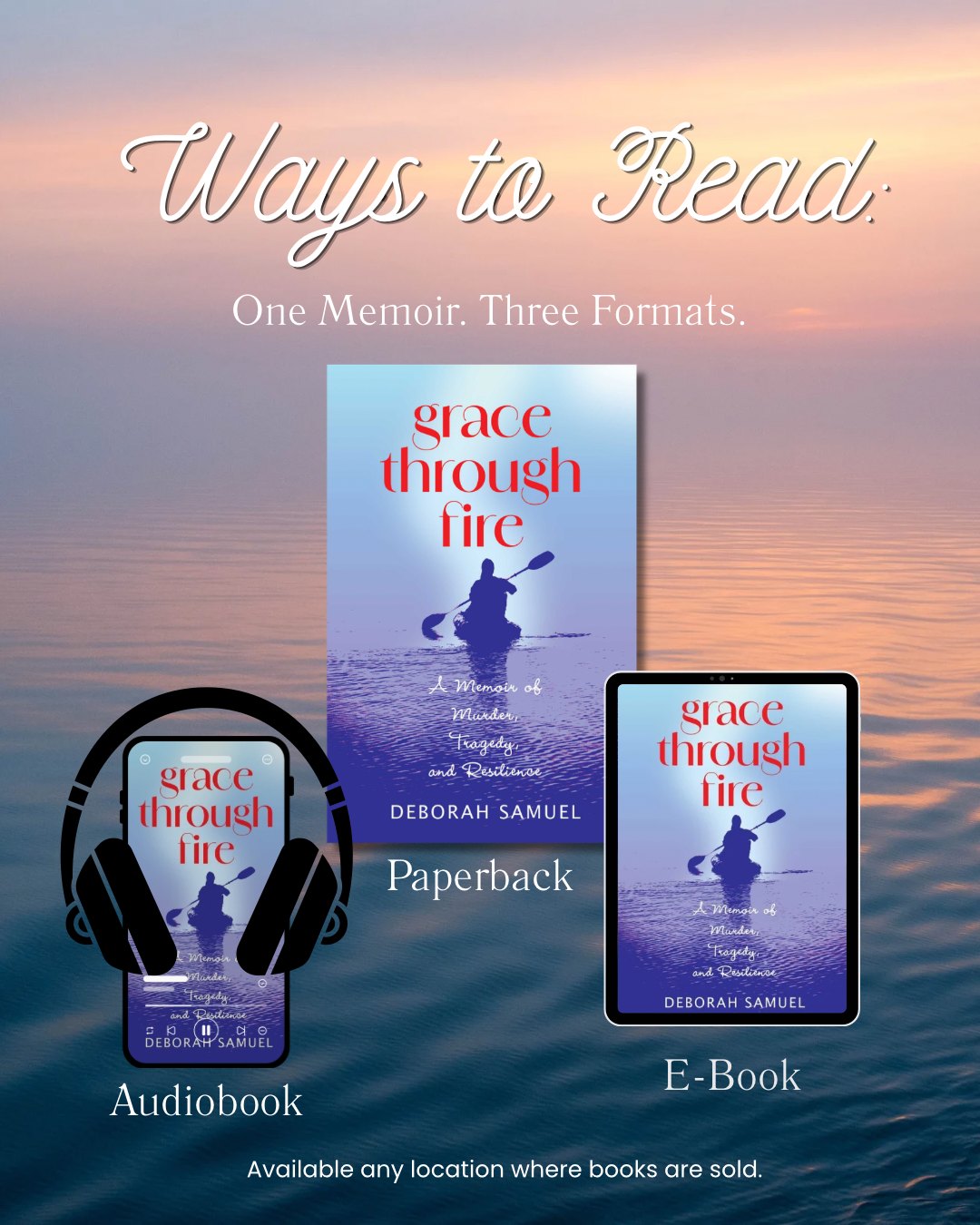
Deborah’s team reported 597 copies across September and October — the run-up to the October 6 release and the weeks right after it. The book is out in paperback, e-book and audiobook and sold wherever books are sold, and the author has been doing her own events, including a talk and signing at Chaucer’s Books in Santa Barbara.
I want to be careful here, the same way we were with The Purple Room’s box office. Book sales happen across dozens of retailers and three formats, and many readers see an ad on Tuesday and buy at their local bookstore on Saturday. Those 597 copies reflect everything working together — the publisher, the press coverage, the author’s own events and our campaign. You won’t find me dividing $1,500 by 597 anywhere in this post. That number would look neat, and it wouldn’t be honest.
What the ad report can tell us is clean: during the month the book launched, 1,911 people were sent to read about it, at less than 80 cents each, from ads they responded to at almost three times the normal rate.
What Made It Work
1. Credibility as the creative
Every ad led with a respected outside voice instead of a sales pitch. That’s the single biggest reason all three ran well above the benchmark.
2. More than one voice, tested together
Three endorsements in one ad set let the audience pick a favorite. We learned that Kirkus mattered most to these readers — useful for every future ad, bookmark and back-cover decision.
3. Letting the budget follow the winner
We didn’t force an even split. Meta shifted delivery toward the strongest ad on its own, which is how the Kirkus ad ended up with 57% of impressions and 60% of page views.
4. A story with an audience waiting for it
A midlife queer love story through the worst of times is exactly the kind of book many LGBTQ+ readers say they want more of. The ads didn’t have to create interest, just point it somewhere.
5. Timing around the release
The campaign started a week before publication and ran through the launch month, alongside LGBTQ+ History Month and National Coming Out Day.
Read the numbers honestly. Campaign figures are from Meta Ads Manager for September 28 to October 29, 2026, on $1,500 total spend; cost per click and cost per landing-page view are calculated against that full amount. Post engagements include link clicks and are not additive to them. The 7.63% figure is link click-through rate per impression. Benchmarks are WordStream’s 2026 median click-through rates for Facebook traffic campaigns. The 597 copies are the author’s reported sales across September and October and are not attributed to the advertising alone. This is one book and one campaign — a useful shape, not a guarantee.
The Takeaway
In one month on $1,500, three endorsement-led ads put Grace Through Fire in front of more than 15,000 people and sent 1,911 of them to read about it, at about 2.8 times the category’s usual click-through rate. And while the campaign ran, the author reported 597 copies.
If you’re an author, a small press or any small business with a product people need to trust before they buy, the lesson travels well: gather the best things other people have said about you, test them against each other, and let your audience tell you which one to lead with. For this book, the review was the ad.
For more on the readers behind this campaign, our LGBTQ+ literature market post maps the category, and the 2026 LGBTQ+ Marketplace Guide covers the national picture.
- Facebook Ads Benchmarks 2026 — WordStream. The 1.93% all-industry and 2.71% Arts & Entertainment median click-through rates for traffic campaigns used as comparisons in this post.
- Facebook lead costs hold at $27.39 as traffic clicks drop to $0.60 — PPC Land. Industry-level breakdown of WordStream’s 2026 benchmarks.
- Grace Through Fire: Deborah Samuel’s Unflinching Memoir — ILoveGay.net. Our feature on the book, its themes and its praise.
- Stories of Resilience, Strength, and Finding Courage When Faced with Catastrophe — Santa Barbara Independent, September 30, 2026. Background on the author and the book.
- Grace Through Fire — Simon & Schuster. Publication details from She Writes Press.
- Banned and Bestselling — Pink Media. How LGBTQ+ literature became publishing’s most resilient growth category.
- Sell November, Not Just Tonight. — Pink Media. Our Purple Room Palm Springs case study, for comparison on reading ad data and sales side by side.
- $500 In. 1,369 Clicks Out. — Pink Media. Our earlier small-budget campaign case study.
- Campaign data: Meta Ads Manager, three single-image ads on Facebook and Instagram, September 28 to October 29, 2026; $1,500 total spend. Sales data: author’s sales report, September and October 2026.