I've watched a lot of categories get scared over the last three years. Beer got scared. Retail got scared. Plenty of household brands went quiet and hoped nobody would notice.
Books did the opposite, and the numbers are hard to argue with. Our newest market guide covers the whole picture — the LGBTQ+ Literature Market Guide summary is here — and the headline finding is the one I keep repeating in meetings because people assume I've got it backwards: they banned the books, and the books hit the bestseller lists.
The timing on this one isn't accidental either. Banned Books Week runs October 4–10 this year, under the theme "Let Books Be. Protect the Freedom to Read." LGBTQ History Month starts October 1. Which means the next four weeks are the densest planning window this category gets all year — and it's the window most brands notice about three days too late.
The Ban Paradox
Start with the commercial number, because it reframes everything else.
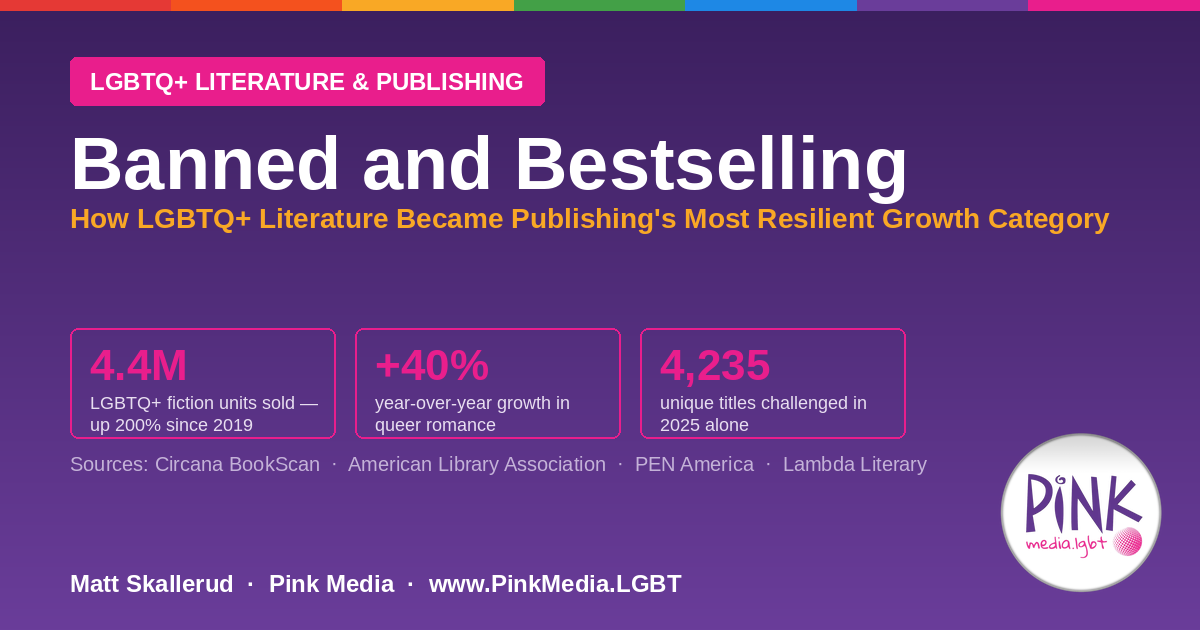
Circana's tracking put LGBTQ+ fiction at roughly 4.4 million units across a twelve-month period — an increase of about 200% over 2019. Queer romance specifically has been growing around 40% year over year. That is not a niche holding steady. In a flat print market, that's one of the strongest growth stories publishing has.
Now put it next to the censorship data, which just got updated this spring. The American Library Association documented 4,235 unique titles challenged in 2025 — the second-highest figure ever recorded, just behind 2023's 4,240. Of those, 1,671 titles (about 40%) represented LGBTQIA+ experiences or people of color. PEN America's school-level tracking found 6,870 book bans in 2024–25, with LGBTQ+ titles climbing to 39% of banned books, up from 25%.
That last number is the one I'd underline for anyone weighing reputational risk. Fewer than 3% of challenges came from individual parents. Ninety-two percent came from organized pressure groups and government officials — up from 72% a year earlier. So the "concerned local community" framing that makes brands nervous doesn't hold up against the data. This is a coordinated campaign, and it is a much smaller group of people than the volume of noise suggests.
Meanwhile the readers responded by buying. Every attempt to remove a title generated coverage, and the coverage generated demand — the clearest demonstration in any category I track that visibility under attack converts into sales.
"They banned the books, and the books hit the bestseller lists. Censorship went up, and sales went up with it. In this category, the thing brands are afraid of is the thing that's driving the growth."
The Backlist Is a Renewable Asset
Here's the part of this market that publishers understand and most brand marketers don't: the canon keeps earning.
James Baldwin's Giovanni's Room, Patricia Highsmith's Carol, Virginia Woolf's Orlando, Audre Lorde's body of work, Leslie Feinberg's Stone Butch Blues — these titles sell continuously, generation after generation, because each new cohort of queer readers finds them the same way the last one did. As the guide puts it, the backlist here functions as a renewable commercial asset, not a museum.
The living tier is just as strong. Ocean Vuong's 2025 novel became an Oprah's Book Club pick, which is about as mainstream as literary fiction gets. Torrey Peters moved trans fiction into the literary center. Justin Torres, Douglas Stuart and Alison Bechdel anchor the prize conversation. And on the commercial side, Casey McQuiston and Alice Oseman are BookTok-native in a way that generates screen deals — Heartstopper and Red, White & Royal Blue both made the jump.
Worth noting the losses too: Edmund White, one of the last of the Stonewall generation, died in 2025. When a foundational author passes, the backlist spikes and the coverage window opens. Heritage marketing in this category has a calendar of its own.
Six Readers, Not One
The mistake I see most is treating "LGBTQ+ book buyers" as a single audience. The guide breaks out six, and they behave completely differently.
1. The BookTok generation
Gen Z, roughly 23% of whom identify as LGBTQ+. They buy in multiples, they buy on recommendation, and they buy fast. Video-first discovery, near-zero response to traditional ad units.
2. Literary readers
The prize-driven audience — National Book Award, Lambda, Oprah's Book Club. Slower purchase cycle, higher hardcover attach, heavily influenced by review coverage and awards.
3. Romance and genre loyalists
The engine of the growth number. They buy backlists in blocks and follow authors rather than titles. Series and series-adjacent recommendations do the work.
4. Parents and allies
Buying inclusive titles for kids and classrooms — often the same books being challenged. Motivated by the news cycle in a way no other segment is.
5. Readers in hostile environments
Closeted readers and those in ban-heavy states, buying e-book and audiobook first for privacy. This is why digital availability isn't a format decision here — it's an access decision.
6. Collectors and patrons
Readers who treat a purchase as an act of support. Signed stock, indie exclusives and limited editions convert this group at rates the rest of the market doesn't see.
Segment five deserves a moment. Programs like Brooklyn Public Library's Books Unbanned and GLAAD's Rainbow Library exist precisely because a teenager in a ban-heavy district still needs the book. If your campaign touches this market, digital access isn't a nice-to-have — for a meaningful share of readers it's the only door.
Discovery Is Social, Not Paid
This is the single most important media finding in the guide, and it runs against how most book budgets are built.
In this category, recommendations flow through BookTok, group chats and bookseller staff picks — and paid advertising consistently underperforms organic community endorsement. Creator and bookseller partnerships deliver the highest return on spend, by a wide margin.
That doesn't mean paid media has no role. It means the job of paid media here is different: it amplifies what the community has already endorsed rather than trying to originate demand. Run the creator partnership first, then put weight behind what's working — books and literature data selects across display, mobile, video and CTV, geo-targeted to tour stops and store trade areas. Amplification, not origination.
"In most categories advertising creates the recommendation. In books, the recommendation comes first — and advertising's job is to make sure more people hear it."
The Bookstore Is an Embassy
The independent queer bookstore is the piece I'd fight hardest to protect, and not for sentimental reasons.
Glad Day in Toronto opened in 1970 and is the oldest LGBTQ+ bookstore in the world. Giovanni's Room in Philadelphia followed in 1973, Gay's the Word in London in 1979 — the shop that survived a customs raid and became a landmark for it. And the format is growing again: Under the Umbrella in Salt Lake City and Charlie's in Seattle are part of a genuine new wave of openings.
The guide's framing is that each of these functions as an embassy: of the community, to its city. That's the commercial logic too. A staff pick in a store like that carries more weight than an ad unit, because the recommendation comes with the store's reputation attached. Fund the infrastructure and you're buying legitimacy, not impressions.
What Doesn't Work Here
- Paid-first launches with no creator layer
- Going quiet when a title gets challenged
- June-only activation in a year-round category
- Chain-only distribution, no indie program
- Print-only thinking in ban-heavy markets
What Works
- Creator and bookseller partnerships first
- Public, named defense of challenged authors
- Indie-first launches with signed-stock programs
- Staff-pick outreach and store-level trade-area targeting
- E-book and audiobook access built into the plan
Stand With the Author
If I had to reduce this guide to one line for a brand or a publisher, it's the one the guide leads with: lead with the book and stand with the author.
Own-voices positioning has to be real — readers in this category are unusually good at spotting the difference between a book made with the community and one aimed at it. And when a title gets challenged, the response is the whole test. Publicly defending a banned author converts a controversy into career-long loyalty. Going quiet, or letting a title get quietly deprioritized, is read exactly the way you'd expect.
This is also where the ALA data becomes genuinely useful internally. When someone in a marketing meeting says "we don't want to get in the middle of a community controversy," the honest answer is that it isn't one: 92% of the pressure is organized and fewer than 3% of it comes from individual parents. That's a much easier risk conversation than most people assume.
The Calendar
Four moments carry this category, and two of them are in the next four weeks.
| When | What | Why It Matters to a Plan |
|---|---|---|
| October 1–31 | LGBTQ History Month | The backlist and heritage window. Canon titles, archive partnerships, author retrospectives. |
| October 4–10, 2026 | Banned Books Week — "Let Books Be." | The highest-attention week of the year for this category, and the one moment when defending a title is the message rather than a risk. |
| Spring | Lambda Literary Awards | The category's own prize season — credibility, coverage and a natural sponsorship tier. |
| June | Pride | Crowded, but still the biggest retail display moment. Best used for frontlist and new-author launches. |
The practical read: October is the real season here, not June. Banned Books Week and LGBTQ History Month land on top of each other, the news cycle does the awareness work for you, and competition for attention is a fraction of what it is in Pride month.
A note on getting the tone right. This is a market where the audience reads for a living, more or less. Copy that sounds like a press release gets clocked instantly. Let the authors and the booksellers do the talking, put your money behind the infrastructure — indie stores, library access programs, author tours — and keep the brand voice in a supporting role. In this category, that's not modesty. It's what actually performs.
The Takeaway
Every other LGBTQ+ category I've written about this year has some version of the same story: the pressure came, some brands held and some brands left, and the ones that held are picking up the ground the others gave away.
Literature is the category where that dynamic is cleanest, because the scoreboard is public. The books people tried hardest to remove are the books that sold. The authors who got attacked got bigger. The stores that were supposed to be a dying format are opening again in Salt Lake City and Seattle.
If your brand has been looking for a place to be visible where the community will actually credit you for it, this is the one that comes with receipts — and the window opens in four weeks.
The full LGBTQ+ Literature Market Guide goes deeper across all sixteen chapters — seventy years of literary history, the sales data, reader demographics and behavior, the foundational canon, contemporary voices, the genre powerhouses, a bookstore directory for North America and worldwide, the publishing and awards ecosystem, the ban battlefield, BookTok and digital reading, and the campaign spotlights. And the broader 2026 LGBTQ+ Marketplace Guide covers the national picture this market sits inside.
- LGBTQ+ Literature Market Guide — Editorial Summary — Pink Media. The full breakdown: seventy years of history, sales data, reader segments, the canon, contemporary voices, bookstores, awards, the ban battlefield, BookTok, and the campaign playbook.
- 2025 Most Challenged Books List — American Library Association. 4,235 unique titles challenged, 1,671 (40%) representing LGBTQIA+ experiences or people of color, and 92% of challenges initiated by pressure groups or officials.
- Soaring Sales of LGBTQ Fiction Defy Book Bans — Circana. The unit-sales and growth data behind the ban paradox.
- Banned Books Week 2026 — October 4–10, "Let Books Be. Protect the Freedom to Read."
- PEN America — Banned Books — school-level ban tracking, including the 6,870 bans recorded in 2024–25 and the rise in LGBTQ+ titles from 25% to 39%.
- Books Unbanned — Brooklyn Public Library · GLAAD Rainbow Library · Unite Against Book Bans — the access and advocacy infrastructure.
- Lambda Literary — the category's awards, fellowships and author programs.
- Pink Media's 2026 LGBTQ+ Marketplace Guide — the national market landscape, categories and year-round calendar.