Every few months a small business owner sits down with us and asks some version of the same question: what does five hundred dollars actually buy me?
It's a fair question, and the honest answer is that our industry tends to dodge it. The case studies that get written up are the six-figure ones — the national brand, the year-long program, the numbers with commas in interesting places. Which is useful if you're a national brand, and not useful at all if you're a regional organization with a board, an event on the calendar and about five hundred dollars to work with.
So here's a small one. Real client, real spend, real numbers, with the client's name and market left out because the point isn't who they are — it's what the shape of the results looks like at this budget level.
The Setup
One client. One event with a fixed date. Roughly $500 in total media across Facebook and Instagram, running a 22-day flight in the lead-up. The objective was traffic: get the right people in one metro area to the event's landing page before the doors opened. Several creative variants in rotation so the platform could find a winner.
No influencer budget. No video production. No retargeting pool to start from. Just a tightly drawn audience, a handful of ads and three weeks.
What Came Back
Here's the full result set, exactly as it came out of Ads Manager:
| Metric | Result | What it tells you |
|---|---|---|
| Impressions | 20,432 | Total ad views delivered across Facebook and Instagram |
| Reach | 15,331 people | Unique accounts — a frequency of about 1.3, so most people saw it once or twice |
| Link clicks | 1,369 | People who left the feed for the event page |
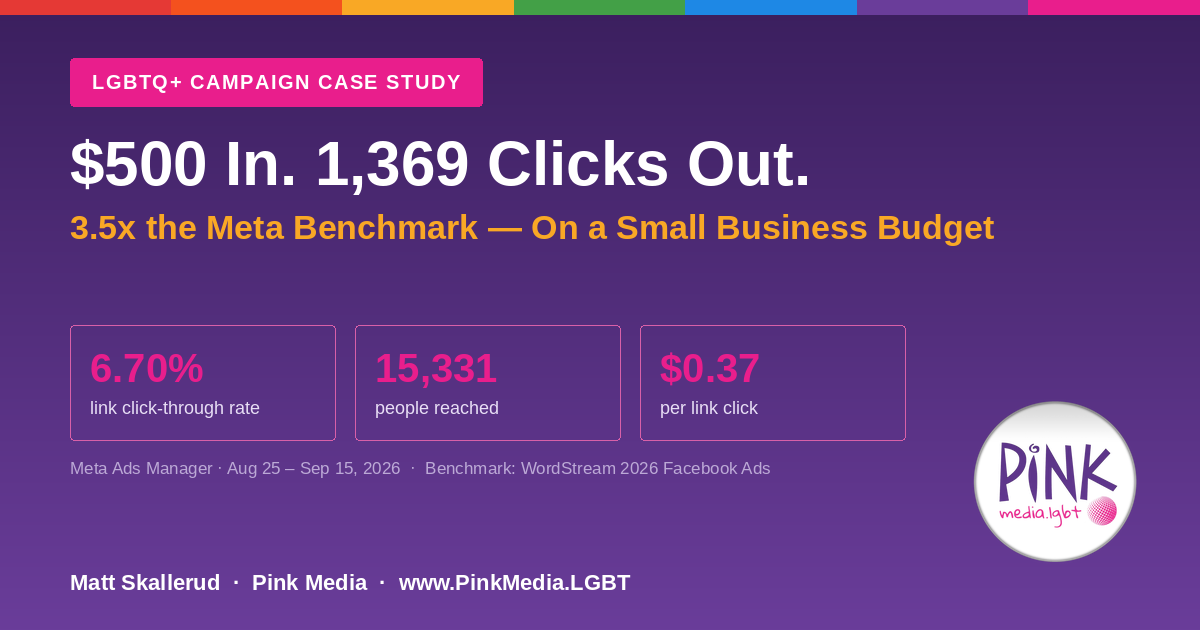
| Link click-through rate | 6.70% | The headline number — roughly 3.5x the industry benchmark |
| Top ad CTR | 7.04% | The single best creative — the one worth rebuilding around |
| Landing page views | 917 | Clicks that actually loaded the page — 67% follow-through |
| Content views | 1,195 | Tracked content engagements on the destination |
| Effective CPM | $24.47 | Cost per thousand impressions at a $500 spend |
| Post engagements | 4,395 | Reactions, comments, shares, saves and clicks on the ads themselves |
| Instagram profile visits | 63 | People who went looking for the brand, not just the event |
The Number That Matters: 6.70%
Impressions are the number that goes in the email to the board. Click-through rate is the number that tells you whether anything worked.
For context: WordStream's 2026 Facebook Ads benchmarks put the average click-through rate for traffic-objective campaigns at 1.93% across all industries, with lead campaigns averaging 2.70%. Broader Meta averages generally land somewhere between 1.5% and 1.8%. Three percent is considered strong.
This campaign ran 6.70%. The best single ad in the set ran 7.04%.
That's roughly three and a half times the benchmark for the exact objective this campaign was built around — and it was produced on a budget most agencies wouldn't take a meeting for — five hundred dollars.
The Metric Nobody Puts in the Deck
Look at the gap between 1,369 link clicks and 917 landing page views. That ratio — 67% — is the quietest important number in this whole report.
Every campaign loses people between the click and the page load. Some of it is technical: slow pages, mobile browsers, people who tap and change their mind mid-load. But a large chunk of it is a promise problem. If the ad says one thing and the page says another, people bounce before the page finishes rendering, and you paid for all of them.
Two-thirds arriving is a healthy number. It means the ad and the page were telling the same story — and that the 1,369 clicks were mostly real intent rather than accidental thumbs.
A high click-through rate with poor page follow-through means your creative is writing checks your landing page can't cash. Always read those two numbers together.
Engagement, Read Honestly
4,395 post engagements is a big number for five hundred dollars — about 11 cents apiece, and roughly 21% of every impression delivered produced some kind of interaction.
One caveat worth stating plainly, because a lot of reports don't: Meta counts link clicks inside post engagements, so these aren't additive. Net of the clicks, you're still looking at roughly three thousand reactions, comments, shares and saves — the kind of activity that keeps an event visible in feeds the platform serves for free.
Then there are the 63 Instagram profile visits. Small number, disproportionately useful. Those are people who saw the ad and went looking for the brand behind it — not the event, the organization. On a campaign this size, that's the earliest measurable sign that you're building something that outlasts the flight.
Why a Small Budget Can Still Work Here
Since Meta removed sensitive-interest targeting in January 2022, you can't simply check a box to reach the LGBTQ+ community — a shift we've written about at length in The Targeting Is Gone. The Audience Isn't. What's left to work with is geography, creative, context and community distribution.
That sounds like bad news for a small advertiser. It's actually the opposite. When the targeting parameter did the heavy lifting, budget size mattered more, because you were essentially buying volume against a machine-selected audience. Now the lever that moves performance is relevance — and relevance is something a small, specific, locally rooted campaign is unusually good at.
A dated event is the single best asset a small budget can have. It gives people a reason to click now, a place to be, and a deadline. That's worth more than another few thousand impressions.
What $500 Does Not Buy
- National reach — 15,331 people is one metro area, not a country
- Frequency — at 1.3, most people saw this once
- Brand building — three weeks is a burst, not a presence
- A retargeting pool you can lean on next time (though you're building one)
- Video production, influencer fees, or a second channel
What $500 Did Buy
- 1,369 people who left the feed for the event page
- 917 confirmed arrivals on the landing page
- 4,395 engagements keeping the event visible in feeds
- A proven winning creative at 7.04% to rebuild around
- A clean read on which audience and message actually work
Small budgets don't usually fail because they're small. They fail because they're spread thin — across too many markets, too many objectives, and too vague a reason to click. Concentrate five hundred dollars on one place, one date and one action, and it stops behaving like a small budget.
— Matt Skallerud, President, Pink Media
The Five Things That Made It Work
1. A narrow geographic footprint
One metro area, not a region and certainly not a country. Every impression that lands outside the people who could physically show up is money spent on a number in a report.
2. A dated reason to act
An event with a fixed date creates urgency the platform can't manufacture for you. "Learn more about us" and "this is happening on the 15th" do not perform the same way.
3. A landing page that matched the ad
67% click-to-page follow-through is the receipt. Same language, same imagery, same promise — so nobody arrived confused and left.
4. Multiple creative variants in rotation
Without several ads running, you never find the 7.04% one. That single winner is the most valuable thing this campaign produced, because it's reusable.
5. Community context instead of a broad blast
Reaching the LGBTQ+ community means showing up where the conversation already lives, in language that reads as written from inside it — not a generic ad with a rainbow on it.
Read the numbers honestly. Spend here is approximate and rounded to $500; derived figures — cost per click, cost per engagement, cost per landing page view — are calculated against that round number. Post engagements include link clicks and are not additive to them. The effective CPM worked out near $24.47 — a normal range for a tightly drawn local audience, though narrow geography and a specific audience will always cost more per thousand than a broad national buy. And this is one campaign in one market over three weeks. It's a useful shape, not a guarantee.
The Takeaway
If you're working with a small budget, the instinct is almost always to stretch it — a little here, a little there, a few markets, a few objectives, in case something hits. That instinct is what kills small campaigns.
This one did the opposite. One market. One date. One action. A handful of creative variants and enough discipline to let the best one win. Three weeks later: 1,369 clicks, 917 landing page views, and a click-through rate three and a half times what the platform average would predict.
Five hundred dollars is not a lot of money in advertising. It's roughly what a starter program costs, and it's more than enough to find out whether your message works — and that answer is worth considerably more than five hundred dollars.
Our 2026 LGBTQ+ Marketplace Guide covers the broader landscape this kind of campaign sits inside — the audiences, the media, the categories and the year-round calendar.
- Facebook Ads Benchmarks 2026 — WordStream. The 1.93% all-industry average click-through rate for traffic campaigns and 2.70% for lead campaigns used as the comparison throughout this post.
- The Targeting Is Gone. The Audience Isn't. — Pink Media. Why Meta's 2022 removal of sensitive-interest targeting changed what small LGBTQ+ campaigns have to do to reach the community.
- 2026 LGBTQ+ Marketplace Guide — Pink Media. The national market landscape, audience segments, media categories and year-round calendar.
- Pink Media Entry Level Package — what a starter LGBTQ+ program looks like at $495, for organizations working at roughly this budget level.
- Campaign data: Meta Ads Manager, Facebook and Instagram, 22-day flight, August–September 2026. Client name and market withheld.