If you've been watching how brands are handling Pride this year, you may have noticed something interesting: the action has moved. Not away — down. Down from the national stage to the city level, from one big campaign to dozens of smaller ones, from a single press release out of headquarters to partnerships with the Pride organization three blocks away. After a few seasons in which national LGBTQ+ campaigns became lightning rods for coordinated boycotts from one direction or the other, brands haven't stopped showing up — they've changed where they show up. And honestly? There's a real strategy hiding inside that caution.
I've started calling it the hyper-local hedge. A national campaign presents a single, very visible target. But a brand that's volunteering in Columbus, sponsoring a community center in Dallas, hosting an employee event in Chicago, and buying media in each of those cities individually is doing something much harder to organize against — and, more importantly, something much easier for the community to actually feel. Let's walk through what this looks like in practice, who's doing it well, and the piece of the puzzle I think too many marketers still overlook: the local LGBTQ+ press.
What Decentralizing Actually Looks Like
The shift shows up in four moves we're seeing again and again this season — each one trading national visibility for community proximity:
The National Playbook
- One campaign, one message, broadcast from headquarters
- A single sponsorship logo on a single big parade
- One press moment in June — then silence
- A single, highly visible target for coordinated backlash
The Hyper-Local Playbook
- Regional volunteerism — employees showing up in their own cities
- Partnerships with local LGBTQ+ organizations, market by market
- Employee-focused and community-scale events over splashy national ones
- Narrowly targeted media buys in trusted local LGBTQ+ outlets
Is some of this defensive? Sure. Brands wary of national polarization are spreading their support across enough cities that no single activation carries the whole weight. But here's the thing — defensive or not, this is how community trust has always actually been built. The majority of LGBTQ+ people who encounter your brand will never see your float at the big parade. They'll encounter you in daily life: in their neighborhood, at their local Pride, in the local outlet they've been reading for decades. Hyper-local isn't a retreat from authentic engagement. Done right, it's a better version of it.
Lime: One Campaign, 21+ Cities
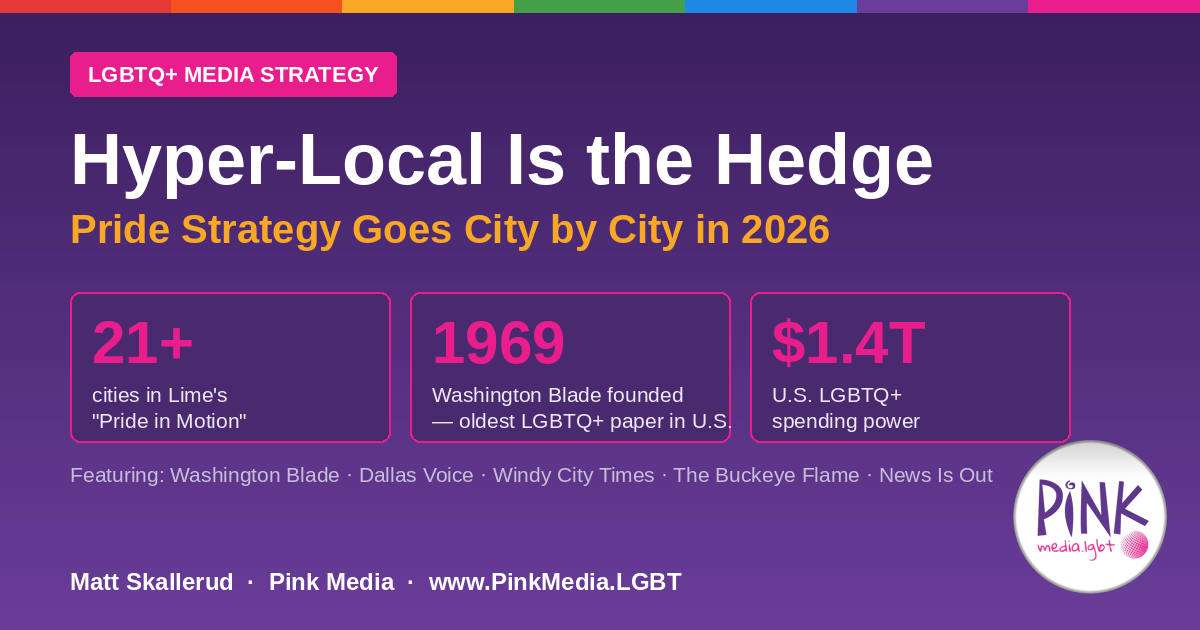
The cleanest example this season is Lime's "Pride in Motion" campaign. On the surface it's the fun stuff — rainbow-wrapped e-scooters and e-bikes rolling through city streets. But the structure underneath is what makes it worth studying: the campaign runs across more than 21 cities worldwide, and in each one, Lime is partnering with the local Pride organization and pairing the vehicles with transportation-access initiatives that help riders actually get to Pride events.
That's the multi-city model in miniature. It's one campaign — one creative idea, one set of brand assets — but it lives locally everywhere it operates. Each city gets its own partnership, its own riders, its own on-the-ground presence. A rainbow scooter parked on a corner in any neighborhood does its work quietly, 24/7, every day of the season — no national media buy required. And because the program is built around a real community need (getting to the parade), it reads as service, not signaling.
Levi's: History as the Local Anchor
Levi's took a different route to the same destination with "Together, We Ride," its 2026 Pride collection honoring the queer motorcycle clubs that gave LGBTQ+ people fellowship and protection decades before Pride was a marketing line item. Look at where that history lives: the Satyrs Motorcycle Club, founded in Los Angeles in 1954. San Francisco's Rainbow Motorcycle Club and the legendary Dykes on Bikes, who have led SF Pride for decades. New York's Sirens Women's Motorcycle Club, a fixture at the front of NYC Pride for nearly forty years.
That's not a national abstraction — it's a city-by-city map of real queer community history, built from the GLBT Historical Society's archives and backed by a $100,000 donation to Outright International. Levi's is telling Los Angeles a Los Angeles story, San Francisco a San Francisco story, New York a New York story. The collection is national; the meaning is local. That's the same hedge, executed through heritage instead of logistics.
"A national campaign is one target. Twenty-one local partnerships are twenty-one relationships — and relationships are a lot harder to boycott than logos."
The Overlooked Layer: Local LGBTQ+ Media
Here's where I want to spend the rest of this post, because if hyper-local is the strategy, local LGBTQ+ media is the most underused channel for executing it. These are outlets that have been the connective tissue of their communities for decades — trusted, brand-safe, deeply read, and (compared to national buys) remarkably affordable. A media plan built around them is a hyper-local strategy, ready-made.
Washington Blade
The oldest LGBTQ+ newspaper in the United States, covering politics, policy, and community life from the nation's capital for more than half a century. If credibility were a currency, the Blade would be a reserve bank.
Dallas Voice
The premier media source for LGBTQ+ Texas, publishing weekly for four decades — and the trusted front door to one of the largest, fastest-growing LGBTQ+ markets in the country.
Windy City Times
Chicago's LGBTQ+ newspaper of record, covering the city and its suburbs for forty years with award-winning journalism that the community actually reads and shares.
The Buckeye Flame
Ohio's only statewide LGBTQ+ newsroom — proof that local queer journalism isn't just legacy print. A nonprofit digital outlet amplifying LGBTQ+ Ohioans, it joined News Is Out as an affiliate in 2025.
And they're not standing alone. Alongside outlets like the Philadelphia Gay News, San Francisco's Bay Area Reporter, and Tagg Magazine, these newsrooms are part of News Is Out — the national queer media collaborative launched by the Local Media Association with Google News Initiative funding. News Is Out members work together on editorial projects, branded content campaigns, philanthropic fundraising, and an annual LGBTQ+ Media Day. For an advertiser, that's the best of both worlds: one point of entry, with the trust and targeting of a dozen local newsrooms on the other side of the door.
As The Buckeye Flame's editor Ken Schneck put it when his outlet joined the collaborative: "There is such collective power to queer newsrooms working together, and that power is especially and acutely needed right now." He's right — and the same collective power is available to the brands that advertise with them.
There's a virtuous circle here worth naming, too. National sponsor dollars have been pulling back from big Pride events for two seasons now — I've written about that shortfall and what it means. Local LGBTQ+ media has felt the same squeeze. So when a brand redirects even part of a national budget into local outlets, two things happen at once: the message lands in the most trusted space available, and the infrastructure of queer journalism gets the support it needs to keep doing its work. That's marketing and community investment in the same line item.
The Watch-Out: Local Shouldn't Mean Invisible
One honest caution, because I'd be doing you a disservice to skip it. There's a version of "going local" that's really just going quiet with better PR — shrinking the budget, scattering what's left, and hoping nobody notices either way. The community notices. The test I'd apply is simple: is your hyper-local strategy adding touchpoints or hiding them? Lime added 21 cities' worth. Levi's added forty years of history and a six-figure donation. If your decentralized plan involves more community relationships than last year's national one — more partners, more local presence, more sustained visibility — you're hedging wisely. If it involves fewer, you're just leaving.
"Hyper-local isn't about lowering your profile — it's about relocating it to where trust actually gets built. The brands doing this well aren't spending less on the LGBTQ+ community. They're spending closer to it."
Where Pink Media Fits
This city-by-city approach is very familiar territory for us. We've spent years helping brands and destinations run geo-targeted LGBTQ+ campaigns — reaching the community in specific cities, regions, and even neighborhoods, through content and media placements that live where people actually are. Broader yet targeted, as we like to say. If you're rethinking a national LGBTQ+ strategy as a network of local ones — and pairing it with the local LGBTQ+ media that makes it credible — that's a planning conversation we're always glad to have.
The Bottom Line
The polarization around national LGBTQ+ campaigns is real, and brands are right to think carefully about it. But the answer that's emerging in 2026 isn't silence — it's proximity. Decentralize the campaign. Partner city by city. Show up through regional volunteerism, local organizations, employee communities, and the local LGBTQ+ press that's been holding these communities together for decades. Lime and Levi's have shown the model works at global and national scale. The Washington Blade, Dallas Voice, Windy City Times, The Buckeye Flame, and the News Is Out collaborative are standing by to help it work in every market you care about. Hyper-local is the hedge — and it might just be the better strategy, full stop.