Two weeks ago I wrote about New York as the capital of queer America. Pink Media has offices in both cities, so the West Coast was always going to get its turn.
And here's the line from our Los Angeles regional guide that I keep repeating to people: New York has Stonewall. Los Angeles has almost everything that came before it.
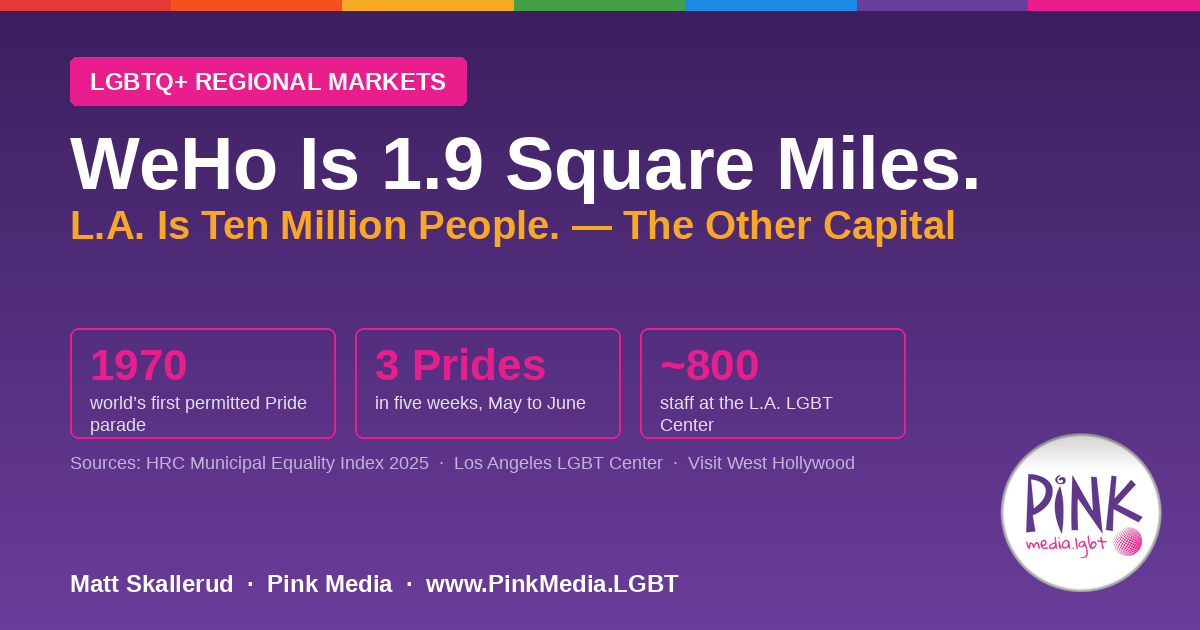
The Mattachine Society — America's first sustained gay-rights organization — was founded in Silver Lake in 1950. ONE magazine launched in 1953 and won a Supreme Court case in 1958 establishing its right to publish at all. The Black Cat protests happened in 1967, two years before Stonewall. And on June 28, 1970, Christopher Street West marched down Hollywood Boulevard as the world's first permitted Pride parade. The Los Angeles LGBT Center, founded in 1969, is now the largest LGBTQ+ organization on the planet.
This is the other capital. The full Los Angeles region guide summary is here — and what follows is the part of it that should change how you build a plan.
The 1.9-Square-Mile Mistake
Most national LGBTQ+ plans for Los Angeles are, in practice, plans for West Hollywood. I understand why. WeHo is iconic. It incorporated in 1984 with an LGBTQ+-majority city council, its population is roughly 40% LGBTQ+, and the Rainbow District is exactly what people picture.
It's also 1.9 square miles.
Los Angeles County is nearly ten million people, and its LGBTQ+ life is genuinely polycentric. Silver Lake and the Eastside. Long Beach, which runs its own Pride and its own city government. Downtown L.A. Boyle Heights. Hollywood. The San Fernando Valley. Each has distinct events, distinct media and distinct gatekeepers — and none of them is reached by a banner on Santa Monica Boulevard. Then add Palm Springs, two hours east, which functions as the same audience on a weekend drive.
The WeHo-Only Plan
- Santa Monica Boulevard, Pride Week, done
- English-only national creative
- One Pride picked off the menu
- June spend, nothing in October
The Plan That Works Here
- County-wide: Long Beach, DTLA, Silver Lake, Boyle Heights, the Valley
- Bilingual creative from the first brief, not translated at the end
- All three Prides, sequenced as one campaign
- Halloween Carnaval and awards season, plus the Palm Springs corridor
Bilingual Is Baseline
This is the rule I'd put at the top of every L.A. brief, and it's the one most often missed.
L.A. County is majority-Latino. That's not a segment to layer in later — it's the majority of the audience. A campaign built in English and translated as an afterthought has already told most of the market it wasn't the intended reader.
The infrastructure to do this properly already exists. Adelante Magazine is a bilingual English-Spanish monthly built for exactly this audience. Univision and Telemundo reach queer Latino viewers at a scale no LGBTQ+-specific outlet matches. The TransLatin@ Coalition runs national advocacy and services for trans Latinas from here, alongside the Latino Equality Alliance, Mi Centro and The Wall Las Memorias. And DTLA Proud in August draws a young, heavily Latino crowd that most national Pride plans never see.
"Los Angeles invented the Pride parade, the movement's first magazine, and the world's biggest LGBTQ+ institution. It didn't do any of it in one neighborhood — and neither should your media plan."
California Wrote the Refuge Playbook
In the Chicago piece I talked about Illinois as the Midwest's refuge. California is where the refuge-state model was invented.
SB 107, signed in 2022, made California the first state with a legislated refuge for transgender youth and their families, barring cooperation with out-of-state prosecutions over lawful gender-affirming care. More than a dozen states have since copied the model. It sits on top of comprehensive non-discrimination law, the country's first state LGBTQ+ curriculum standards, conversion-therapy bans and insurance equality — all backed by an Attorney General's office that litigates nationally.
In Los Angeles, that becomes operational infrastructure. The city and county maintain LGBTQ+ liaisons and funded services, West Hollywood functions as a policy laboratory, and the L.A. LGBT Center serves as the region's intake system for arrivals. That refuge economy is a real, measurable part of this market — and people moving here are paying close attention to which brands actually fund the systems that received them.
The Industry Town Sits Above the Local Press
Every market I've written about has a community press. Los Angeles has that and something no other market has: the apparatus that manufactures how LGBTQ+ people appear on every screen in the world.
The local and regional press
The Los Angeles Blade, the West Coast sibling of the Washington Blade, carries statewide policy coverage. Adelante serves the bilingual majority. The Fight, The Pride LA and WeHo Times cover the hyperlocal beat — the council votes, the bar openings, the neighborhood fights that decide who the community trusts.
The Spanish-language giants
Univision and Telemundo reach queer Latino audiences at mass scale. In a majority-Latino county, this is a core channel rather than a multicultural line item.
The media manufacturing layer
GLAAD's L.A. operation and Media Awards, the content pipelines of the studios and streamers, and a queer creator economy whose audiences now dwarf traditional print. This is the layer where LGBTQ+ culture's gatekeepers decide what works — which is why L.A. is where brand work effectively auditions nationally.
"In L.A., the community's media isn't just the local paper — it's the entire apparatus that decides how LGBTQ+ America appears on every screen in the world. Advertise like you know the difference."
Three Perfect Scores, and an Industry That Set the Bar
The municipal scorecards look like you'd expect — with one detail worth noticing.
| City | 2025 MEI Score | What's Behind It |
|---|---|---|
| West Hollywood | 100 | The perennial benchmark — a city founded with LGBTQ+ governance built in |
| Los Angeles | 100 | A megacity maxing the scorecard through ordinances, liaisons and funded services |
| Long Beach | 100 + 11 | A perfect score plus 11 bonus flex points — its 14th consecutive top recognition |
Long Beach is the detail. It's the city national plans most often skip, and it has the strongest scorecard in the region.
On health, Cedars-Sinai and UCLA Health lead on healthcare equality. On the corporate side, Disney, Warner Bros. Discovery, Netflix, Sony and Paramount have anchored the Corporate Equality Index's entertainment cohort for two decades. That's the local bench — and it's a high one. Brands advertising into this market are being read against companies that decide how queer stories get told.
The Institutions Are Built at a Different Scale
If there's a single fact that separates L.A. from every other market I've covered, it's the size of its institutions.
The Los Angeles LGBT Center has nearly 800 employees delivering health, social services, housing, culture and advocacy. Its Anita May Rosenstein Campus includes intergenerational housing serving residents from 18 to 80, and its 2026 gala raised $1.25 million in a single evening. It's the regional sponsorship flagship and, more importantly, the region's trust engine — the organization whose partnership tells the community a brand is serious.
Los Angeles is also headquarters to the AIDS Healthcare Foundation, the world's largest HIV/AIDS care organization, treating patients across dozens of countries and running pharmacy networks and Out of the Closet thrift stores across the county. Add APLA Health, founded in 1983 as AIDS Project Los Angeles, with primary, dental and HIV care clinics; the TransLatin@ Coalition; and the Williams Institute at UCLA, the country's premier LGBTQ+ demographic research center — the source behind a lot of the numbers this industry quotes.
Three Prides in Five Weeks — and the Halloween Nobody Buys
L.A.'s calendar has a structure no other market has: three separate Prides stacked into about five weeks, each with a different audience.
| When | What | Why It Matters to a Plan |
|---|---|---|
| May 15–17 | Long Beach Pride — "Fearless and Free" | Opens the season in the region's highest-scoring city. Its own audience, its own tourism board. |
| June 5–7 | WeHo Pride Week — Street Fair, Dyke March, OUTLOUD | City-produced, with a ticketed music festival (2026: Pussycat Dolls, Ava Max, JADE). The iconic weekend. |
| June 14 | LA Pride, 56th edition — Hollywood Boulevard | The direct descendant of the 1970 Christopher Street West march. History you can sponsor. |
| July 23–26 | OutfestNEXT | Emerging queer filmmakers — the creator pipeline in its earliest form. |
| August | DTLA Proud | Young and heavily Latino. The audience most national plans never reach. |
| October | AIDS Walk L.A. | The giving circuit, and a long-standing community institution. |
| October 31 | WeHo Halloween Carnaval | One of the world's largest Halloween gatherings. The most under-leveraged mega-audience in LGBTQ+ marketing. |
Two things to take from that. First, run the gauntlet rather than picking one. Long Beach, WeHo and LA Pride are three distinct audiences in a five-week window, which is a sequenced campaign sitting there waiting to be built. Second — and this is the timely one — the Halloween Carnaval is a month from today. Pride-scale crowds, a fraction of June's clutter, and almost nobody buying it properly. Between that and awards season, L.A. offers more off-peak attention than any market in the country.
On the destination side, the West Hollywood Travel + Tourism Board, led by CEO Tom Kiely, markets the Rainbow District as a core product — "where LGBTQ+ culture lives loud" — and in 2025 WeHo became an official IGLTA Global Partner. L.A. Tourism markets the megacity globally, Visit Long Beach promotes Long Beach Pride, and the desert connection means Palm Springs and Los Angeles function as one LGBTQ+ tourism corridor, the same way Miami and Fort Lauderdale do.
Seven Rules for Los Angeles
The region guide lays these out in full. Here's the working version.
1. Market polycentric. WeHo is iconic; the market is the county. Long Beach, DTLA, Silver Lake, the Valley and Boyle Heights each have their own events, media and gatekeepers.
2. Run the Pride gauntlet. Don't cherry-pick. Long Beach, WeHo and LA Pride are three audiences in five weeks — plan them as one sequenced campaign.
3. Bilingual is baseline. In a majority-Latino county, Spanish-language creative isn't an adaptation. It's how you reach the majority.
4. Anchor with the Center. The L.A. LGBT Center is the region's trust engine. A real partnership there signals seriousness to everyone else.
5. Use the industry angle. GLAAD's orbit, awards season and the creator economy make L.A. the place where work auditions nationally in front of LGBTQ+ culture's gatekeepers.
6. Use the off-peak moments. The Halloween Carnaval and awards season deliver Pride-scale attention without June's clutter.
7. Bridge to the desert. Los Angeles and Palm Springs are one audience on a two-hour drive. Plan them as a corridor.
The practical version: take a WeHo-only Pride budget and rebuild it as three things — a bilingual campaign that runs across all three Prides and reaches Long Beach and DTLA, a real partnership with the Center or one of the culturally specific organizations, and an October 31 flight for the Carnaval. Same money, most of the county instead of 1.9 square miles of it, and a presence that outlasts June.
The Takeaway
Los Angeles gave the movement its first sustained organization, its first magazine, its first permitted parade and its largest institution — and it did all of it across a sprawling, majority-Latino, multi-city region rather than in one famous neighborhood.
That's the brief. The brands that do well here plan for the county, write in two languages, fund the institutions that carry the refuge economy, and show up in October as well as June. And because this is where LGBTQ+ culture gets manufactured for the rest of the world, work done well in L.A. doesn't stay in L.A.
Our LGBTQ+ Los Angeles Region Guide goes deeper across thirteen chapters — the history, the polycentric map, the refuge architecture, the media landscape, the MEI, CEI and HEI scorecards, the institutions, the destination organizations, the three-Prides calendar and the full playbook. And the broader 2026 LGBTQ+ Marketplace Guide covers the national picture this market sits inside.
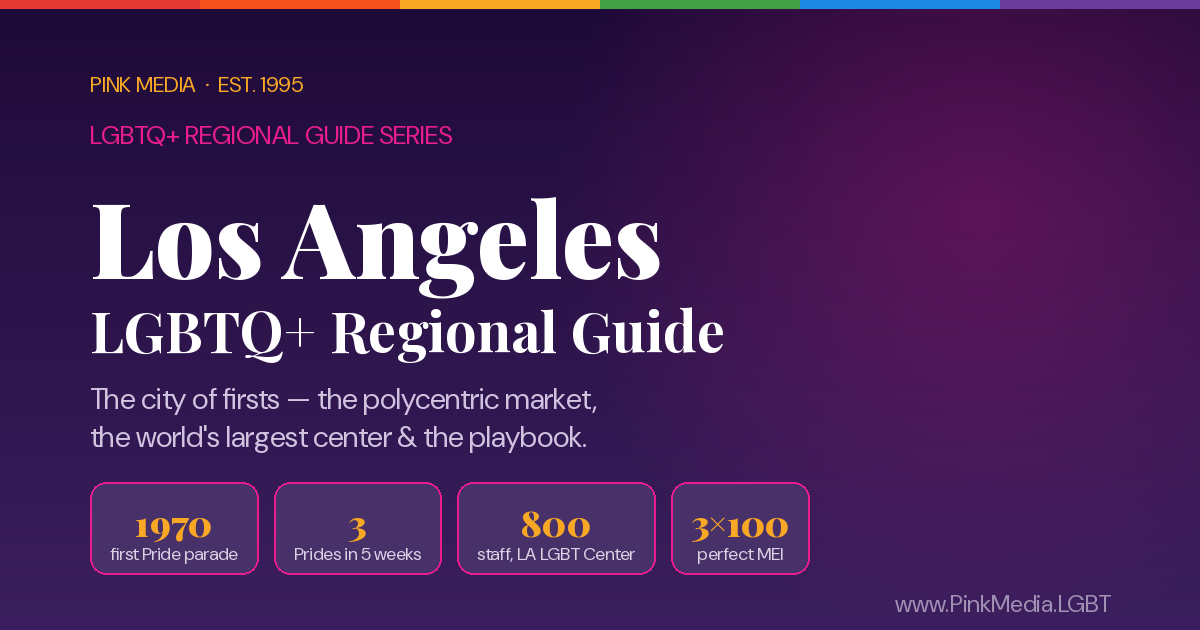
- LGBTQ+ Los Angeles Regional Guide — Editorial Summary — Pink Media. Thirteen chapters: the history, the polycentric map, refuge architecture, media, equality scorecards, institutions, DMOs, the three-Prides calendar and the seven-rule playbook.
- New York Doesn't Need You at the Parade. — Pink Media. The companion piece on the other coast's capital.
- America's Gayest City, Mapped for Marketers — Pink Media. The desert end of the L.A.–Palm Springs corridor.
- Municipal Equality Index — Human Rights Campaign Foundation. The 2025 scores for West Hollywood, Los Angeles and Long Beach.
- Los Angeles Blade · Adelante Magazine · WeHo Times — the local and bilingual press.
- Los Angeles LGBT Center · AIDS Healthcare Foundation · APLA Health · TransLatin@ Coalition · Williams Institute at UCLA — the institutions.
- Visit West Hollywood · LA Pride · WeHo Pride · Long Beach Pride — the destination and the calendar.
- Pink Media's 2026 LGBTQ+ Marketplace Guide — the national market landscape, categories and year-round calendar.