Here's a question I've started asking in meetings, mostly because the answer lands so well: where was the first gay-rights organization in America founded, and when?
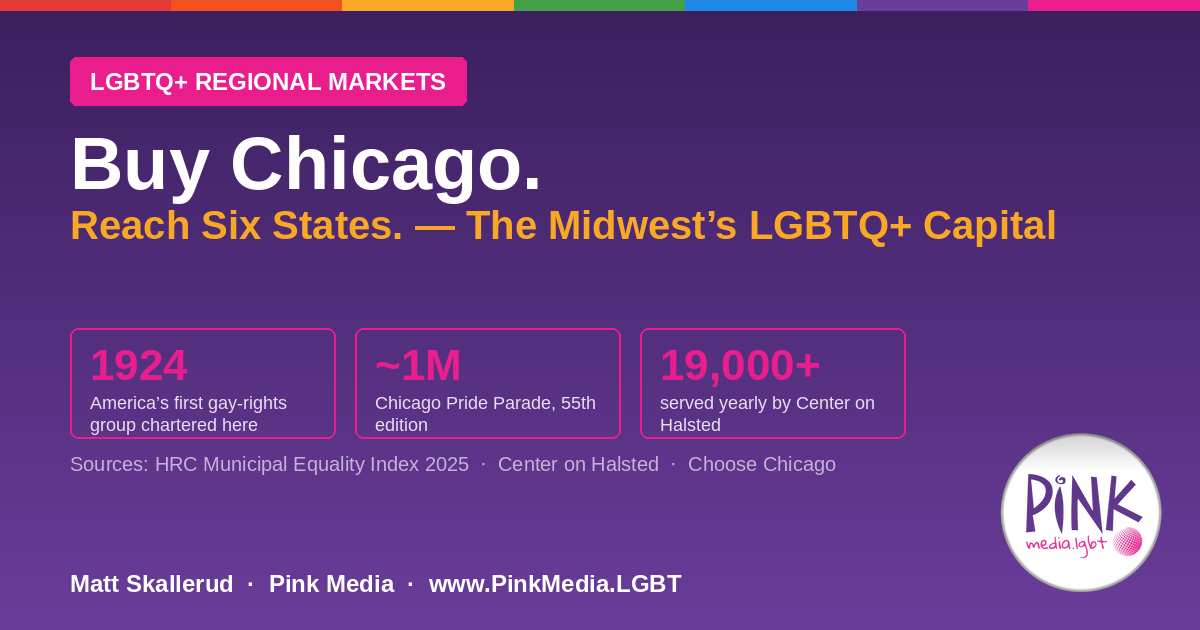
Almost everybody guesses New York, and almost everybody guesses somewhere around 1969. The answer is Chicago, 1924 — when Henry Gerber chartered the Society for Human Rights, forty-five years before anyone threw anything at Stonewall. Gerber's house is a landmark today. It's about a fifteen-minute drive from the first officially designated gay district in the United States, which Chicago created in 1997 by putting rainbow pylons up on North Halsted.
I bring it up because it reframes the market. Chicago doesn't get discussed as an LGBTQ+ capital the way New York, Los Angeles, San Francisco and Miami do. It just quietly is one, and has been the longest. Our newest regional deep dive covers it in full — the LGBTQ+ Chicago Region Guide summary is here — and this is the case for why it belongs on your 2027 map.
One City, Six States' Worth of Demand
Start with the thing that has changed most in the last three years, because it's the reason the media math works differently here now.
Illinois has covered sexual orientation and gender identity under its Human Rights Act since 2005, and reached marriage equality in 2014 — ahead of Obergefell. In January 2023, Governor Pritzker signed HB 4664, the Patient and Provider Protection Act, a shield law protecting patients and providers of gender-affirming and reproductive care from out-of-state enforcement.
Then the states around it moved the other way. And through 2025, the coverage was consistent enough to become its own beat: trans people and their families relocating to Illinois from Indiana, Missouri, Iowa and beyond. Not visiting. Moving.
So Chicago became the only haven in the middle of the country — which produces a very specific marketing consequence that I don't think most national planners have caught up to. Municipal Equality Index scores drop sharply the moment you cross the state line in any direction. The refuge map and the media map are now effectively the same map. Everything for six states funnels through one city.
"Chicago is the only market in the middle of the country where one buy reaches six states' worth of LGBTQ+ community — and it's still priced like a single city. That gap is the opportunity."
The Scorecards Back It Up
Chicago earned a perfect 100 on HRC's 2025 Municipal Equality Index — 98 on the base scoring, plus 11 flex points, capped at 100. Worth noting what earned those flex points, because it's not symbolic: funded services for LGBTQ+ youth, seniors, people living with HIV, and trans residents. Actual budget lines.
For context, a record 132 cities reached a perfect 100 out of 506 rated nationally in 2025. Chicago is in that group — and, more importantly for a media plan, it is surrounded by cities that are not.
The corporate picture is just as developed, and it matters here because so many of these are hometown companies. United Airlines and Hyatt Hotels anchor travel and hospitality — Hyatt has been a perfect Corporate Equality Index scorer since 2005. McDonald's, Mondelez and Kraft Heinz on the consumer side. Walgreens, Abbott and AbbVie in health. Allstate, Discover and Northern Trust in finance. On healthcare equality, Rush University Medical Center is a perennial HEI Leader, with Northwestern, UChicago Medicine and Lurie Children's alongside it.
That's a deep local bench of brands who already answered the "should we be visible here" question years ago. If you're building a case internally, co-sponsorship alongside names like these is an easier conversation than going first.
The Media That Actually Reaches This Market
Chicago has something that has gotten rare: a functioning local LGBTQ+ press, with a nonprofit newsroom at the center of it.
Windy City Times — the newsroom worth partnering with
Founded in 1985 and co-founded by Tracy Baim, now operating as a nonprofit digital newsroom with daily coverage, a community-journalism training cohort, and signature franchises including its 30 Under 30 honors. It's one of the clearest models anywhere for how legacy queer press survives the digital transition — which means a media partnership here doubles as community investment rather than just impressions.
GoPride Network / ChicagoPride.com — the planning hub
Where people actually go to figure out what's happening this weekend. High intent, event-driven, and directly useful if you have anything with a date attached.
GRAB Magazine — venue level
Nightlife coverage at the bar-and-block level. If your campaign touches hospitality, spirits, events or nightlife, this is where the local audience lives.
Mainstream and archive
The Chicago Reader and Block Club Chicago provide consistent queer coverage; the Tribune, Sun-Times and WBEZ carry the migration and institutional beats. And Gerber/Hart Library and the Leather Archives & Museum hold a century of the community's own record — a real asset for any brand doing heritage work.
The practical note: partnering with a nonprofit newsroom is a different transaction than buying a rate card. You're funding local journalism in a market that needs it, and you get credited for that in a way a programmatic impression never gets credited.
The Institutions Are Carrying the Region
This is where I'd point any brand looking for the highest-leverage giving between the coasts, because these organizations are absorbing demand created by other states' policies.
Center on Halsted is the Midwest's largest LGBTQ+ community center, serving more than 19,000 people a year from its landmark Halsted Street building, with Town Hall Apartments providing LGBTQ+-friendly senior housing next door. Howard Brown Health, founded in 1974, is the Midwest's largest LGBTQ+ health system — clinics on the North and South Sides, primary care, HIV services, a major trans-care program, behavioral health and research, funded partly through its Brown Elephant resale shops. It is also under real financial strain, precisely because of the six-state refuge demand described above.
Brave Space Alliance is the first Black- and trans-led LGBTQ+ center on the South Side, running mutual aid, food programs, trans services and organizing. Equality Illinois has been the statehouse force behind that strong statute book since 1991. Add Affinity Community Services, the Pride South Side tradition, and AIDS Foundation Chicago's work under the Getting to Zero Illinois framework.
"Funding the refuge infrastructure isn't charity attached to a campaign. In this market it's the most efficient community investment available between the coasts."
Cover Both Sides of the City
Here's the mistake I see most often in Chicago plans, and it's an expensive one.
Northalsted and Andersonville are the gayborhoods, and they're the default. They're also not the whole market. The South and West Side Black and Latino queer communities in this city created house music and ballroom culture — two of the most globally influential things any queer community has produced, full stop. A plan that runs entirely on Halsted Street has reached half of Chicago and called it the market.
The Default Plan
- Northalsted and Andersonville only
- June activation, then nothing until next June
- National creative dropped in unchanged
- Impressions bought, nothing funded
The Plan That Works Here
- North Side gayborhoods plus South and West Side communities
- June, August and September — three tentpoles
- Geo-targeting built for six states, not one metro
- Newsroom partnership and refuge-infrastructure giving
The Second Season Is the Real Opening
Chicago's calendar runs every season except deep winter, and the two dates I'd flag hardest are not in June.
| When | What | Why It Matters to a Plan |
|---|---|---|
| Memorial Day weekend | International Mr. Leather (IML) | Anchors Chicago's standing as the world's leather capital, with a global audience arriving in the city. |
| June 28, 2026 | Chicago Pride Parade, 55th annual (plus Chicago Pride Fest) | ~1 million people. The Midwest's largest LGBTQ+ moment — and the most crowded weekend for brand messaging all year. |
| August 7–9 | Northalsted Market Days | The region's largest LGBTQ+ street festival. Pride-scale attention with a fraction of June's competition — the best value weekend on the calendar. |
| September 17–27 | Reeling Film Festival, 44th edition | The world's second-oldest LGBTQ+ film festival. Cultural credibility, a captive audience, and a sponsorship tier most brands have never looked at. |
| Seasonal | Pride South Side · Andersonville Midsommarfest | Neighborhood-level reach into the parts of the market a Halsted-only plan misses. |
| October | Halloween on Halsted | The fall street moment, and a natural close to a three-season presence. |
Reeling opens in ten days. If your 2026 budget is already spent and your 2027 plan is still open, that's the calendar item I'd put a pin in right now — because August and September deliver Pride-scale attention outside June, at a moment when almost nobody else is buying.
On the destination side, Choose Chicago runs a year-round LGBTQ+ hub with neighborhood guides for Northalsted and Andersonville rather than a June-only page, and the Northalsted Business Alliance functions as the gayborhood's chamber — producing Chicago Pride Fest and Market Days and stewarding the rainbow-pylon streetscape. Both are real partners, not just listings.
Seven Rules for This Market
The region guide lays these out in full. Here's the working version.
1. Buy Chicago, reach the Midwest. Every major event and media buy here includes regional visitors, migrants and weekenders. Build creative and geo-targeting for six states, not one metro.
2. Fund the refuge infrastructure. Howard Brown, Brave Space Alliance and Equality Illinois are carrying demand generated by neighboring states' policies. This is the highest-leverage giving available between the coasts.
3. Cover both sides of the city. Halsted Street and the South Side — or you've reached half of Chicago.
4. Invest in the nonprofit newsroom. A Windy City Times partnership is a media buy and a community investment in the same line item.
5. Use the second season. Market Days in August and Reeling in September. Pride-scale attention, off-peak competition.
6. Leverage the hometown giants. United and Hyatt's Corporate Equality Index leadership set the local bar. Co-sponsorships alongside them signal belonging rather than experimentation.
7. Honor the century. From Gerber's 1924 charter to the Legacy Walk bronzes, this city's queer history is street-level and genuinely sponsorable — and heritage partnerships here carry resonance across the whole Midwest.
The practical version: if Chicago is currently a line item somewhere below the four coastal cities on your map, move it. It has the oldest history, a perfect equality score, the region's largest center and health system, a working press, and a calendar with three separate tentpoles — and because it's the only refuge in the middle of the country, it's the one buy that reaches an entire region's worth of community.
The Takeaway
The heartland has a capital, and it has had one since 1924. What's changed is that Chicago is no longer just a big-city LGBTQ+ market — it's the gravitational center for six states' worth of people who had to make a decision about where they could live.
Brands that show up here consistently, on both sides of the city, across all three seasons, aren't buying a metro. They're reaching a region at the exact moment that region is paying close attention to who is present and who isn't.
Our LGBTQ+ Chicago Region Guide goes deeper on all of it — the history, the refuge dynamics, the media landscape, the equality scorecards, the institutions and the full playbook. And the broader 2026 LGBTQ+ Marketplace Guide covers the national picture this market sits inside.
- LGBTQ+ Chicago Regional Guide — Editorial Summary — Pink Media. The full regional breakdown: the century of history, Illinois as the Midwest's refuge, the media landscape, equality scorecards, the institutions, the calendar and the seven-rule playbook.
- Municipal Equality Index — Human Rights Campaign Foundation. Chicago's 2025 perfect 100, and the 132 cities that reached it out of 506 rated.
- Windy City Times · GoPride / ChicagoPride.com · GRAB Magazine — the market's LGBTQ+ press.
- Center on Halsted · Howard Brown Health · Brave Space Alliance · Equality Illinois — the institutions carrying regional demand.
- Gerber/Hart Library & Archives · Leather Archives & Museum · The Legacy Project — a century of the community's own record, and the world's only outdoor LGBTQ+ history museum.
- Choose Chicago — LGBTQ+ Chicago · Northalsted Business Alliance — the year-round destination hub and the gayborhood chamber behind Pride Fest and Market Days.
- Reeling Film Festival — the world's second-oldest LGBTQ+ film festival, 44th edition September 17–27.
- Pink Media's 2026 LGBTQ+ Marketplace Guide — the national market landscape, categories and year-round calendar.