I've spent the last few months writing up regional markets one at a time, and New York was the one I kept putting off — not because there's nothing to say, but because everyone already thinks they know what to do here. Buy the parade. Put the logo on Fifth Avenue. Done.
Then I sat down with the numbers and found the sentence that reframed the whole thing for me: a perfect equality score is the least interesting fact about this market.
Think about what that actually implies. In Florida, a city holding a 100 on HRC's Municipal Equality Index is a plot twist — it's the fact that changes a brand's mind about the market. In New York it's a Tuesday. Everybody's got the badge. So the entire question shifts from will you stand up to will you follow through — and that's a much harder test to pass. The full New York region guide summary is here; this is the working version of what it means for a media plan.
Start by Accepting That Your Credentials Don't Impress Anyone
New York's 2025 Municipal Equality Index score breaks down about as cleanly as a scorecard can: 30 out of 30 on non-discrimination laws, 26 of 28 as a municipal employer, a perfect 34 of 34 on services and law enforcement, plus 8 leadership points and 20 flex credits for funded services. A 100, comfortably.
Now look at the corporate side. JPMorgan, Citi, Goldman Sachs, Morgan Stanley, MetLife, American Express and Pfizer are all Corporate Equality Index top scorers with major New York presence. On the health side, NYU Langone has been an HEI Leader for twelve consecutive years, alongside Mount Sinai's Center for Transgender Medicine and Surgery, NewYork-Presbyterian, Northwell, Montefiore and NYC Health + Hospitals.
So if your pitch to this market is "we have policies," you're saying something every employer in the skyline can also say. The differentiator here isn't the credential. It's what you fund, how long you stay, and whether anyone outside Manhattan ever sees you.
"Florida tests whether brands will stand up. New York tests whether they'll follow through. Different climate — same question."
Go Borough-Deep or Don't Bother
This is the single most common failure I see in New York plans, and it's the easiest one to fix.
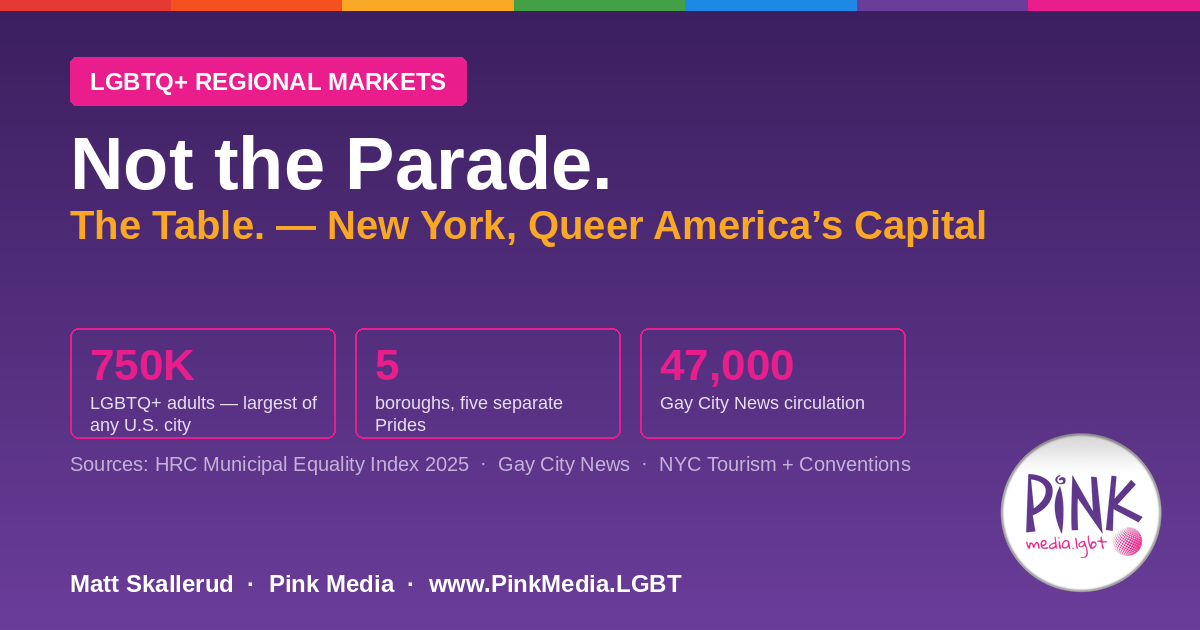
Roughly 750,000 LGBTQ+ adults live here — the largest such population of any American city. They are not standing on Christopher Street. Hell's Kitchen and the West Village in Manhattan, yes. But also Park Slope and Bushwick in Brooklyn, Jackson Heights in Queens — plausibly the most linguistically diverse LGBTQ+ neighborhood in the country — Harlem, and genuinely emerging scenes in the South Bronx and Staten Island. Plus Fire Island, which functions as the market's summer annex from May through September.
Each of those has its own gatekeepers, its own organizations, its own media moments. A plan that treats "New York" as one buy running below 14th Street has bought the most expensive sliver of the largest LGBTQ+ market in the country.
The Default New York Plan
- Manhattan below 14th Street, June only
- One parade contingent, one weekend
- National creative, dropped in unchanged
- Young, white, male-coded imagery
The Plan That Works Here
- All five boroughs, with Jackson Heights and Harlem funded like Chelsea
- June anchor plus Fire Island, Bushwig, NewFest and the fall galas
- Local community press and the national outlets, both
- Creative that includes elders and recent arrivals
Five Boroughs, Five Prides — and Eight Other Months
The calendar here is the deepest in the country, and the mistake is spending it all in one week.
| When | What | Why It Matters to a Plan |
|---|---|---|
| May 28–June 1 | NewFest Pride | The film-festival organization's Pride edition — culture programming ahead of the crowd. |
| May 30 | Staten Island Pride | The borough most national plans have never once considered. |
| June 7 | Queens Pride | The city's second-oldest Pride, in Jackson Heights. Enormously diverse, deeply local. |
| June | Brooklyn Pride (30th anniversary) · Bronx Pride | Brooklyn's Twilight March is a signature night-time moment with its own visual identity. |
| June 26–28 | PrideFest · Pride Island | The festival and music side of the weekend, with distinct audiences from the march itself. |
| June 27 | Harlem Pride | A separate, historically Black Pride with its own media ecosystem and partners. |
| June 28 | NYC Pride March (Heritage of Pride) | Down Fifth Avenue, past Stonewall. The world's biggest stage — and the most crowded one. |
| May–September | Fire Island season · July 4 Invasion of the Pines | Twelve weekends of concentrated audience. Almost nobody buys it properly. |
| September | Bushwig | Brooklyn drag and music at scale. The most culturally credible weekend on the list. |
| October 15–27 | NewFest | The country's largest LGBTQ+ film festival. Sponsorship here reads as cultural investment, not advertising. |
| Fall | AIDS Walk · Broadway Cares · Center Dinner · GLAAD Awards | The giving circuit. A gala table is a marketing channel in this city, and everybody in the room knows who bought one. |
Use June as the anchor. Don't use it as the plan. Bushwig, NewFest, Fire Island and the fall galas are precisely what separates the year-round brands from the tourists — and this audience makes that distinction out loud.
The Only Market With Two Media Layers
New York is unique in this respect, and it's worth planning around deliberately rather than accidentally.
Layer one — the local community press
Gay City News is the largest LGBTQ+ newspaper in the United States at roughly 47,000 circulation. GO Magazine is the nation's most-read free lesbian publication. Get Out! covers nightlife weekly. This is where a brand builds actual community presence, and where a local audience decides whether you're a neighbor or a visitor.
Layer two — the national press, headquartered here
Out, The Advocate, them and GLAAD all operate from New York, and the GLAAD Media Awards happen here. This is industry visibility — the layer that decides how your LGBTQ+ work is described to everyone else in the country.
The consequence nobody plans for
Because both layers share a city, what a brand does in New York gets covered nationally by default. A thin activation here doesn't just underperform locally — it becomes the example in someone's think piece. Conversely, real work here travels further than the same work anywhere else.
The Institutions Are the Proof of Seriousness
If you want to know where a sponsorship dollar does the most work in this market, it's here — and the depth of the bench is genuinely remarkable.
The LGBT Community Center, founded in 1983, is the building where both ACT UP and GLAAD were born. SAGE, founded in 1978, is the largest U.S. organization serving LGBTQ+ elders — and New York has the country's largest LGBTQ+ senior population. GMHC, founded in 1982, was the world's first HIV/AIDS service organization and still runs testing, prevention, meals, housing, legal and mental-health services, plus AIDS Walk New York. Callen-Lorde has spent more than fifty years building what's fairly described as a global model for LGBTQ+ community healthcare.
Then the organizations most national plans have never heard of, which is exactly why they're worth funding: the Ali Forney Center, the largest provider for homeless LGBTQ+ youth in the country; the Hetrick-Martin Institute; Destination Tomorrow in the South Bronx; the Pride Center of Staten Island; and nglccNY, the largest LGBTQ+ supplier-diversity chamber pipeline in the country — which, if you have a procurement team, is a second door into this market entirely.
"In Florida, a perfect equality score is a plot twist. In New York, it's the least interesting fact about the market — and that itself tells you how to market here."
A Refuge Market, Too
This part gets less attention than it should, because people assume the refuge story is only about the South and the Midwest.
New York added gender identity to its state human-rights law with GENDA in 2019, passed a Safe Haven Law in 2023 barring cooperation with out-of-state investigations into gender-affirming care, and expanded those shield protections in 2025 to among the strongest in the country. In 2026 the city stood up an Office of LGBTQIA+ Affairs.
Which produces a specific creative brief that most brands get wrong. This market contains the largest LGBTQ+ senior population in the country and a steady flow of people arriving from states that became unlivable for them. Both groups are badly served by creative built around 24-year-olds at a festival. If your New York work can't speak to a 70-year-old in Park Slope and a family that just moved from Tennessee, it's reaching a narrower slice than the media plan implies.
Seven Rules for This Market
The region guide lays these out in full. Here's the working version.
1. Substance over spectacle. Funded services and multi-year commitments outperform one-weekend activations — and in this market, people can tell which one they're looking at.
2. Go borough-deep. Jackson Heights, Park Slope, Bushwick, Harlem and the South Bronx each have distinct gatekeepers and media moments. Manhattan-only is not a New York plan.
3. Work both media layers. Local press for community presence; national outlets for industry visibility. They cost different things and do different jobs.
4. Respect elders and newcomers. The largest senior population in the country and a continuing refuge arrival — both underserved by youth-only creative.
5. Join the giving circuit. AIDS Walk, Broadway Cares, the Center Dinner, the GLAAD Awards. A gala table is a marketing channel here, with a room full of decision-makers attached.
6. Use June as the anchor, not the entire plan. Fire Island, Bushwig, NewFest and the fall galas are where year-round brands separate themselves.
7. Remember accountability. What you do in New York gets covered nationally, because the national press works here. That cuts both directions.
The practical version: take whatever you were going to spend on a single June weekend in Manhattan and split it three ways — one borough Pride outside Manhattan, one non-June cultural moment, and one funded commitment to an organization that will still be doing the work in March. That plan costs the same, reaches more of the market, and is the version this city actually notices.
The Takeaway
New York is not just a market. It's the community's capital city — the place where the modern movement started in June 1969, where the first National Park LGBTQ+ Visitor Center opened at Stonewall in 2024, and where what works gets exported everywhere else.
That's the opportunity and the exposure in the same sentence. The bar here isn't whether you'll show up — everyone shows up. It's whether you're still around in February, whether you made it to Queens, whether you bought the table, whether you took the ferry.
New York doesn't need another brand at the parade. It needs brands at the table. Show up where the community actually lives, and the world's biggest stage takes care of itself.
Our LGBTQ+ New York Region Guide goes deeper on all of it — the history, the refuge framework, the media landscape, the equality scorecards, the institutions and the full playbook. And the broader 2026 LGBTQ+ Marketplace Guide covers the national picture this market sits inside.
- LGBTQ+ New York Regional Guide — Editorial Summary — Pink Media. The full regional breakdown: the history, the five-borough map, the refuge framework, the media landscape, the equality scorecards, the institutions and the seven-rule playbook.
- Municipal Equality Index — Human Rights Campaign Foundation. New York's 2025 perfect 100 and the category-by-category scoring.
- Gay City News · GO Magazine · Get Out! — the local community press layer.
- The LGBT Community Center · SAGE · GMHC · Callen-Lorde — the anchor institutions.
- Ali Forney Center · Hetrick-Martin Institute · Destination Tomorrow · Pride Center of Staten Island · nglccNY — the organizations most national plans miss.
- NYC Tourism + Conventions — LGBTQ+ NYC · I LOVE NY LGBTQ+ — the destination hubs, including the statewide program running since 2012.
- Stonewall National Monument · NewFest · NYC Pride / Heritage of Pride — the history and the calendar.
- Pink Media's 2026 LGBTQ+ Marketplace Guide — the national market landscape, categories and year-round calendar.