I've been working at the intersection of LGBTQ+ media and marketing since 1995, and film and television have always been at the center of it. Long before most brands paid attention to our community, queer audiences were finding each other through the films and shows that reflected them. A good LGBTQ+ film was never just entertainment. It was proof that we existed.
That's why our new LGBTQ+ Film & TV Market Guide starts with a simple idea: representation is the product this industry actually makes. And in 2026, that product is in an unusual spot.
We've seen global queer hits, a Best Picture win for Moonlight, and the most visible LGBTQ+ creators in history. We're also seeing studio inclusion fall and queer series cancelled at a striking rate. Both things are true at once.
The Numbers: Fewer Stories on Screen
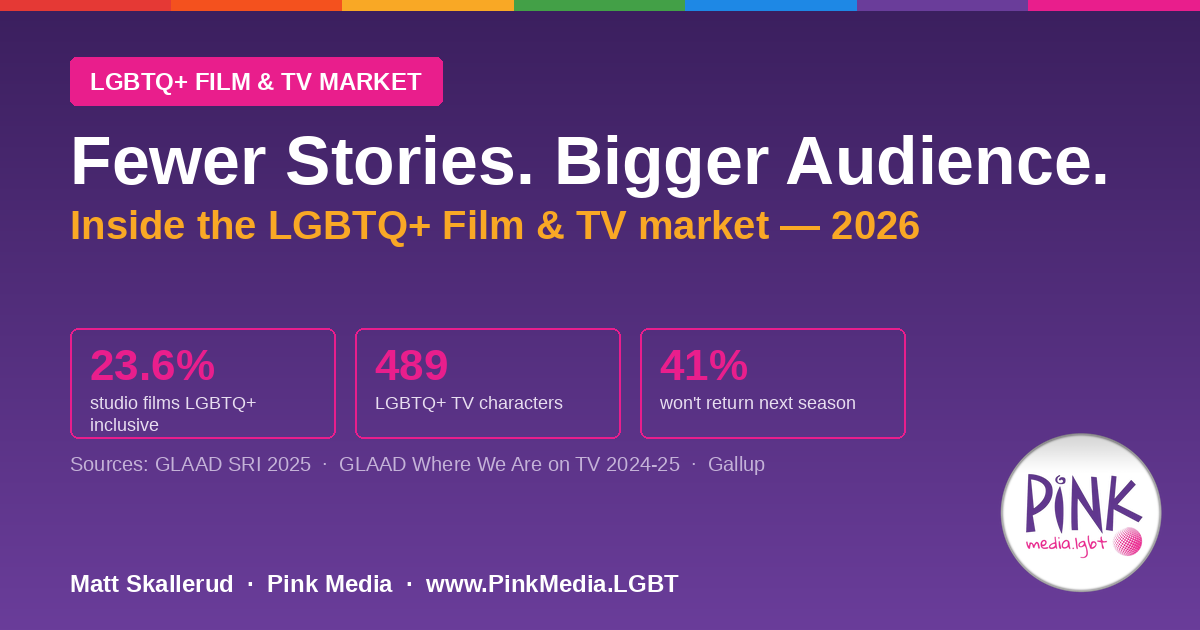
Every year, GLAAD measures how the major studios are doing. Its 2025 Studio Responsibility Index looked at 250 films released in 2024 by 10 major distributors. Only 23.6% included an LGBTQ+ character. That's down from 27.3% the year before and a record 28.5% in 2022.
The details are tougher still. Only two of those 250 films included a transgender character. And 37% of LGBTQ+ characters were on screen for less than a minute, while the share with more than ten minutes of screen time dropped from 38% to 27%.
Television tells a similar story with a twist. GLAAD's Where We Are on TV report for the 2024-25 season counted 489 LGBTQ+ characters on scripted series, up 4%. Streaming carried most of them, with 372 characters across eight major services. But 41% of those characters, roughly 200, won't return because their shows were cancelled, ended as limited series, or wrote them out.
The Audience: Bigger Than Ever
Here's the other side of the ledger. According to Gallup's latest data, about 9% of U.S. adults identify as LGBTQ+, and among adults under 30 it's 23%. Add in the large group of straight allies who seek out and champion queer stories, and you have an audience that is anything but niche.
Our guide describes today's LGBTQ+ viewer in a few clear ways:
- They over-index on streaming, social conversation and fandom. Gen Z and millennial superfans make the edits, the fan art and the campaigns that keep a show alive, and they push back hard when one is cancelled.
- They check the credits. Queerbaiting, hinting at LGBTQ+ storylines without delivering, is now a real commercial risk. Audiences notice, and they talk.
- Cancellations have a cost. When a beloved queer series ends abruptly, it shows up in subscriber goodwill and, often, in churn.
- Viewing is social. Premieres work as community events. Think of how "Long, Long Time," the 2023 episode of The Last of Us, became a shared moment far beyond the show's usual fan base.
The Drag Race universe is a good example of all of this at once: a TV franchise that has grown into its own genre, with a live touring and nightlife economy built around it.
"Studios are making fewer LGBTQ+ stories at the exact moment more young people than ever see themselves in those stories. That isn't just a representation gap. It's a market gap."
The Makers and the Keepers
The guide profiles two people who show the range of what it takes to build LGBTQ+ screen culture.
The Maker: Ryan Murphy
- Producer behind Glee, American Horror Story, Feud and Pose
- Pose brought together the largest cast of transgender actors in series regular roles in TV history
- Billy Porter won the Emmy for Lead Actor in a Drama, and MJ Rodriguez won a Golden Globe for the role of Blanca
The Keeper: Jenni Olson
- Filmmaker, historian and former co-director of the Frameline festival
- Co-founder of PopcornQ and author of The Queer Movie Poster Book
- The Harvard Film Archive acquired her queer film collection in 2020
I like this pairing because it reminds us that the industry needs both. Someone has to make the work, and someone has to make sure it's still there for the next generation to find.
The Festival Circuit: Where Queer Cinema Is Found
LGBTQ+ film festivals have always done two jobs. They're where distributors and streamers discover new work, and they're year-round communities with loyal members. The major names include:
| Festival | City | Why It Matters |
|---|---|---|
| Frameline | San Francisco | Founded in 1977, the oldest and largest LGBTQ+ film festival |
| Outfest | Los Angeles | Industry-facing festival in the heart of the business, now rebuilding |
| NewFest | New York | East Coast hub for premieres and industry screenings |
| Reeling | Chicago | One of the longest-running LGBTQ+ festivals in the U.S. |
| BFI Flare | London | The UK's leading queer film festival |
| Inside Out | Toronto | Canada's largest LGBTQ+ film festival |
| Teddy Award | Berlin | The Berlinale's official queer film prize |
Outfest's story is worth paying attention to. The Los Angeles nonprofit went through a financial and structural collapse in 2023, laid off staff and paused its programming. It has since rehired a team, seated a new board and relaunched as OutfestNEXT in November 2025, in partnership with HBO Max. The lesson: this infrastructure is fragile, but it can be rebuilt when the industry decides it matters.
There's a historical pattern here too. The Hays Code era, the backlash of the 1980s and other difficult periods all pushed LGBTQ+ filmmakers to create outside the system. The New Queer Cinema movement of the early 1990s grew out of exactly that kind of moment. The current dip in studio inclusion may well produce something similar, and the festivals are where we'll see it first.
What Winning This Audience Looks Like
The guide closes with four practical moves for studios, streamers, distributors and brands that want to connect with LGBTQ+ viewers:
Show Up Honestly
- Market the authenticity you actually have. Don't oversell representation. This audience will check.
- Treat premieres as community events. Festival premieres, screenings at queer venues and watch nights build word of mouth that paid media can't buy.
Show Up Where They Are
- Buy media where the audience already is. LGBTQ+ publishers, creators, video and connected TV, geo-targeted to theatrical and festival markets.
- Support the infrastructure, not just the content. Festivals, restorations, archives and filmmaker labs are what keep the pipeline full.
For Films Already Out There: Getting Them Seen
Much of the great LGBTQ+ work being made today never reaches a studio slate at all. It's released by independent distributors, LGBTQ+ streaming services and filmmakers themselves, and it rarely gets the daily video promotion that mainstream releases receive. Since 2022, Meta also no longer allows ad targeting based on interest in sexual-orientation topics, which makes reaching the right viewers harder. I wrote about this in more detail in Made, Released, Unseen.
To help, we've put together a set of LGBTQ+ film marketing packages built on four pieces: a featured review on ILoveGay.NET, vertical video reels cut from the trailer, posts across LGBTQ+ media partners, and a paid social campaign with one clear call to action showing viewers where to rent, buy or stream. They're organized around the three lives of a film:
| Stage | Built For | Goal | Starting At |
|---|---|---|---|
| Act I: Release Launch | New theatrical or digital releases | Opening-week rentals and sales | $2,500 |
| Act II: Subscription Partner | LGBTQ+ streaming services and distributor channels | New subscribers and free trials | $3,000 / month |
| Act III: Rental Spotlight | Independent, festival and catalog titles | Visibility and rentals | $2,000 |
Paid media is included in each package, the filmmaker approves every reel, and paid reviews are clearly labeled as sponsored. Reports cover reach, views, cost per view and tracked clicks to each watch link.
And What Else?
Every one of our market guides ends with the same question: and what else? For film and TV, I think the answer is that the audience has already made its choice. LGBTQ+ viewers, and the allies watching with them, want stories that are real, and they'll show up in big numbers for the ones that get it right. The studios that see this dip as an opening, rather than a trend to follow, are the ones that will win this decade's most loyal fans.
About this research. Representation figures come from GLAAD's 2025 Studio Responsibility Index (films released in 2024) and GLAAD's Where We Are on TV report for the 2024-25 season. Audience figures come from Gallup's 2025 LGBTQ+ identification data, published February 2026. Festival and creator details come from public sources. The full 16-chapter LGBTQ+ Film & TV Market Guide covers queer screen history, representation data, a filmmaker map, a canon of films and series, archives, streaming and distribution, and 2024-2026 campaign spotlights. For how LGBTQ+ viewers use streaming, see our post on the Nielsen LGBTQ+ streaming audience.
- LGBTQ+ Film & TV Market Guide 2026 — Editorial Summary — Pink Media.
- GLAAD's 13th Annual Studio Responsibility Index Finds LGBTQ Inclusion at Three-Year Low — GLAAD, June 11, 2025.
- 2025 Studio Responsibility Index (full report, PDF) — GLAAD.
- Nearly Half of All LGBTQ+ Characters Will Disappear From TV Next Season, GLAAD Study Finds — TheWrap.
- Gallup survey: 9% of U.S. adults identify as LGBTQ+ — Joe.My.God., February 16, 2026 (Gallup data).
- Outfest returns in 2025 with OutfestNEXT — Q Voice News, September 30, 2025.
- Jenni Olson Queer Film Collection — Harvard Film Archive.
- LGBTQ+ Film Marketing Packages — Pink Media.
- Made, Released, Unseen: Why Great LGBTQ+ Films Have a Discovery Problem — Pink Media blog.