I've watched a lot of LGBTQ+ film over the years. When we launched GayWired back in 1995, getting your hands on a gay film often meant a trip to a specialty video store or a mail-order catalog. Today the opposite is true. There's an enormous library of high-quality LGBTQ+ films sitting on Amazon, Apple TV, Hulu, Roku and dedicated LGBTQ+ streaming services, available any night of the week.
And most of it goes unseen.
Our team at Pink Media recently spent time studying why, and the answer turned out to be simpler than I expected. It isn't the films. It's discovery.
Mainstream films are marketed to viewers. LGBTQ+ films mostly wait for viewers to come looking.
How Most People Find an LGBTQ+ Film Today
Think about how a major release reaches you. The studio or network cuts its trailer into short vertical clips and runs them as reels on Facebook, Instagram, TikTok and YouTube for weeks before and after release. Some independent filmmakers do a version of this for their own work, on a much smaller budget.
LGBTQ+ films mostly go without it. So viewers do the work themselves. They open Netflix, Hulu, Amazon or Roku, type "LGBTQ" or "gay" into the search bar, and scroll through whatever the algorithm decides to surface. If you didn't already know a film existed, there's a good chance you'll never hear about it.
That's a loss for viewers, and it's a real business problem for the distributors, streaming services and filmmakers who invested in getting those films made and released.
Why It Got Harder After 2022
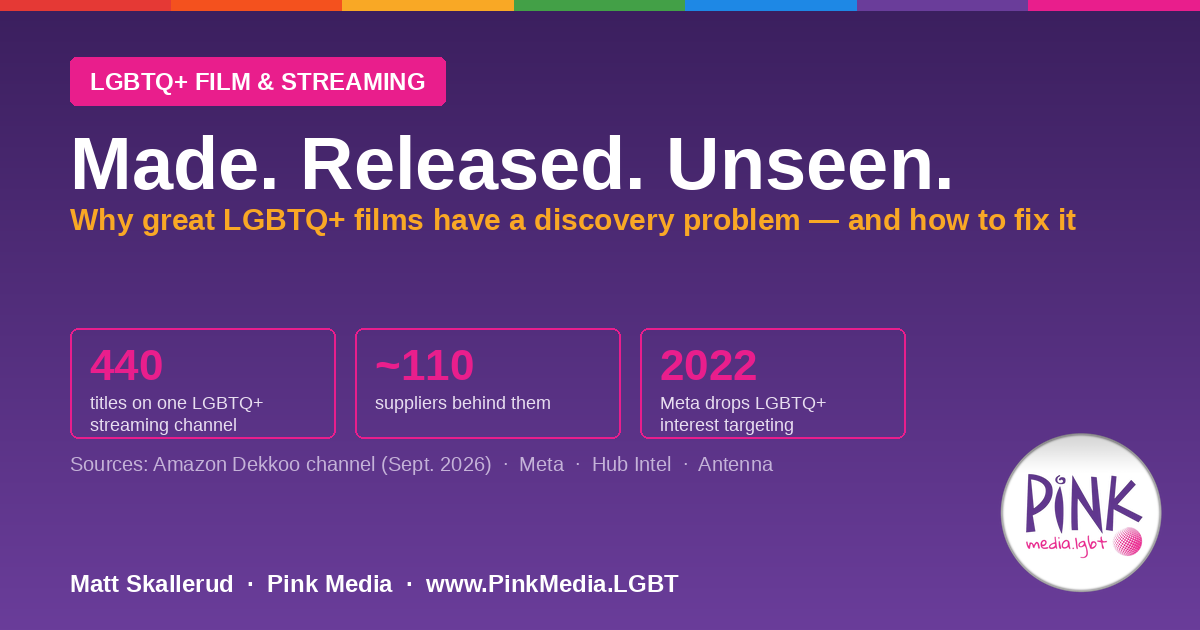
For years, the workaround was paid social. A distributor could run a trailer on Facebook and Instagram and target people interested in LGBTQ+ topics. That option went away. Meta announced in late 2021 that it would remove detailed targeting tied to sensitive topics, including sexual orientation, and the change took effect on January 19, 2022. The examples it gave were "same-sex marriage" and "LGBT culture."
There were good privacy reasons for the change. But the practical result for film marketers is that a trailer for a gay romance now has to find its audience the same way a trailer for a superhero film does, with far less money behind it. Distributors still have marketing budgets. What they've lost is a direct line to the audience most likely to care.
The audience didn't go anywhere, of course. It's still reading LGBTQ+ publications, following LGBTQ+ creators and engaging with LGBTQ+ community pages every day. The route to it just runs through those channels now, not through an interest checkbox.
A Look Inside One LGBTQ+ Streaming Catalog
To understand who's actually behind these films, we looked closely at one of the best-known LGBTQ+ streaming services. Dekkoo launched in Philadelphia in 2015, grew out of the long-running gay film label TLA Releasing, and is sold for $9.99 a month on its own apps and as an add-on channel on Amazon Prime Video and other platforms. Its founders told the Philadelphia Inquirer back in 2017 that the service was profitable almost from the start. It's a good example of a focused, well-run niche streamer.
On September 29, 2026, we captured the "Studio" credit on every title in the Dekkoo channel on Amazon in the U.S. Here's what we found.
About a third of the catalog (roughly 35%) comes from Dekkoo's own companies, TLA Releasing and Dekkoo Films. Everything else comes from a wide range of outside suppliers:
| Supplier Type | Titles | Examples |
|---|---|---|
| In-house (TLA Releasing + Dekkoo Films) | 152 | TLA Releasing (101), Dekkoo Films (51) |
| Independent filmmakers (self-credited) | ~80 | Directors and producers distributing their own work |
| LGBTQ+ specialist distributors | 58 | Dark Star Pictures, Breaking Glass Pictures, Here TV, NQV Media, Altered Innocence |
| Sales agents & aggregators | 37 | Companies that deliver titles on behalf of rights holders |
| Indie & art-house distributors | 34 | Film Movement, Strand Releasing, Oscilloscope, Music Box, Kino Lorber |
The takeaway for me was the size of that long tail. Behind one LGBTQ+ streaming channel sit dozens of distributors and close to a hundred independent filmmakers, each with a film that needs an audience, and very few with the tools to reach one.
How we counted. The studio credit on Amazon shows whoever delivered the file, which may be a sales agent rather than the rights holder, and Amazon search can miss some titles. One large supplier credited mostly on short films (71 titles) isn't shown above because we couldn't confirm what kind of company it is. The supplier groupings are ours, not Amazon's.
Why Amazon Channels Changes the Math
Where people subscribe matters too. According to Hub Intel research reported by Señal News, 91% of niche streaming subscriptions in Q2 2024 were acquired through an aggregator, and 58% of those came through Amazon Channels. Antenna data reported by StreamTV Insider put Channels at 25% of all U.S. streaming sign-ups in early 2025.
That reach is great for small services. The trade-off is that Amazon owns the shelf and the customer relationship. Inside a store with hundreds of thousands of titles, a film that nobody is talking about outside the store is very hard to find inside it. Marketing has to happen out in the world, where viewers actually spend their time, and then point them to the exact place to press play.
"Great LGBTQ+ films don't have a quality problem. They have a 'nobody told me it existed' problem. Fix the telling, and the watching follows."
Every Film Has Three Lives
One thing the research made clear is that there's no single "LGBTQ+ film campaign." A film's needs change depending on where it is in its life, and so does who pays for the marketing.
| 1. New Release | 2. Subscription Title | 3. Rent-Only Title | |
|---|---|---|---|
| Where it lives | Theaters and/or a rent/buy launch on Apple TV, Amazon, Google Play | Dekkoo, OUTtv, Here TV or a distributor's own subscription service | Rent or buy only, no subscription deal |
| Who usually pays | The distributor, sometimes the filmmaker | The streaming service | Independent filmmakers, small labels, older catalog titles |
| The goal | Opening-week rentals, sales and press | New subscribers and free-trial sign-ups | Visibility |
| Timing | Tied to a release date | Ongoing, month to month | Flexible: Pride, holidays, a cultural moment |
Match the campaign to how the film earns money
This is the part I think gets overlooked. When a distributor licenses a film to a subscription service, it's usually paid a flat fee for a set period. Extra views on that service don't earn it anything more. Its upside is in rentals and purchases. A streaming service, on the other hand, cares about new sign-ups.
So a good campaign shows viewers every way to watch, in the order that serves the client:
- Rent or buy it online on Amazon, Apple TV, Google Play and others
- Subscribe on the company's own website, where it offers a subscription
- Subscribe to its channel on Amazon Prime Video or another major platform
The Solution: Content as Advertising, Built for Film
This is where Pink Media comes in, and why we've put together a dedicated set of LGBTQ+ film marketing packages for distributors, streaming services and independent filmmakers. The idea behind them is the same "Content as Advertising" approach we've used for years: start with the film's own story, and run it across the channels where LGBTQ+ viewers already are.
Every campaign is built from four pieces:
The Story
- A featured review on ILoveGay.NET: a searchable, lasting home for the film
- Video reels cut from the trailer and clips, in vertical format for Facebook, Instagram, TikTok and YouTube
The Reach
- Media partner posts from LGBTQ+ sites, blogs, creators and influencers focused on film and TV
- A paid Meta, TikTok and YouTube campaign with one call to action: where to watch
Because the content is already running on LGBTQ+ channels, the paid campaign doesn't need sexual-orientation targeting to find the right people. The audience comes with the channel.
Three packages for three stages
| Package | Built For | What's Included | Price |
|---|---|---|---|
| Act I: Release Launch | New releases, theatrical or digital | Spotlight: review, 3 reels, network posts, $1,000 paid media Launch: plus a 2–3 week campaign timed to release, $3,500 paid media Premiere: plus 6–8 reels, a podcast interview, 4-week campaign, $7,500 paid media | $2,500 $5,000 $10,000 |
| Act II: Subscription Partner | Streaming services | 2–4 titles a month, each with 3 reels, a review and network posts, plus a 2–3 week paid campaign each month | $3,000–$7,500 / month |
| Act III: Rental Spotlight | Catalog, indie and festival titles | Single title: review, 3 reels, network posts, $750 paid media Catalog Relaunch: a themed push across several titles | $2,000 Custom |
Distributors that commit a full year of releases save 15–20% per title. Paid media is included in the package prices. You can see the full details on the film marketing packages page.
The ground rules
Film is a creative business, and filmmakers rightly care about how their work is presented. So a few things are fixed:
- You own the edit. The client supplies the trailer, clips and stills, and approves every reel before it runs.
- Ad-safe clips. Meta and TikTok often reject ads with nudity or sexual themes, so clips are chosen to pass ad review the first time.
- Honest labeling. Paid reviews are marked as sponsored, as FTC endorsement rules require. We guarantee coverage, not a positive review.
- Honest reporting. You get reach, video views, cost per view, tracked clicks to each watch link, and free-trial sign-ups where the platform supports tracking. We don't promise rentals or sales, because the stores don't share reliable click-to-purchase data.
Who This Is For
Distributors & Streamers
- LGBTQ+ distributors with a steady release slate
- Art-house labels with LGBTQ+ titles in the mix
- LGBTQ+ streaming services building subscribers
- Distributors running their own subscription channels
Independent Filmmakers
- Self-distributed films available to rent or buy
- Festival-circuit titles heading to digital
- Older films ready for a second life
- Anyone who's tired of hoping the search bar does the work
The Films Are Already Here
What strikes me most about this research is how much good work is already finished, released and available. Nobody needs to make another film for LGBTQ+ viewers to have something great to watch this weekend. They just need someone to tell them it's there, and where to press play.
That's a solvable problem. It's also, honestly, one of the more enjoyable ones we get to work on.
About this research. Catalog figures come from the studio credits on Amazon's U.S. Dekkoo channel, captured September 29, 2026. Dekkoo company details come from public reporting. Market data comes from Hub Intel (via Señal News) and Antenna (via StreamTV Insider). The three-stage model and package details are Pink Media's own. For more on reaching LGBTQ+ audiences across categories, see our LGBTQ+ Marketplace Guide, and for how LGBTQ+ viewers use streaming, our post on the Nielsen LGBTQ+ streaming audience.
- LGBTQ+ Film Marketing Packages — Pink Media. Package details, pricing and process.
- Updating Meta's Detailed Targeting Options — Meta for Developers, December 8, 2021.
- Meta will remove ad targeting categories on sexual orientation, health and more — Gizmodo, November 2021.
- Amazon Channels emerges as strategic growth lever for niche streamers — Señal News, May 29, 2025 (Hub Intel data).
- SVODs average 5.6M more subs through Amazon Prime Video Channels — StreamTV Insider, June 30, 2025 (Antenna data).
- Dekkoo — Wikipedia.
- Philly-based streaming services serving the G in LGBT — The Philadelphia Inquirer, June 2017.
- Amazon is rebuilding cable, and right now that's great for indie film — SNR Films.
- Amazon.com U.S. Dekkoo channel title pages, studio credits captured September 29, 2026 — Pink Media analysis.
- LGBTQ+ Marketplace Guide — Pink Media.