
I read the new Destinations International and IGLTA toolkit the week it came out, and I want to be clear about something before I say anything else: it's good. Not good-for-a-trade-association good. Actually good.
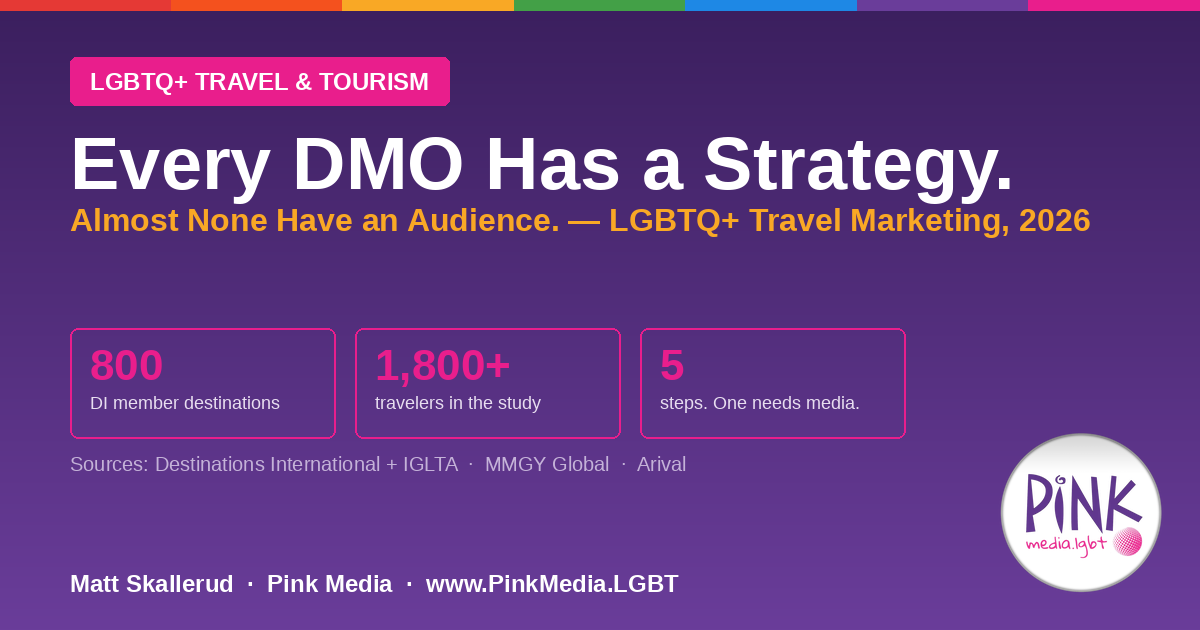
Why Values Matter: A Destination Guide to LGBTQ+ Travelers launched on May 20, 2026, supported by the Destinations International Foundation and the IGLTA Foundation. It's built on Valuegraphics research with more than 1,800 LGBTQ+ travelers from key international markets considering U.S. travel — which is a real sample, from real markets, measuring real inbound intent rather than Pride-week enthusiasm. It identifies three power values: Harmony, Health & Well-Being, and Balance. And it gives destinations a five-step path to act on them.
Meg Ten Eyck, IGLTA's board chair, framed the finding simply: LGBTQ+ travelers "naturally seek out places where they can truly be themselves." Don Welsh at Destinations International put the destination side of it: "creating environments where all travelers feel genuinely welcomed and represented is essential."
I agree with all of it. I've been making a version of that argument since 1995.
So here's my problem — and it isn't with the toolkit.
Strategy Just Became Free. Distribution Didn't.
Destinations International welcomed its 800th member at its Portland convention in July. IGLTA runs a B2B network of 11,000+ tourism professionals across more than 80 countries. Between the two organizations, an enormous number of destination marketers just received the same research, the same three values, and the same five steps, in the same twelve months.
That's a win for the community. It's also a fact about competitive dynamics that I don't think has fully landed yet: when a strategy framework becomes free and universal, it stops being a strategy and starts being table stakes.
Two years from now, "we have an LGBTQ+ travel strategy" will be as differentiating as "we have a website." Every CVB in the room will be able to say it. Many of them will be able to say it using the same three words — Harmony, Health & Well-Being, Balance — because they all read the same excellent document.
Strategy is the cheap part now. It's downloadable, it's peer-reviewed, and it costs a destination nothing but an afternoon. Distribution — actually getting a message in front of LGBTQ+ travelers, and being able to prove you did — is the part that still costs money, still requires partners, and still separates destinations that grow this market from destinations that merely have a position on it.
— Matt Skallerud, Pink Media
Step One Is Where It Quietly Breaks
The five-step framework in the toolkit is sensible and correctly ordered. Here it is, with what I'd add in a third column — the part that decides whether a step actually happens.
| The Toolkit Step | What It Asks For | What Execution Actually Requires |
|---|---|---|
| 1. Marketing representation | LGBTQ+ people visible in destination creative | Media placements where LGBTQ+ travelers will actually see it — which no longer exist as a checkbox inside the major ad platforms |
| 2. Training & policies | Front-line staff and partner businesses prepared | Budget, scheduling, and buy-in from hotels and attractions the DMO doesn't control |
| 3. Support LGBTQ+-owned business | Local queer-owned operators promoted and included | An itinerary and content program that gives those businesses somewhere to appear |
| 4. Embed community voices | LGBTQ+ residents inside tourism planning | Ongoing relationships with local orgs, not a one-time advisory panel |
| 5. Measurement & storytelling | Track it, then tell the story | Verifiable audience data — which broad, automated ad delivery cannot give you |
Look at rows one and five. Both of them terminate in the same place: you need a channel with a known audience. Not a hoped-for audience. A known one.
And that is precisely the thing that has gotten harder every year since 2022.
The Channel Problem Nobody Put in the Toolkit
I've written about this at length elsewhere, so I'll keep the summary tight — but destination marketers in particular need to hear it, because your category is named in the policy language.
On January 19, 2022, Meta removed detailed targeting options tied to sensitive topics, sexual orientation among them. The interest selections travel marketers had used to reach LGBTQ+ audiences on Facebook and Instagram stopped existing, and the years since have been a steady consolidation of manual controls into AI-driven broad delivery.
Google's personalized advertising policy goes further than most people realize. Advertiser-curated audiences — your own customer list, your own segments, lookalikes built from them — cannot be used to promote sexual-orientation-related content. And one of Google's own stated examples of that content category is "gay travel."
Read that again if you run a destination. The single most-cited example in the restriction is your line of business.
A destination can now adopt a research-backed LGBTQ+ strategy on Monday and discover on Tuesday that there is no parameter inside the major ad platforms that means "reach LGBTQ+ travelers." The strategy is finished. The media plan hasn't been started.
None of this is a conspiracy against our community, and I don't argue it that way. Orientation-based targeting can be turned against the people it describes — that risk is real, and the platforms are not wrong to take it seriously. But the commercial consequence is unchanged: legitimate destinations that want to reach LGBTQ+ travelers lost the mechanism, and the community lost the ad revenue that flowed through it.
What the Deck Gives You vs. What a Media Plan Gives You
The Strategy Framework Alone
- A defensible internal position on why this market matters
- Language for the board deck and the annual report
- Training and policy direction for partner businesses
- A values vocabulary shared with 800+ peer destinations
- No audience. No placements. No reach data.
- Nothing that a competing destination can't also download
A Media Plan Built On It
- Placements inside LGBTQ+ publications and creator channels with known audience composition
- Contextual placement where the editorial environment does the qualifying
- A first-party LGBTQ+ visitor list the destination owns outright
- Year-round presence instead of a June flight
- Published, structured content that AI assistants can retrieve and recommend
- Reach and engagement numbers you can put in front of a board
Why This Traveler Justifies the Line Item
If you're the person who has to defend an LGBTQ+ media budget internally, the values research is your why. The spending research is your how much.
Arival's work on experiences is the cleanest data I've seen on yield. LGBTQ+ travelers spend about $213 on attractions versus $152 for other travelers, $372 on activities versus $288, and average roughly seven experiences per trip compared with four. Three-quarters take tours, and they take about double the number. They're nearly twice as likely to leave an online review and 25% more likely to post video — which means the in-destination spend comes with earned distribution attached.
And on the decision itself: more than 66% say they prioritize destinations and brands welcoming to LGBTQ+ people and people of color, compared with 39% of other travelers.
MMGY Global's portrait of American LGBTQ+ travelers adds the part every destination in a contested state already suspects: 52% say state politics greatly impact their travel decisions, half say destination safety is a concern, and 43% say inclusive destination marketing is very or extremely important to them. That last number is the one I'd put on the wall. Nearly half this audience is explicitly telling you they're watching your marketing for evidence — and marketing they never see can't function as evidence.
Five Things to Build Before the Framework Means Anything
1. Buy where the audience composition is already known. LGBTQ+ publishers, media outlets and creators can tell you who their audience is, and you can document it. That's the practical replacement for the targeting parameter you lost — and unlike a platform setting, nobody can remove it in a policy update.
2. Take contextual placement seriously again. When an ad runs inside LGBTQ+ editorial, the environment does the qualifying for you. It's the one buying method that has been strengthened, not weakened, by every privacy and policy change since 2020.
3. Build a first-party LGBTQ+ visitor asset. An email list, a dedicated landing page, an itinerary hub, a content series. Assets you own can't be deprecated. Most destinations have a general visitor list and nothing segmented — that's a gap you can close this quarter.
4. Fund twelve months, not one. Harmony, Health & Well-Being and Balance are judgments a traveler makes about your place, over an entire trip. You cannot demonstrate any of the three with a June campaign. Year-round presence is the format the research is asking for — 24/7, 365 — even if the toolkit doesn't say it in those words.
5. Publish for the recommendation layer. A growing share of travelers now ask an AI assistant which destinations are genuinely welcoming. Those answers get assembled from published content — editorial coverage, structured data, community media presence — not from your ad account. If your LGBTQ+ story lives only in a strategy document on a shared drive, it is invisible to the fastest-growing discovery channel in travel.
The Takeaway
Destinations International and IGLTA did the field a real service. The research is sound, the values framing is the right framing, and putting it in front of hundreds of destinations for free was exactly the correct move.
But a playbook distributed to everyone creates a very specific kind of gap — and it's the gap between the destinations that will treat this as a document and the destinations that will treat it as a brief.
The ones treating it as a document will add a slide, update a page, sponsor a Pride, and report the strategy as complete. The ones treating it as a brief will ask the harder question: where does this actually run, who will actually see it, and how will we prove it?
That second question doesn't have a free answer. It never did. But it's the one that turns Harmony, Health & Well-Being and Balance from a set of values into a set of visitors.
Our LGBTQ+ Travel Market Guide covers the destination side of this market in depth, and the 2026 LGBTQ+ Marketplace Guide covers the broader media landscape and the year-round calendar.
- Destinations International and IGLTA Launch LGBTQ+ Tourism Toolkit — Destinations International, May 20, 2026. The Why Values Matter launch, the three power values, the five-step framework, and the Discover Puerto Rico and Jaipur case studies.
- Destinations International Welcomes Its 800th Member — Destinations International, July 2026. Membership scale and the Portland convention.
- About IGLTA — International LGBTQ+ Travel Association. 11,000+ members across 80+ countries.
- LGBTQ+ Travelers Do and Spend More on Experiences — Arival. Attraction, activity and tour spend versus other travelers, experiences per trip, and the 66% welcoming-destination preference.
- New Research on American LGBTQ+ Travelers — MMGY Global. State politics, safety concerns, and the importance of inclusive destination marketing.
- Sexual orientation in personalized advertising — Google Ads policy. The advertiser-curated audience restriction and the "gay travel" example.
- Harmony, Health & Balance: The New DI + IGLTA Research — ILoveGay.NET. Further reading on the values framework.
- The Targeting Is Gone. The Audience Isn't. — Pink Media. The full platform-policy timeline behind the channel problem.
- Why Travel Is the Outlier Vertical · LGBTQ+ Travel Market Guide · 2026 LGBTQ+ Marketplace Guide