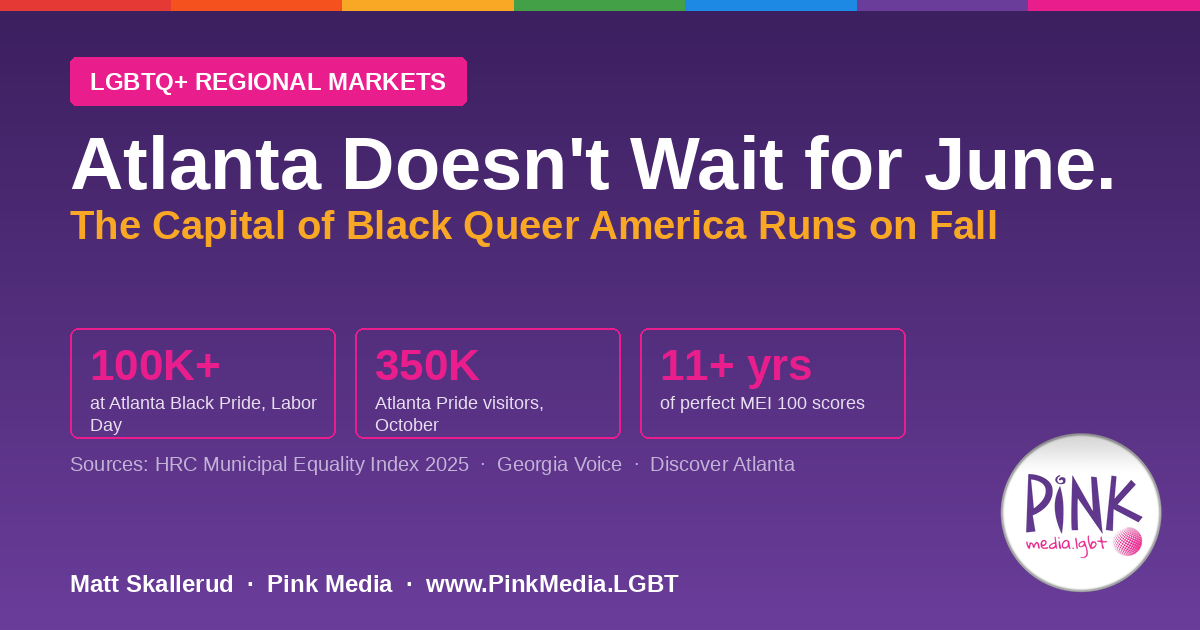
Atlanta just wrapped the biggest six weeks on its LGBTQ+ calendar. Black Pride over Labor Day. Out On Film from late September into October. Atlanta Pride down Peachtree on October 10–11. If your LGBTQ+ budget was fully spent by the first of July, you just missed the LGBTQ+ capital of the South — completely, and without noticing.
That's the single most important thing to understand about this market, and it's the thread through everything in our LGBTQ+ Atlanta Region Guide. After New York, Chicago and Los Angeles, Atlanta is the one that most directly rewards brands willing to plan differently.
Because this isn't just a big Southern city with a gay neighborhood. In the guide's words: the cradle of the civil rights movement is also the capital of Black queer America.
The Calendar Most National Plans Miss
Atlanta's first Pride march was in 1971. Today the city's peak season sits in a window when most national brands have gone quiet — which is exactly why it's worth so much.
| When | What | Why It Matters to a Plan |
|---|---|---|
| Labor Day weekend (Sept 2–7, 2026) | Atlanta Black Pride | The world's largest Black Pride, anchored by the free Pure Heat Community Festival in Piedmont Park. 100,000+ people. |
| Sept 24–Oct 4, 2026 | Out On Film, 39th year | An Oscar- and BAFTA-qualifying LGBTQ+ film festival. Cultural credibility at a moment with very little competition. |
| October (Oct 10–11, 2026) | Atlanta Pride | Peachtree parade into Piedmont Park, timed to National Coming Out Day. Roughly 350,000 visitors. |
| Fall and holiday season | HRC Atlanta Dinner · Joining Hearts · Toy Party · AIDS Walk Atlanta | The benefit circuit — the HRC Atlanta Dinner is among HRC's largest. A room full of the city's decision-makers. |
Put those together and you get something unusual: a market whose Pride season lines up with the strongest Q4 LGBTQ+ inventory in the country. September and October in Atlanta deliver Pride-scale attention at precisely the point in the year when most brands have already moved on. For 2027 planning, that's the window I'd circle first.
Center Black Queer Atlanta — Not as a Segment
Every market guide we've written includes a rule about cultural specificity. In Atlanta it isn't a rule. It's the market.
Atlanta is the center of Black queer American life, and the city says so itself — the Atlanta Convention & Visitors Bureau explicitly markets "Experience LGBTQ+ Black Culture in Atlanta" as part of its destination offer. Black Pride over Labor Day is the largest in the world. The health organizations doing the most important work here — NAESM, THRIVE SS, Positive Impact Health Centers — were built by and for Black gay, bisexual and same-gender-loving men.
So the brief writes itself, and it's the one most national campaigns still get wrong. If your Atlanta creative is a lightly localized version of a national Pride spot, it's aimed at a minority of the people you're trying to reach. Show up at Black Pride. Fund the organizations built by the community. Cast the creative like you actually looked at the city. And budget for both general LGBTQ+ and Black LGBTQ+ channels, because this market rewards cultural specificity far more than reach alone.
"The cradle of the civil rights movement is also the capital of Black queer America."
A Perfect City Inside a State With No Protections
Like Fort Lauderdale, Atlanta is a case where the state and the city tell two very different stories — and you have to plan for the city while staying honest about the state.
On the state side: Georgia has no statewide LGBTQ+ non-discrimination protections. Protection here comes from city ordinances and corporate policy. In April 2025, Governor Kemp signed SB 36, a Religious Freedom Restoration Act that the ACLU of Georgia and Georgia Equality warned could open the door to discrimination given the lack of state civil-rights backstops. SB 39 bans gender-affirming care coverage for people on state insurance plans, extending 2023 restrictions on care for minors. HRC grouped that session's bills under its "Slate of Hate."
On the city side: Atlanta has held a perfect 100 on HRC's Municipal Equality Index for more than eleven years — the only city in Georgia with a perfect score — with an LGBTQ Affairs office, an advisory board, protective ordinances and funded services, and a mayor's office under Andre Dickens that celebrates the streak publicly. Metro jurisdictions like Decatur have expanded protections of their own. For context, 132 of the 506 cities HRC rated in 2025 reached a perfect score; most of Georgia scored far lower.
What the State Shows
- No statewide LGBTQ+ non-discrimination law
- SB 36 Religious Freedom Restoration Act (April 2025)
- SB 39 removes gender-affirming coverage on state plans
- Most Georgia cities score well below 100 on the MEI
What the City Shows
- 11+ consecutive years of a perfect MEI 100
- LGBTQ Affairs office, advisory board, funded services
- World's largest Black Pride and a 350,000-person October Pride
- A tourism bureau that markets Black LGBTQ+ culture by name
The guide's read on what that means for brands is the right one, and it's worth stating plainly: sustained engagement is credible; episodic engagement isn't. In a state where protections can't be taken for granted, the community notices who keeps showing up after the parade.
In Georgia, Corporate Policy Is Civic Policy
This is the part of the Atlanta story that's genuinely different from anywhere else I've written about, and it matters for every employer and every brand with a footprint here.
Atlanta is a headquarters town, and its Corporate Equality Index bench is deep: Coca-Cola (a longtime top scorer), UPS, Cox and Norfolk Southern, plus American, United, Southwest and Alaska all scoring 100 with operations at Hartsfield-Jackson, and a growing roster of Midtown tech and finance firms. On healthcare equality, Emory Healthcare holds HEI Leader recognition and Grady's systems are HEI-rated.
Here's why that's more than a scorecard. With SB 39 removing gender-affirming coverage from state plans, employer benefits at CEI-grade companies are now one of the main routes to care for many trans Georgians. A benefits policy in Atlanta isn't just an HR document — it's functioning civic infrastructure.
And Georgia business has moved state policy before. A 2016 RFRA was vetoed, in part because of business pressure. That history is exactly why a company's posture in this state gets watched closely — by the community, and by everyone else.
"In most markets, a benefits policy is an HR document. In Georgia in 2026, for a lot of people, it's the healthcare system."
The HIV Frontline Is Here
The South accounts for more than half of all new HIV diagnoses in the United States, and metro Atlanta sits at the center of that epidemic. The CDC is headquartered here. UNAIDS has profiled Grady's clinic. This is where the work happens.
Grady's Ponce de Leon Center
One of the nation's largest comprehensive HIV programs, serving more than 6,000 patients a year.
AID Atlanta
Founded in 1982 — the Southeast's most comprehensive AIDS service organization.
NAESM
A national leader in health services for Black gay and bisexual men.
Positive Impact Health Centers & THRIVE SS
A clinic network and a peer-support organization built by and for Black same-gender-loving men.
If you're in pharma, health, insurance, or any category with a genuine health connection to this community, this is one of the highest-leverage places in the country to partner — and with outreach funding under pressure at the state level, it's a moment when private-sector support carries real weight.
The Media: One Paper of Record, and Two Channels to Fund
Georgia Voice — the paper of record
Publishing since 2010 in the lineage of Southern Voice, with a monthly print edition and daily digital coverage. It produces Destination: Gay Atlanta, the official LGBTQ+ travel guide, with the Atlanta Convention & Visitors Bureau. It joined Rough Draft Atlanta in December 2024 and received NLGJA's Legacy Award in 2025. Buying here — and in the official guide — reaches residents and visitors in one placement.
Culture and community reach
WUSSY covers queer arts and culture. Southern Fried Queer Pride and the Black Pride promoters carry strong event and social reach — often the most direct line to the audience a national plan most wants and least often reaches.
Mainstream and destination
Rough Draft Atlanta and the Atlanta Journal-Constitution cover LGBTQ+ civic life, and Discover Atlanta runs a dedicated LGBTQ+ hub.
The Institutions Behind the Parade
Georgia Equality, the state's largest LGBTQ+ advocacy group, led the statehouse opposition and the municipal ordinance campaigns that built Atlanta's scorecard. The Phillip Rush Center gives dozens of organizations shared community space. Lost-n-Found Youth works on LGBTQ+ youth homelessness. Charis Books & More, open since 1974, is the South's oldest feminist bookstore. Add Out Front Theatre, the OUT Georgia Business Alliance (NGLCC-affiliated, and a direct route into supplier diversity), and the National Center for Civil and Human Rights — which is a reminder that in Atlanta, civil-rights framing isn't borrowed language. It's local language.
On the travel side, Atlanta's major airport and its pricing relative to the coasts make it one of the most accessible LGBTQ+ destinations in the country — which is part of why Black Pride and Atlanta Pride draw from far beyond the metro's roughly six million residents.
Seven Rules for Atlanta
The region guide lays these out in full. Here's the working version.
1. Showing up is what earns trust in Georgia in 2026. Sustained presence, not a single campaign.
2. Center Black queer Atlanta. Fund NAESM and THRIVE SS, be at Black Pride, and cast creative that reflects the city.
3. Assess risk on the city, not the statehouse. Atlanta's MEI 100, the CEI employer layer and fifty-plus years of Pride are the real picture of this market.
4. Buy the paper of record. Georgia Voice and Destination: Gay Atlanta reach residents and visitors together.
5. Use the September–October season. Black Pride, Out On Film and Atlanta Pride land in the country's strongest Q4 LGBTQ+ window.
6. Treat corporate policy as civic policy — and fund the health frontline. Benefits and partnerships matter more here than almost anywhere.
7. Speak the local language. Civil-rights framing isn't a borrowed metaphor in Atlanta. It's how the city talks about itself.
The practical version: if your 2027 LGBTQ+ calendar ends on June 30, add a second flight for Labor Day through mid-October and point it at Atlanta first. Pair it with a funded partnership with one of the community health organizations and a placement in the Georgia Voice. That's a plan this market will recognize — and one that lands when almost nobody else is in front of the audience.
The Takeaway
Atlanta is the LGBTQ+ capital of the South and the center of Black queer American life, and it runs on a calendar most national plans have already abandoned by the time it peaks. It also asks something specific of brands: in a state with no statewide protections, the community pays close attention to who keeps showing up.
The brands that do well here plan for the fall, center the community that defines the city, treat their own benefits and partnerships as part of the civic picture, and stay present long after the parade crosses into Piedmont Park.
Our LGBTQ+ Atlanta Region Guide goes deeper across thirteen chapters — the political climate, the media, the MEI, CEI and HEI scorecards, the HIV frontline, the institutions, the destination and the full playbook. And the broader 2026 LGBTQ+ Marketplace Guide covers the national picture this market sits inside.
- LGBTQ+ Atlanta Regional Guide — Editorial Summary — Pink Media. Thirteen chapters: the big picture, Georgia's 2026 political climate, the media landscape, equality scorecards, the HIV frontline, institutions, the destination, the fall calendar and the playbook.
- WeHo Is 1.9 Square Miles. L.A. Is Ten Million People. · New York Doesn't Need You at the Parade. · Three Perfect Scores, One Hostile State. — Pink Media's other regional market pieces.
- Municipal Equality Index — Human Rights Campaign Foundation. Atlanta's perfect score and the 2025 national results.
- Georgia Equality · ACLU of Georgia — on SB 36 and SB 39 and the state legislative picture.
- Georgia Voice · WUSSY — the LGBTQ+ paper of record and the arts-and-culture outlet.
- AID Atlanta · NAESM · THRIVE SS · Grady Health System — the HIV frontline.
- Discover Atlanta · Atlanta Pride · Out On Film — the destination and the calendar.
- Pink Media's 2026 LGBTQ+ Marketplace Guide — the national market landscape, categories and year-round calendar.