I've been watching this market since 1995, and one of the things you learn is that "the industry pulled back" is almost never true as a whole sentence. Some of it pulled back. Some of it didn't. And the interesting question is always which parts, and why.
So here's the 2026 version of that question, and I think the answer is the most useful thing I can hand a marketer this month. Travel is the outlier vertical. While consumer packaged goods and retail contracted their LGBTQ+ programs, tourism went the other direction — publicly, on the record, with budget attached and press releases to match. Travel remains the one sector where LGBTQ+ marketing is framed as revenue rather than as risk.
That's not a mood. It's two concrete things that happened this year, and they're worth walking through in detail.
Two Verticals, Two Directions
Start with what contracted, because it got all the coverage. As ILoveGay.NET laid out this month, Pride 2026 was the season brands got nervous about the merch — not about showing up. The spending didn't vanish so much as it moved: off the shelf and into activations that happen once, in a controlled space, and then end. Ice cream stations along a parade route instead of a collection. A bus float built on an existing partnership instead of a product line. Donations attached to named organizations instead of rainbow SKUs sitting in a store where a boycott campaign can photograph them.
I understand the logic. A Pride product is a physical object with a long tail of exposure and no off switch. An activation is four hours in a place you control. If your risk committee is running the calendar, the second one is an easier yes.
And the pressure on the event side was real — NYC Pride's budget came in around $3.2 million in 2026, down from $3.8 million in 2025 and $4.1 million in 2024. That's the number people quote when they say the market is shrinking.
Now look at travel over the same stretch.
Two institutional moves, both in 2026, both pointed the opposite way from the retreat narrative. Let's take them one at a time.
The Toolkit: When an Industry Body Puts It in Writing
On May 20, 2026, Destinations International — the trade association for destination marketing organizations — and the International LGBTQ+ Travel Association (IGLTA) jointly released Why Values Matter: A Destination Guide to LGBTQ+ Travelers, supported by both organizations' foundations. (ILoveGay.NET's breakdown of the research is the fastest way in if you want the findings without the full document.)
Pay attention to who that is. This isn't an advocacy group asking destinations to be better. This is the industry's own trade body, the one that convenes the CVBs and the state tourism offices, telling its members: here is how you market to LGBTQ+ travelers, here's the research, here's the five-step framework, go do it. In a year when other trade associations were quietly scrubbing language off their websites, Destinations International shipped a formal toolkit with IGLTA's name on the cover.
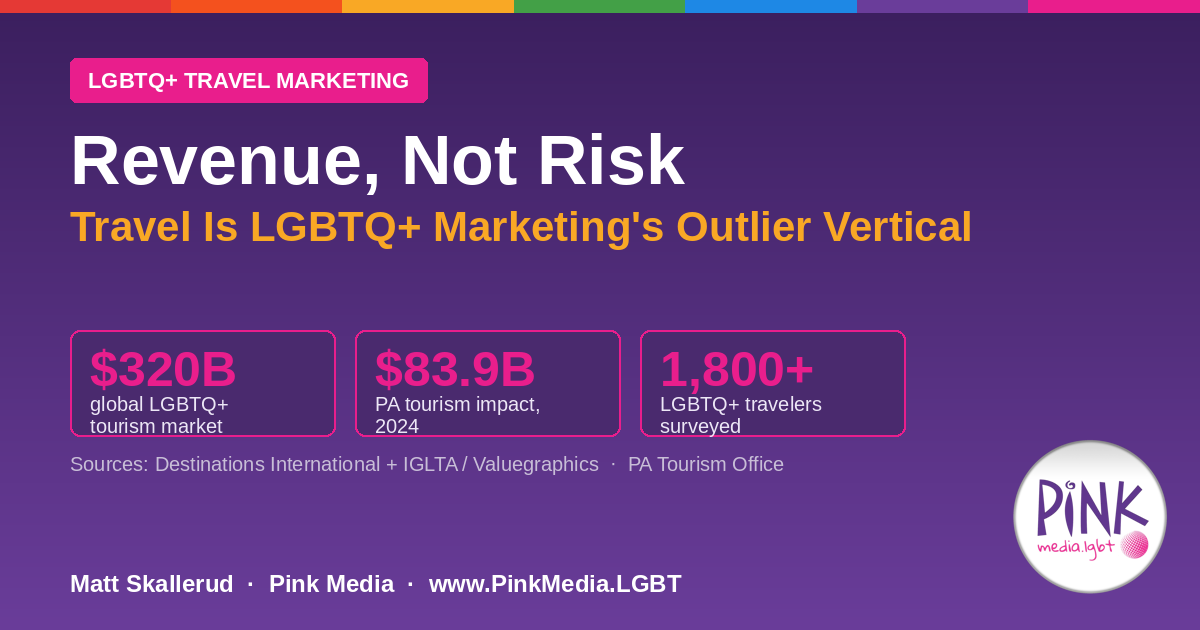
The research underneath it is the part I'd put in front of any DMO board. It was conducted by Valuegraphics, a firm that studies audiences by what they value rather than by demographics, across more than 1,800 LGBTQ+ travelers in international markets considering U.S. travel. Three power values came out of it.
1. Harmony
A destination where the traveler fits — where being there doesn't create internal conflict with their identity. Not tolerance. Fit.
2. Health & Well-Being
Physical and emotional safety at a level that allows actual relaxation, rather than low-grade vigilance for the length of the trip.
3. Balance
Stability and restoration. A trip that gives energy back instead of spending it on constant navigation and calculation.
Read those three again and notice what they have in common: every one of them is about the ordinary hours of a trip, not the headline event. Breakfast. The front desk. Walking back to the hotel. That's where the value is either delivered or it isn't.
Which is why the toolkit's most commercially useful finding is also its most uncomfortable one for a lot of marketing plans: Pride parade sponsorship, while valuable, is not the primary driver. Year-round authentic storytelling about everyday experiences in the destination is more persuasive. The research is telling destinations that the June logo is the least efficient thing in the budget — and I've been saying a version of that for years, so I'll take the corroboration.
"LGBTQ+ travelers naturally seek out places where they can truly be themselves."
The toolkit also does the thing trade materials usually skip: it names mechanisms. Strengthen representation in marketing. Invest in welcoming training and policies. Support LGBTQ+-owned businesses. Embed community voices in tourism development. And it carries case studies — Discover Puerto Rico's long-running LGBTQ+ strategy, and community-based cultural programming in Jaipur, India — so a mid-size DMO can see what the work actually looks like at two very different scales.
Destinations International President & CEO Don Welsh framed it plainly: "Creating environments where all travelers feel genuinely welcomed and represented is essential." Essential. That's the trade association's word, in 2026.
The State DMO That Said It Out Loud
The second move is the one I keep sending to clients, because it answers the question every destination marketer is actually asking right now: can a government tourism office still do this?
Pennsylvania's Tourism Office — housed inside the state's Department of Community & Economic Development — launched three coordinated campaigns aimed at travelers the state's marketing had been underserving. ILoveGay.NET covered the launch in detail, and the framing is the story:
| Campaign | Audience | Angle |
|---|---|---|
| "Sorry Not Sorry" | LGBTQ+ travelers | Self-expression and authenticity, unapologetically |
| "You Do You" | Black travelers | Individual experience and authentic exploration |
| "Visita Para" | Hispanic and Spanish-speaking travelers | Inclusive visual storytelling in-language |
Look at the department name again: Community & Economic Development. That's the framing, and it's the whole point. Deputy Secretary of Tourism Anne Ryan put the welcome in plain terms — "Pennsylvania is a place where everyone should feel welcome to explore, connect, and create lasting memories" — and the announcement put the economics right alongside it.
That's not a values statement with an economic footnote. That's an economic development announcement that happens to include LGBTQ+ travelers as a growth audience — which is a materially different thing politically, and a much harder thing to argue with in a budget hearing.
The execution is worth studying too, because it wasn't a logo and a hashtag. The office worked with Mendoza Group and Miles Partnership, ran focus groups with each community first, and then showed up in person — Out Fest, the Latino Ball, OURfest, the 8 Seconds Rodeo. Research, then presence, then campaign. The creative runs across the Visit PA site plus Facebook, Instagram and TikTok.
And it isn't starting from zero. Philadelphia has been marketing to LGBTQ+ travelers since 2004 — one of the longest continuous destination programs in the country — and Pittsburgh runs a year-round LGBTQ+ travel hub. The state campaign sits on top of two decades of city-level infrastructure. That's what "institutional" looks like in practice, and it's why Pennsylvania could move in a year when others hesitated.
The timing helps as well: 2026 brings America's 250th anniversary centered in Philadelphia, FIFA World Cup matches, and the MLB All-Star Game. When you have that much inbound attention, leaving audiences on the table is the expensive choice.
"When the marketing is a revenue line, you don't cut it because the news cycle got loud. You cut things that live in the reputation column. Tourism never filed this there."
Why Travel Can Do What CPG Can't
So why this vertical? I don't think it's that tourism people are braver. I think the structure is different in four ways that matter.
The product can't be boycotted off a shelf. A destination isn't a SKU. There's no display to photograph, no barcode to scan in a viral video, no inventory to pull. The thing being marketed is a place that exists whether or not anyone is mad about the ad.
The ROI is directly attributable. Visitor volume, visitor spend, hotel tax, jobs. A DMO can put an LGBTQ+ campaign next to a revenue number in a way a CPG brand manager usually can't, and "we grew visitation from this segment" is a defensible sentence in any room.
The mandate is growth, not brand safety. Tourism offices exist to increase the number of people who come and the amount they spend. Leaving a high-spending, high-loyalty, repeat-visit segment unmarketed isn't cautious — it's a miss, and their own economic impact reporting makes the miss visible.
The infrastructure was already built. IGLTA has been convening this industry for decades. Destinations International has the members. Cities like Philadelphia have been at it since 2004. When you already have the association, the research and the relationships, "keep going" is a much cheaper decision than "start."
What Contracted in 2026
- Pride merchandise and rainbow product lines
- NYC Pride budget: $4.1M → $3.8M → $3.2M
- Retail shelf presence and in-store collections
- Public, named corporate sponsorship at the national level
What Expanded in Travel
- A formal DI + IGLTA toolkit, on the record, May 2026
- 1,800+ traveler research base with a 5-step framework
- A state tourism office running a named LGBTQ+ campaign
- City programs deepening — Philadelphia since 2004, Pittsburgh year-round
The Part Travel Still Has to Solve
I'd be doing you a disservice if I made this sound simple, because there's a real complication underneath the good news, and the 2026 Spartacus Gay Travel Index put a number on it.
Iceland took the top spot, with Malta and Spain just behind. But the finding that should reorganize a marketing plan isn't at the top of the list — it's that Canada, Australia and Denmark all lost points in the "locals hostile" category. Not because laws changed. Because public-attitude survey data slipped. The legal protections held; the social temperature dropped.
That gap matters enormously for destination marketing, because a traveler doesn't experience your anti-discrimination statute. They experience the front desk, the restaurant, and the street at one in the morning. Which is exactly the harmony/health/balance finding arriving from a completely different direction.
And for U.S. destinations specifically, the index treats this country as fractured rather than singular — New York, California and Nevada near the top while other states move the other way. That fragmentation is precisely why state and city marketing now carries more weight than national marketing. "Come to America" isn't a proposition an international LGBTQ+ traveler can evaluate. "Come to Philadelphia, here's what the week actually looks like" is.
What I'd Do With All of This
If you market a destination, a hotel group, a cruise line or a tour operator, here's how I'd translate the year into a plan.
Build the case in your leadership's language. Pennsylvania didn't win the internal argument with a values statement. It won with $83.9 billion, 514,261 jobs and 201.6 million visitors, and then said everyone is welcome. If you need an approval, bring the economic impact framing first — and the DI + IGLTA toolkit gives you an industry-standard document to point at while you do it.
Market at the level the traveler actually experiences. In a fragmented country, that's the state, the city and the neighborhood — not the flag. The more specific the welcome, the more credible it reads.
Sell the ordinary hours, not the parade. The research is unambiguous here. Show the coffee shop, the trail, the museum on a Tuesday, the couple who didn't have to think about it. Everyday storytelling, running all twelve months, beats a June sponsorship on persuasion — and it costs less.
Prove the welcome operationally. Frontline training. LGBTQ+-owned businesses in your itineraries and your media buys. Community voices inside the planning, not just in the photo shoot. This audience has been reading marketing for a very long time, and the gap between the ad and the arrival is the only thing that actually gets remembered.
One practical note on media: travel purchases have a long consideration window — people research destinations for months before they book. That makes a year-round presence in LGBTQ+ travel media meaningfully different from a seasonal buy. The goal isn't to be seen during Pride; it's to be familiar by the time the trip gets planned. Consistency is the cheapest advantage available in this category.
The Takeaway
Here's what I want people to carry out of 2026. The story is not "brands abandoned the LGBTQ+ community." The story is that the sectors that measured this market as revenue kept investing, and the sectors that measured it as reputation got skittish. Travel is the clearest proof of the pattern — an industry association publishing a formal toolkit, and a state government running a named LGBTQ+ campaign inside its economic development department, in the same twelve months that consumer brands were quietly reworking their Pride merchandise plans.
If your organization is trying to decide what to do next year, that's the real lesson, and it applies well outside of tourism: put this market in the revenue column, where it belongs, and the annual debate mostly goes away.
Our full 2026 LGBTQ+ Travel Market Guide goes much deeper — the traveler profile, the researchers behind the numbers, the niche segments, and the year-round execution roadmap for destinations, DMOs, hotels, cruise lines and tour operators. This post is the short version of why the vertical held.
If you're building an LGBTQ+ travel program for 2027 and want it to run all twelve months rather than four weeks, we'd love to help you put it together.
- Harmony, Health & Balance: The New DI + IGLTA Research That Should Reshape How Destinations Court LGBTQ+ Travelers — ILoveGay.NET, July 29, 2026. The Valuegraphics findings behind Why Values Matter.
- "Sorry Not Sorry": Pennsylvania Is Still Spending on LGBTQ+ Travelers — and Calling It Economic Growth — ILoveGay.NET, August 19, 2026. The state campaign, the agencies, and the economic framing.
- Brands Got Nervous About the Merch — Not About Showing Up — ILoveGay.NET, August 20, 2026. What actually changed in CPG and retail this Pride season.
- Iceland Is #1 — But the Real Story in the 2026 Spartacus Index Is Where Acceptance Slipped — ILoveGay.NET, August 1, 2026. Why the legal-vs-social gap matters for destination marketing.
- Paris Builds the Committee, Not the Campaign: A Model for LGBTQ+ Destination Marketing — ILoveGay.NET. A second example of a destination building structure before creative.
- Pink Media's 2026 LGBTQ+ Travel Market Guide — the full traveler profile, segments, and year-round execution roadmap.