Here's something I've observed over 30 years in LGBTQ+ media and marketing: the LGBTQ+ travel market does not move in sync with the corporate support cycle. Brands come and go from Pride sponsorships. Political climates shift. DEI budgets get slashed. But LGBTQ+ people — who have always understood that community connection often requires traveling to find it — keep booking flights, hotels, and festival passes. They did it long before corporate America showed up with rainbow logos, and they're doing it now that some of those logos have quietly disappeared.
What is shifting in 2026 is the shape of where they're going, and what they find when they get there. That's worth paying attention to — both for the LGBTQ+ community and for the destinations and travel brands that serve them.
The Funding Gap Is Real — and It Shows Up on the Ground
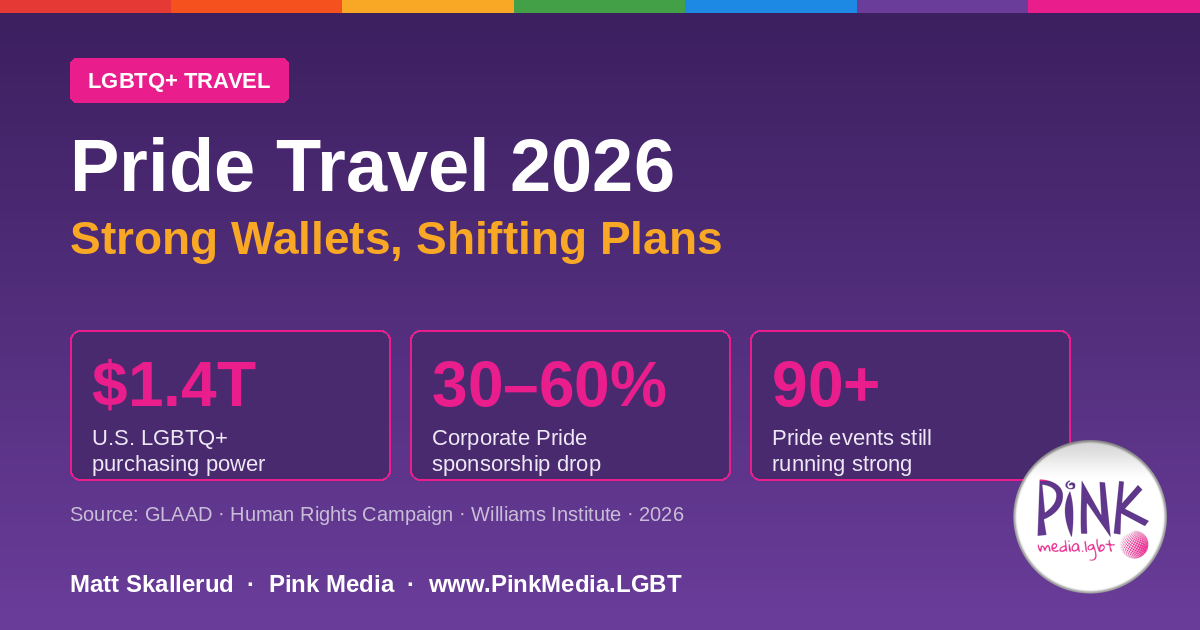
Let me be direct about what's actually happening with Pride event funding in 2026, because it has a direct line to tourism. Across major U.S. cities — New York, Pittsburgh, Salt Lake City, Orlando, St. Louis, Louisville — corporate sponsorships for Pride events have declined meaningfully. Pittsburgh Pride, to use one concrete example, expects to secure only 30–40% of its previous sponsorship levels. Some smaller, community-organized Pride events in rural or politically challenging markets are facing outright cancellation or are consolidating with neighboring cities' events.
The reason is well-documented. After the 2023 double-boycott cycle around Bud Light, Target, and Disney, and then the 2025 federal DEI rollbacks, corporate support for visible LGBTQ+ initiatives has become — in the eyes of many companies' legal and communications departments — a reputational risk to be managed rather than a market opportunity to pursue. Many Pride organizations rely on corporate funding for 30 to 60 percent of their budgets. When that funding contracts by half, the programming contracts too. Fewer stages. Fewer activations. Smaller footprints. Less reason for out-of-town visitors to make the trip.
For the travel industry, that is not an abstract concern. It translates directly into hotel nights, restaurant covers, airline seats, and the kind of concentrated, community-driven tourism that LGBTQ+ travelers generate when they descend on a city for a major Pride weekend.
"For us in the LGBTQ+ community, there's no waiting. We don't have the luxury of just pulling back, jumping back into the closet and waiting for a better day."
Where the Rebound Is Happening — and What It Looks Like
The story isn't uniformly dark, and I don't want to leave that impression. There are genuine signs of a corporate rebound in select markets and among specific brands. NYC Pride is reporting 90+ corporate partners in 2026, up from 77 in 2025 and 70 in 2024 — although the dollar amounts behind those partnerships remain lower than pre-pullback levels. Mastercard, American Eagle, and Levi's have all increased their contributions to LGBTQ+ causes and Pride participation in 2026. In the hospitality space, both Marriott and Hilton have maintained their longstanding LGBTQ+ travel programs — Marriott's #LoveTravels initiative in particular has been a consistent, year-round commitment to queer travelers, not a June-only activation.
These are the brands worth watching. Not because they're making the loudest pronouncements, but because they're maintaining genuine programs — the kind built around real community relationships rather than quarterly DEI metrics. In the travel sector especially, that long-term orientation matters. LGBTQ+ travelers have long memories for the properties, airlines, and destinations that showed up when it was less convenient to do so.
Facing Funding Challenges
- Pittsburgh — expects only 30–40% of prior sponsorship levels
- Salt Lake City, Louisville, St. Louis — reduced corporate support
- Orlando, New York — major sponsors reduced or gone silent
- Smaller & rural Pride events — cancellation or consolidation risk
- Reduced activations mean smaller tourism draw
Where the Market Is Resilient
- NYC Pride — 90+ partners in 2026, a cautious rebound
- Marriott — #LoveTravels program, year-round LGBTQ+ commitment
- Hilton — maintained LGBTQ+ travel programs
- Mastercard, American Eagle, Levi's — increasing contributions
- Community-organized events — growing in number and attendance
The Traveler Picture: Spending Power Hasn't Pulled Back
Here's the thing that gets lost in the sponsorship-pullback coverage: LGBTQ+ travelers themselves have not retreated. The community's economic profile — detailed in our 2026 LGBTQ+ Marketplace Guide — reflects $1.4 trillion in U.S. purchasing power, with travel consistently ranking as one of the top spending categories. LGBTQ+ consumers over-index on leisure travel, international travel, and experiential travel. They travel in pairs and groups. They return to welcoming destinations year after year and recommend them actively within their networks.
None of that has changed because some corporations got nervous about their Pride sponsorship logos. What has changed is the map — which destinations, which events, and which kinds of travel experiences LGBTQ+ travelers are gravitating toward. And that shift is actually creating opportunities for destinations smart enough to notice.
The Grassroots Shift — and What It Means for Destinations
One of the most interesting developments in LGBTQ+ travel for 2026 is the acceleration of community-driven, grassroots experiences. With fewer large corporate activations anchoring the big-name Pride events, travelers are increasingly seeking out smaller, more intimate Pride celebrations — the kind organized by local LGBTQ+ community groups, regional nonprofits, and neighborhood businesses rather than by sponsorship committees and major production companies.
This isn't a consolation prize. For many travelers, it's the preferred experience. Community-organized events tend to feel more authentic, more locally rooted, and more genuinely celebratory than the heavily branded, corporate-activation-heavy versions of Pride that dominated the mid-2010s. The Levi's "Together, We Ride" campaign — built around the real history of queer motorcycle clubs — is a useful reference point. It resonates precisely because it's rooted in actual community history rather than June-calendar marketing.
For destinations and travel brands, this shift toward community-driven travel presents a real opportunity — but it requires a different kind of marketing approach. It's less about buying naming rights at the main stage and more about building year-round relationships with local LGBTQ+ organizations, community spaces, and media. Broader yet more targeted, as we've been saying at Pink Media for years. The destinations winning LGBTQ+ travelers in 2026 are the ones that are visible and present year-round — not just when it's Pride Month.
"LGBTQ+ travelers remember who showed up. The destinations and hospitality brands that maintain genuine community presence — through the political weather changes, not just when conditions are comfortable — are building the kind of loyalty that makes travelers come back and bring their friends."
What Travel Brands Should Be Doing Right Now
I've been working with travel and tourism clients at Pink Media for a long time — hotels, destinations, tour operators, cruise lines, visitor bureaus. The brands that perform best in the LGBTQ+ market over the long run share a common characteristic: they think about this community the same way they'd think about any high-value, brand-loyal travel segment. Consistently. With genuine investment. Not seasonally.
In the current environment, that means a few things specifically. First, show up where the community actually is — in LGBTQ+ digital media, in community publications, in the social channels where LGBTQ+ travelers are actively sharing travel recommendations and experiences. This audience is online, on mobile, and highly engaged with content from trusted LGBTQ+ sources. Second, tell a real story. LGBTQ+ travelers are good at detecting hospitality marketing that's performative versus genuine. The destinations that attract them aren't just showing rainbow flags in June — they're demonstrating, year-round, that LGBTQ+ guests are genuinely welcome and valued. Third, think beyond Pride Month. The travel market for LGBTQ+ consumers is a 24/7, 365-days-a-year opportunity. Pride is one moment in it — an important one, but not the only one.
For destinations and travel brands trying to navigate the current moment, the sponsorship pullback by major corporations is, frankly, an opening. The LGBTQ+ travel market is still there — robust, high-spending, loyal, and actively looking for the destinations and hospitality brands that are willing to engage with them genuinely. The brands stepping into that space right now, with authentic community presence and targeted reach, are positioning themselves well for the years ahead.
The Long View
I've watched LGBTQ+ travel evolve from the early days of niche guidebooks and word-of-mouth to the global, data-driven market it is today. The fundamentals have not changed: LGBTQ+ people travel to find community, celebration, safety, and belonging — and they're willing to spend meaningfully to find it. What changes, in every political cycle, is which destinations and brands they trust to provide that experience authentically.
The sponsorship pullback of 2025–2026 is going to be remembered, in LGBTQ+ community circles, for a long time. So will the destinations and travel brands that chose to maintain their commitment during it. The community doesn't forget who was there when it mattered — and in the travel market, that long institutional memory translates directly into bookings, repeat visits, and word-of-mouth that no advertising budget can fully replicate.
If your destination, hotel, cruise line, or travel brand is looking at this moment and wondering whether now is the right time to build or deepen your LGBTQ+ marketing presence — the answer is yes. The market is still here. The travelers are still booking. And the window to establish yourself as a genuine partner to the LGBTQ+ travel community, right when some of the big corporate players have stepped back, is genuinely open. We'd love to help you walk through it.