Here's something I noticed watching the brand campaigns roll out this Pride season, and it's worth pausing on. The companies that actually broke through — the ones our community talked about instead of scrolled past — all did the same unglamorous thing. They didn't stop at a rainbow logo and a warm caption. They routed real money through an established advocacy organization, and then they showed the receipts. Absolut, Chipotle, Skittles, Diesel, Tinder — different products, different budgets, same move. And when you line them up, two names keep appearing underneath the checks: GLAAD and Outright International. Those two became the donation anchors of the entire 2026 season.
That's not a coincidence, and it's not charity for charity's sake. It's a signal. In a year when the whole marketplace is watching to see who's real and who's rainbow-washing, giving through a trusted organization is the clearest, hardest-to-fake proof a brand can offer. Let me walk you through who did it, and why the mechanism matters as much as the money.
The Money Went Somewhere You Can Check
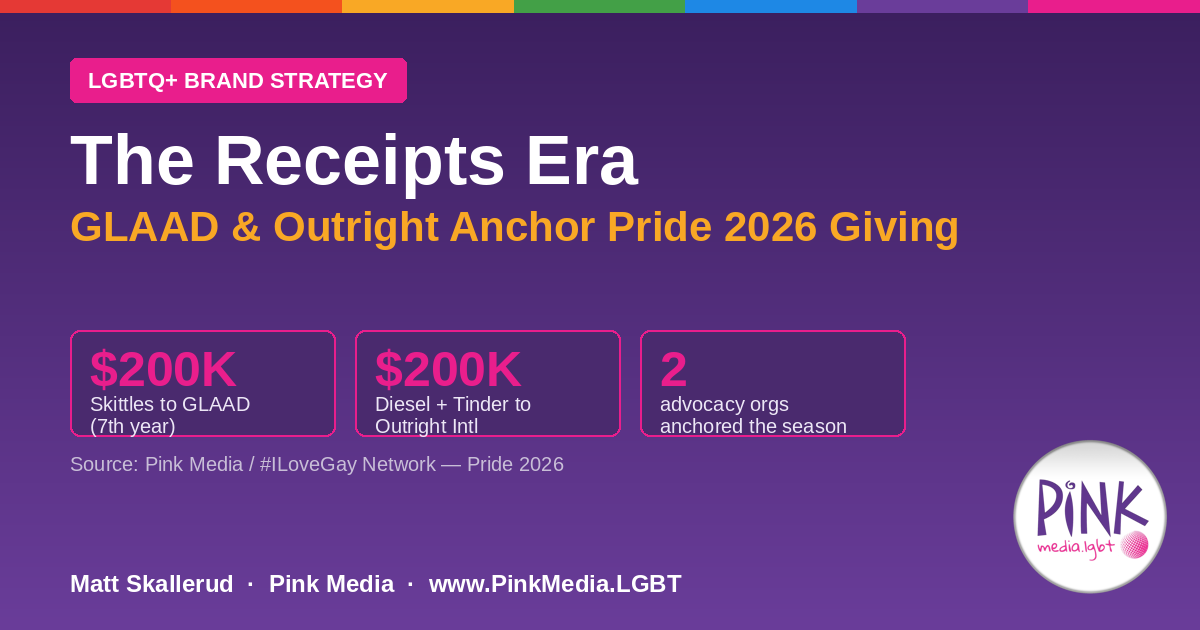
Start with the candy, because it's the cleanest example. For Pride, Skittles once again gave up the very thing it's famous for — it turned its rainbow gray, releasing colorless Pride Packs on the premise that during Pride, only one rainbow matters. Behind the packaging sits the part that counts: a $200,000 donation to GLAAD, now in its seventh consecutive year. That's not a one-off stunt reacting to a news cycle. That's a standing relationship you can look up. You can read about how the candy-store brands have navigated Pride — the smart moves and the scandals alike — in our friends' coverage over on the #ILoveGay Network's 2026 marketing rundown.
Then there's the fashion-meets-dating play. Diesel and Tinder teamed up on a Pride 2026 capsule they called "For Successful Loving," and they didn't let the collab end at product. Together they pledged a combined $200,000 to Outright International — $100,000 from each partner — earmarked for economic-inclusion programs supporting LGBTIQ people in markets including Colombia, South Africa, Ukraine, and the Philippines. That's giving with a passport, and it's exactly the kind of specificity that reads as real. The full Diesel x Tinder story is on the #ILoveGay Network — including why dating apps have quietly become Pride's favorite collaborators.
And the legacy players kept their word. Chipotle, whose "Love What Makes You Real" campaign now runs in June and October — a 365-not-just-June rhythm we love to see — again channeled giving through GLAAD via its Pride merchandise. The #ILoveGay Network broke down the Chipotle approach here. Absolut — a brand that's been showing up for this community for 45 years, most recently through its Madonna "Icon" partnership — continued its long line of GLAAD support, proof that legacy isn't nostalgia when you keep funding it. The case for Absolut's legacy is laid out on the #ILoveGay Network too.
"A rainbow logo says 'we see you' for the price of a color swap. A donation to GLAAD or Outright International says 'we see you' with a number attached, a nonprofit's name on it, and a paper trail. In 2026, only one of those still counts."
Why GLAAD and Outright Became the Anchors
So why did giving cluster around these two organizations specifically? Because they solve different halves of the same problem, and together they cover the map.
GLAAD is the domestic credibility engine — media accountability, entertainment representation, and its widely cited Social Media Safety Index, which has become required reading for any brand thinking hard about where its message runs, not just what it says. When Skittles, Chipotle, and Absolut route giving through GLAAD, they're borrowing that credibility and reinforcing it at the same time. Outright International is the global partner — it moves resources to LGBTIQ communities and human-rights work in the places where the need is sharpest and the headlines rarely reach. When Diesel and Tinder chose Outright, they signaled that their idea of Pride doesn't stop at the U.S. border.
Put simply: an established advocacy org is a trust intermediary. The community already knows these names, already vets them, already tracks their work. A brand that partners with one isn't asking us to take its word for anything — it's pointing to a third party who'll keep the score. That's the whole reason measurable giving beats visibility right now. Visibility asks for applause. Giving submits to an audit.
What "Showing Receipts" Looks Like
- A named nonprofit partner (GLAAD, Outright, and peers)
- A specific dollar figure, disclosed — not "a portion of proceeds"
- A multi-year track record, not a one-season cameo
- Programs you can point to — and, ideally, a location
- Giving that runs alongside the product, not instead of it
What Doesn't Cut It Anymore
- A rainbow logo with nothing funded behind it
- "We stand with the community" and no mechanism
- Vague "proceeds benefit charity" with no name or number
- June-only visibility that vanishes on July 1st
- Borrowed LGBTQ+ talent with no LGBTQ+ investment
The Community Is Keeping Receipts — So Keep Yours
I won't pretend the backdrop isn't tense. Plenty of brands went quiet this year, softened their language, and treated community support like a liability. I've said it before and I'll say it again: for us, this isn't a quarterly campaign decision — it's our lives, and it's personal. But here's the encouraging half of the story. The pullback made the brands that did show up stand out more, not less. And the smartest of them figured out that the safest way to show up in a skeptical, scrutinizing moment is also the most authentic way: put a number on it, name your partner, and let the receipts do the talking.
Recent HRC data makes the stakes concrete — brands seen retreating from the community lose LGBTQ+ shoppers at roughly twice the rate, because consumers are, quite literally, keeping receipts. Measurable giving is the flip side of that same coin. When you route real money through GLAAD or Outright International, you're not just funding good work — you're building a record that protects you the next time someone asks whether your Pride post meant anything.
"Nobody's going to remember your rainbow palette in five years. They'll remember whether there was a check behind it — and whose name was on the check."
What This Means for Your Brand
If you're deciding how to show up — this Pride, or any of the 365 days around it — take the lesson these anchors are teaching. One: pick a real partner. A national credibility org like GLAAD, a global one like Outright International, or a local LGBTQ+ organization in the markets that matter to you. Two: put a number on it and say the number out loud. "A portion of proceeds" is the language of hedging; "$200,000 to GLAAD" is the language of commitment. Three: make it recurring. The reason Skittles' seventh straight year lands harder than any single donation is that consistency is its own proof. Four: pair the giving with year-round presence. Measurable philanthropy plus authentic, always-on storytelling through LGBTQ+ media — that's the combination that turns a Pride moment into a community relationship. That 24/7, 365 approach is what Pink Media and the #ILoveGay Network are built for.
The brands that anchored their Pride to GLAAD and Outright International this year didn't just buy goodwill — they earned it, on the record, in a way the community can verify. That's the receipts era. If your organization wants to show up for the LGBTQ+ community in a way that actually holds up to scrutiny — with real giving, real storytelling, and real reach — we'd love to help you get it right.