For the last couple of Pride seasons, the headline wrote itself: brands going quiet. Sponsors stepping back from parades, retailers shrinking their collections, marketing teams getting nervous about visible LGBTQ+ associations. I've written about that retreat more than once, because it was real and it mattered. But something has shifted in 2026, and I don't want it to get lost in the louder narrative of pullback. A meaningful group of brands has stopped flinching. Pride got loud again — and the data says they're reading the room correctly.
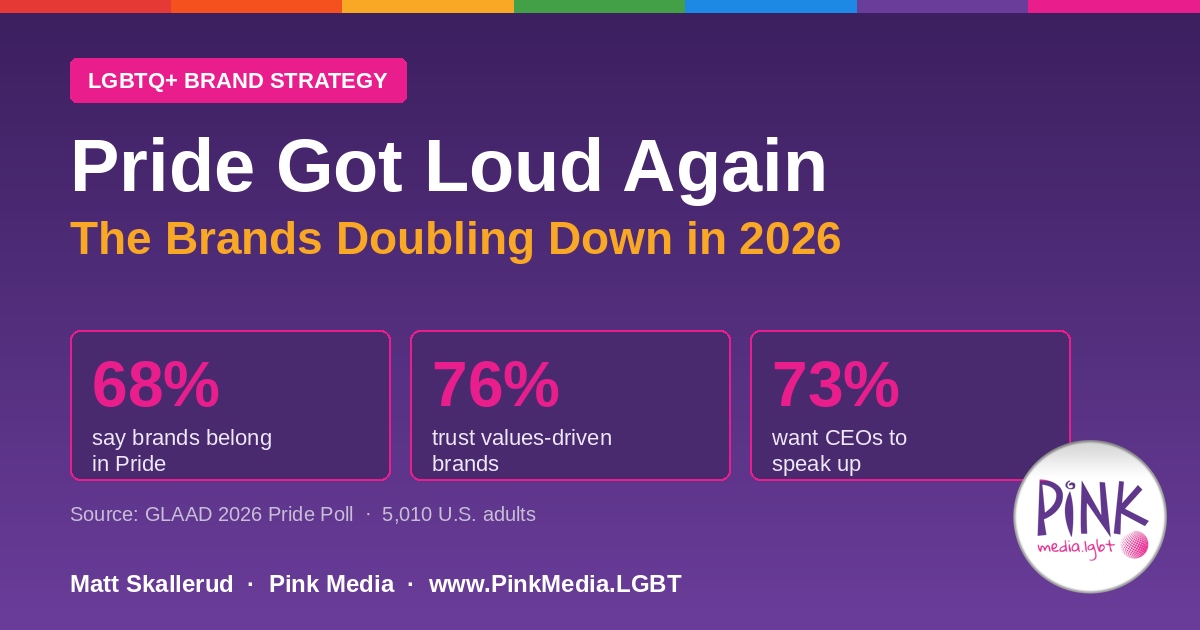
I say that because we finally have a clear number to point to. GLAAD's 2026 Pride poll — conducted with MRI-Simmons across a nationally representative sample of 5,010 U.S. adults — found that a supermajority of Americans don't just tolerate brands showing up for the LGBTQ+ community; they expect it. That's the spine of everything I'm about to walk through, so let's start there.
The Numbers That Should Settle the Debate
Three figures from the GLAAD poll do most of the work, and they line up almost too neatly with everything we've been telling clients for years.
Read those together and a pattern jumps out. This isn't really a poll about Pride flags and rainbow logos — it's a poll about consistency. What Americans are rewarding isn't the gesture; it's the spine behind it. The 76% number is the one I'd circle in red for any marketer: people are telling us, plainly, that they trust the brand that holds its position under pressure more than the one that folds. That cuts directly against the instinct to go quiet "until things calm down."
"The data doesn't say be loud for the sake of being loud. It says be consistent — and consistency, in this climate, is what reads as loud."
Five Brands That Didn't Wait for Permission
Numbers make the case; brands make it real. Five plays stood out to me this Pride season — not because they had the biggest budgets, but because each one showed up in a way that matched what the data rewards. None of them treated Pride as a one-off logo swap. We've covered each of these in more depth over on ILoveGay.net, and I've linked those pieces below if you want the full story.
Levi's — Heritage With a Backbone
Levi's launched its 2026 Pride collection, "Together, We Ride," as a homage to the queer motorcycle clubs of the early gay rights movement — the Satyrs (1954), Dykes on Bikes (1976), the Sirens (1986) — built from real materials provided by the GLBT Historical Society. That's not a vague rainbow capsule; it's a story rooted in real LGBTQ+ history. Levi's paired the collection with a $100,000 donation to Outright International and, notably, did it after very publicly declining to eliminate its DEI programs. That's the 76% in action — values held under pressure. We dug into the history behind the denim in our full look at "Together, We Ride" on ILoveGay.net.
SWISS — Visibility Backed by Substance
Swiss International Air Lines kicked off June with rainbow livery on selected aircraft and a coordinated digital campaign across its global network — and carried the message inward, onto seat-back screens, onboard announcements, and cabin signage. What makes it more than a paint job is what sits behind it: internal LGBTQ+ awareness training, non-discrimination policy work, and a deliberate framing of the whole effort as year-round rather than seasonal. The external visibility and the internal commitment point the same direction — which is exactly how you avoid the pinkwashing charge. The flag means something when the operation behind it matches. We broke down why the SWISS activation works on ILoveGay.net.
Google — Showing Up Across the Product
Google marked Pride 2026 with a homepage Doodle celebrating disco's LGBTQ+ pioneers and, more substantively, by spotlighting LGBTQ+ creators and artists across its products — Google Play collections, YouTube's channels, Google TV programming, and tools in Maps and Search for finding LGBTQ+-owned businesses year-round. For a company whose front door is seen by billions, choosing to keep that door rainbow-lit in 2026 is its own statement. It's also a reminder that "showing up" doesn't have to mean a campaign — sometimes it means using the surfaces you already own to amplify community voices. We covered the full Google Pride 2026 program on ILoveGay.net, including why the Maps and Search piece is the part that keeps working after June.
TikTok — A Platform Handing Over the Spotlight
On June 1, TikTok announced its Pride Month 2026 programming: eight rising LGBTQIA+ creators and small business owners promoted across the platform's own channels all month, a dedicated Pride hub that stays active through June, and an educational series with category-based creator spotlights. The engagement data behind it is the part marketers should circle — in the month leading up to June, posts using #PrideTikTok climbed 64% and #Pride rose 77%. Even in a year of brand hesitation, the community itself is leaning in harder, and the platform is following that energy. We read TikTok's announcement as a platform-level signal on ILoveGay.net — a map of exactly where attention and creator partnerships are concentrating this June.
Diesel x Tinder — The Smartest Pairing of the Season
Diesel and Tinder launched "For Successful Loving" — a 17-piece cobranded Pride capsule riffing on Diesel's classic slogan, fronted by Gigi Goode in a documentary-style, VHS-textured campaign that feels more like a casting tape than an ad. Behind the merch, Diesel (through the OTB Foundation) and Tinder each pledged $100,000 to Outright International — $200,000 total to a partner doing the work year-round. It's brand-to-brand co-marketing at its most efficient: a fashion house borrowing a dating platform's young, meaningfully queer audience, and the platform getting cultural credibility its users can actually wear. We unpacked why dating apps are becoming Pride's favorite collaborators on ILoveGay.net.
Loud vs. Quiet — The Real Scorecard
Put the two postures side by side and the strategic question stops being "is it safe to support Pride?" and becomes "which risk do I actually want to carry?"
Going Quiet
- Reads as conditional support the moment pressure arrives
- Forfeits the trust premium the 76% are offering
- Signals to employees and customers that values are negotiable
- Cedes cultural space to competitors who stayed
- Has to rebuild credibility from scratch when it returns
Doubling Down
- Earns trust precisely because it held under pressure
- Aligns with what a supermajority of consumers say they want
- Builds durable community loyalty, not seasonal goodwill
- Owns cultural relevance competitors abandoned
- Compounds — each consistent year deepens the relationship
Here's the part that I think gets missed: going quiet was never the neutral, risk-free option it felt like. The GLAAD numbers make that explicit. When 76% of people tell you they trust the brand that stands firm, retreating isn't avoiding a risk — it's choosing a different one, and arguably the more expensive one over time.
"For two years the safe-looking move was to go quiet and wait for a calmer day. The 2026 data calls that bluff. A supermajority of Americans say they trust the brands that hold their values under pressure — which means the brands doubling down on Pride aren't being brave at the expense of being smart. They're being smart. The retreat was the gamble all along."
Why "Loud" Has to Mean "Consistent"
I want to be careful here, because there's a version of this that goes wrong. The lesson isn't "crank the volume every June." A loud one-month splash from a brand that's invisible the other eleven months reads as exactly what it is, and LGBTQ+ audiences are unusually good at spotting it. What the five plays above have in common isn't volume — it's that the visibility connects to something real: a donation, a training program, a piece of history, a year-round commitment.
That's the same idea we've built our work around for years — Content as Advertising, distributed across the channels where the community actually spends its time, 24/7 and 365 days a year rather than for a single Pride post. Authentic engagement isn't a campaign you switch on in June; it's a presence you maintain. The GLAAD poll is really just national confirmation of something the community has always known: people can tell the difference between a brand that shows up because it believes in them and one that shows up because the calendar said so. It's also why we keep tracking these campaigns one by one on ILoveGay.net — the pattern only becomes visible when you watch who keeps showing up.
Where Pink Media Fits
This is the conversation we have with brands every week — not "should you support Pride?" but "how do you do it in a way that holds up, that reaches the right people, and that keeps working past June?" Because we work across a broad LGBTQ+ media and content network, we can help a brand turn a Pride moment into a year-round presence: the right creators and publishers, content that lives well beyond a single post, and distribution into the spaces where the community is already paying attention.
The brands getting loud in 2026 have the wind at their backs, and now there's a number to prove it. For any marketer who's been waiting for cover to re-engage, the GLAAD poll is about as clear a green light as the data ever gives you. The question isn't whether the audience is there. It's whether you'll show up consistently enough to earn the trust they're plainly offering.
The Bottom Line
Pride got loud again in 2026, and the brands turning up the volume — Levi's, SWISS, Google, TikTok, Diesel x Tinder, and the many others reading the moment clearly — aren't taking a flyer. They're following the data. A supermajority of Americans support brands that stand with the LGBTQ+ community, and they reserve their trust for the ones that don't flinch. The retreat narrative isn't the whole story anymore. The smarter, better-supported move is to show up, stay consistent, and let the loudness come from the substance behind it.