Here's a question I find myself asking about every Pride campaign that crosses my desk these days: who held the pen? Not who approved the creative, not who signed the sponsorship check — who actually made the thing? Because somewhere over the last couple of Pride seasons, that question quietly became the whole ballgame. The campaigns landing with the LGBTQ+ community in 2026 are the ones built with queer artists and rooted in real community history. The ones getting called out — increasingly by name, increasingly fast — are the logo swaps that show up June 1 and vanish July 1. The creative bar has moved, and I want to walk through exactly where it moved to.
REI: The Answer Is Right in the Name
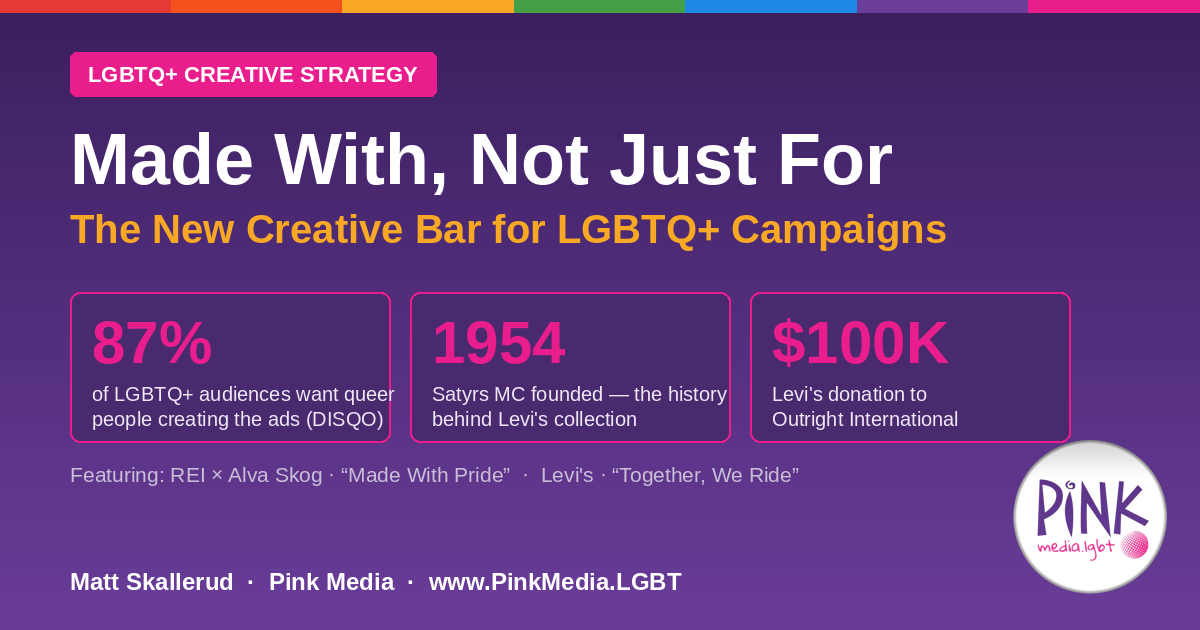
Start with the campaign that puts the principle on the label. REI's 2026 Pride collection is called "Made With Pride" — and the "with" is doing the heavy lifting. The co-op partnered with Alva Skog, a nonbinary illustrator whose bold, playful work explores identity and connection, and put Skog's artwork across the entire product lineup: apparel, bags, camping chairs, water bottles. The anchor design is a multicolored topography of mountain ridges — the outdoor settings REI customers actually live in, fused with the rainbow flag's palette. It's recognizably Skog's work, not a brand template with rainbow fills.
And Skog's own framing of the collection says more than any brand copy could:
"My hope is that this little image will spark inspiration to spend more time outdoors together and a reminder that rest is resistance."
That's a queer artist's voice leading a national campaign — not decorating it. REI backed the collection with Pride pop-up events in Denver, Seattle, and Washington, D.C., plus a year-round commitment to expanding outdoor access for LGBTQ+ communities. The creative connects to the brand's actual mission, the artist gets named credit, and the support extends past the shelf. That's the model.
https://ilovegay.net/rei-made-with-pride/
Levi's: History as the Co-Creator
The other way to clear the new bar is to build with the community's past — and Levi's "Together, We Ride" collection is the strongest example of that approach this year. Working from materials provided by the GLBT Historical Society, Levi's anchored its 2026 Pride collection in the real history of LGBTQ+ motorcycle clubs: the Satyrs Motorcycle Club, founded in Los Angeles in 1954 and widely recognized as one of the oldest ongoing LGBTQ+ organizations in the country; San Francisco's Rainbow Motorcycle Club and the legendary Dykes on Bikes; New York's Sirens Women's Motorcycle Club, at the front of NYC Pride for nearly forty years.
In an era when being out could cost you everything, those clubs were lifelines — communities built on mutual protection and the radical idea that you didn't have to ride alone. Levi's translated that heritage into coated leather-look denim, vintage club graphics, studs and patches — and backed it with a $100,000 donation to Outright International. Anyone can print a flag. It takes real intent to dig through a historical society's archives and put names and dates from 1954 at the center of a national campaign. The community isn't the audience for that collection — it's the source material, honored and credited.
https://ilovegay.net/levis-together-we-ride-queer-motorcycle-culture-as-campaign-inspiration/
The 87% That Should Reshape Your Creative Brief
If REI and Levi's are the proof points, here's the data underneath them. DISQO's research on brand integrity and LGBTQ+ inclusion found that 87% of LGBTQ+ audiences say inclusion must come from the inside out — with queer people involved in the creation of the ads themselves. Not consulted after the concepting. Not represented in the casting call. Involved in the making.
That number is worth sitting with, because it redefines what "representation" means in practice. For years, the inclusive-marketing conversation focused on who appears in the ad. The community has moved the conversation upstream — to who's in the room, who's holding the pen, whose name is on the work. A campaign can feature LGBTQ+ faces and still be entirely made for the community by people outside it. And audiences can tell. Quickly.
With vs. For: The Creative Scorecard
Made For (The Logo Swap)
- Rainbow applied to existing brand assets by the internal team
- No named LGBTQ+ creative anywhere on the work
- Live June 1, gone July 1 — no presence the other eleven months
- No donation, partnership, or programming behind it
- Increasingly called out by the community — and the trade press
Made With (The New Bar)
- Queer artists and creators lead the creative — and get named credit
- The work is recognizably theirs, not a template with rainbow fills
- Rooted in real community history, culture, or need
- Backed by donations, events, and year-round commitments
- Connects to what the brand actually does and believes
One pattern worth noting across both campaigns: the creative is better. Not just more authentic — better. Skog's topography is a more interesting piece of design than any rainbow-filled logo would have been. Levi's biker heritage collection has texture and story that a generic Pride capsule never could. Bringing queer creatives and queer history into the work isn't a compliance step that constrains the creative — it's where the good ideas come from. The authenticity and the quality arrive together, because they're the same thing.
"The logo swap era assumed the community was an audience to be reached. The campaigns landing in 2026 understand the community is a creative force to be partnered with. That's not a messaging shift — it's a process shift. It changes who's in the room before the first concept is sketched."
What This Means for Your 2026–2027 Planning
If you're a brand or destination mapping out your next LGBTQ+ campaign, the practical takeaway is to move the authenticity question to the front of the process, not the end. Before budgets and placements, ask: which queer artists, creators, or community voices will shape this work? What real history or community need does it connect to? Will the people who made it be named and visible? What's still standing in October? Answer those four questions well and the rest of the campaign — the media plan, the social strategy, the PR story — gets dramatically easier, because there's something real to amplify.
That last part is where we live. We've spent years helping brands work with LGBTQ+ creators and turn community-made content into long-term marketing assets — Content as Advertising, distributed across the channels where the community actually spends its time, year-round. When the work is made with the community, our job becomes making sure the community actually sees it — and that's a much better conversation to be having than trying to make a logo swap look like a commitment.
The Bottom Line
The creative bar for LGBTQ+ marketing has moved, and it's not moving back. REI showed what it looks like to hand a queer artist the pen and put their name on the work. Levi's showed what it looks like to treat community history as source material worth honoring. And the research confirms what both campaigns intuited: 87% of LGBTQ+ audiences want queer people on the inside of the creative process, not just in front of the camera. "Made with, not just for" is the standard now. The brands that internalize it will make better work, build deeper trust, and stand out in a season when the community is watching more closely than ever.