Here's something I've watched play out over 30 years in LGBTQ+ media and marketing: no segment of this marketplace has a longer history than travel — and none is moving faster right now. We've just finished mapping it end to end in the new 2026 LGBTQ+ Travel Market Guide, a companion to our 2026 LGBTQ+ Marketplace Guide, and I want to walk you through the headline of it, because the story it tells is genuinely useful whether you're running a tourism board, a hotel group, a cruise line, or a tour operator.
Let me start with the number that gets everyone's attention, and then get to the number that actually matters.
Travel Has Always Led the Way
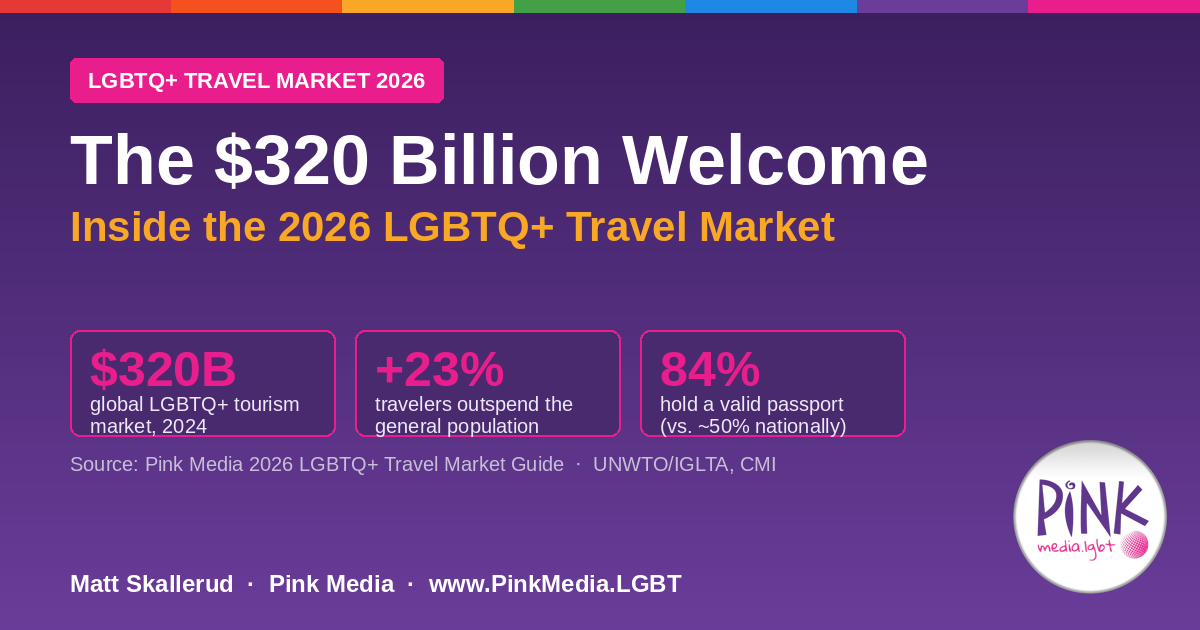
Back in 1999, airlines were already courting an estimated 9.2 million gay and lesbian internet users. By 2006, our original Gay Market Guide sized the U.S. gay and lesbian travel market at roughly $65 billion. Two decades later, that figure looks quaint. The global LGBTQ+ tourism market reached $320.4 billion in 2024 and is on track for $579 billion by 2033 — growing about 7% a year, faster than travel overall. The U.S. piece alone is worth more than $100 billion annually.
This is the flagship vertical of LGBTQ+ marketing. It's the one with the most data, the most established infrastructure, and the longest institutional memory. And that maturity is exactly why it rewards brands that treat it seriously — and quietly punishes the ones that show up for a month and disappear.
The 2026 LGBTQ+ Traveler
The top-line behavior is striking. 96% of LGBTQ+ adults take at least one leisure trip a year, versus 64% nationally. The median household income of LGBTQ+ travelers tops $95K. They take more trips, book more shoulder-season stays, and spend more per trip than the general population. If you run a property or a destination with a slow season, that last point alone should have your attention — this is an audience that travels when everyone else isn't.
But the real lesson isn't in any single statistic. It's this: this isn't one audience — it's a portfolio. Solo travelers now drive over half of segment revenue. Couples anchor the romance, cruise and luxury markets. Nearly 45% of LGBTQ+ adults live in households with children, which quietly upends the old nightlife-only stereotype. And Gen Z, where LGBTQ+ identification nears 28%, increasingly discovers travel on TikTok and Instagram rather than in a brochure. You can't market to all of them the same way, and the brands that win are the ones that stop trying to.
"Every day is an opportunity for authentic LGBTQ+ engagement — keep your Pride message alive 24/7, 365 days per year."
The One Rule That Matters Most: Safety Is a Threshold, Not a Differentiator
If you take one idea away from this entire guide, make it this one. For LGBTQ+ travelers, safety is a threshold, not a differentiator. Travelers verify a destination's welcome before they book — leaning on a now-standard set of indexes like Spartacus, Equaldex, ILGA World, and Out Leadership's Business Climate Index. They're checking established tolerance, perceived safety, and whether there's a visible community on the ground. All of those are things a destination marketing organization can influence directly.
But here's the part marketers get wrong. Once a destination clears that safety bar, LGBTQ+ travelers choose like everyone else — on weather, culture, food, and budget. They are not looking to be marketed to as a problem to be reassured. They want the same gorgeous, specific, mouth-watering reasons to visit that you'd give anyone else — they just need to know they're genuinely welcome first. So lead with the destination, and prove the welcome. Don't build your whole campaign around the welcome and forget to sell the trip.
And once a brand earns that trust, it keeps it: 71% of LGBTQ+ consumers stay loyal to brands that show clear, consistent support. In a travel market built on repeat visits and word-of-mouth, that loyalty compounds.
"Once a destination clears the safety bar, LGBTQ+ travelers choose like everyone else. Lead with the destination — and prove the welcome. That's the difference between a campaign that reassures and a campaign that actually books."
The People Who Built the Numbers
The figures in this guide didn't appear out of nowhere. For more than three decades, two researchers in particular have done the foundational work that lets brands take this market seriously — and the full guide spotlights both, because credit matters and because using the right number for the right argument matters even more.
Bob Witeck — President, Witeck Communications
Since 1993, Bob Witeck has been the strategist who put a number on the LGBTQ+ market. His widely cited buying-power estimates — the lineage behind today's $1.4 trillion U.S. figure — gave Fortune 500 brands a language to understand and connect with LGBTQ+ households. He's also the voice of caution worth heeding: buying power measures economic contribution, not affluence, and the travel market is its own, more specific number. Use the right figure for the right argument, and your pitch holds up under scrutiny.
Tom Roth — President, Community Marketing & Insights
In 1992, Tom Roth co-founded Community Marketing & Insights (CMI) — now the world's most-respected LGBTQ+ research firm — to help brands treat the community as a real, knowable market segment. CMI's annual traveler surveys are the bedrock of LGBTQ+ tourism research, informing everything from destination strategy to the behavioral patterns in this very guide. When the industry cites how LGBTQ+ travelers actually book, decide, and spend, it's usually Roth's data doing the talking.
Destinations, Pride & the Pull of Events
Destinations aren't born LGBTQ+-friendly — they market themselves into it. The factors travelers weigh most (established tolerance, perceived safety, a visible community) are all things a destination can influence. And no motivator is more powerful, or more unique to this market, than Pride. More than half of LGBTQ+ travelers plan to attend a Pride event each year, and roughly three-quarters travel away from home to do it. Host cities see an average 13% bump in rideshare activity during major Pride events — nearly double a Taylor Swift tour stop.
2026 is a banner year for exactly this kind of travel, and if you're a destination or travel brand, these are the moments to be visible around:
2026 Anchor Events
- WorldPride & EuroPride — Amsterdam
- Gay Games XII — Valencia
- Global Black Pride's first European edition — Paris
- IGLTA Global Convention — Seville
What Travelers Verify First
- Spartacus & Equaldex destination indexes
- ILGA World legal climate data
- Out Leadership Business Climate Index
- A visible, welcoming local community
What Authentic Travel Marketing Looks Like in 2026
The era of seasonal pinkwashing is over, and the community can tell the difference — fast. The travel brands and destinations winning in 2026 share one common thread: they pair message with mechanism — money, infrastructure, product, or policy. In practice, that means showing the full community across life stages rather than the nightlife stereotype, building long-term ambassadorships with niche creators instead of one-off June posts, walking the talk with inclusive booking systems and staff training, and putting real money into community causes — then saying where it went.
The infrastructure of trust has already been built, from directory listings all the way up to a six-figure-scale training discipline baked into platforms like Booking.com and Expedia. The competitive frontier now is authenticity and delivery. Because in 2026, the LGBTQ+ traveler's first question of any rainbow ad is simple:
"And what else?"
That's the question I'd encourage every travel marketer to sit with. A rainbow logo, a welcoming tagline, a Pride-month landing page — those are table stakes now, not strategy. And what else? What does the brand actually do, year-round, with money and product and policy behind it? That's broader yet more targeted, as we've been saying at Pink Media for years: be visible to the whole community, but back it with something real and specific. The travelers — and the $320 billion they represent — reward the brands that have a good answer.
The Long View
I've watched LGBTQ+ travel evolve from niche guidebooks and word-of-mouth into the global, data-driven market it is today. The fundamentals haven't changed: LGBTQ+ people travel to find community, celebration, safety, and belonging — and they spend meaningfully to find it. What changes, in every cycle, is which destinations and brands they trust to deliver that experience authentically. The full 2026 LGBTQ+ Travel Market Guide goes deep on every piece of it — the industry ecosystem, cruise lines, business travel, trans-inclusive travel, and 2024–2026 campaign spotlights. This post is the short version. If your destination, hotel, or travel brand is ready to build year-round presence with this audience, we'd love to help you walk through it.