I've spent 30 years watching brands pour marketing dollars into Pride parades every June — and I love a good parade. But if you want to know where the most organized, most loyal, most year-round LGBTQ+ community in America actually lives, don't look at the floats. Look at the fields, the pools, the pitches, and the bar after the game. We've just mapped it end to end in the new 2026 LGBTQ+ Sports Market Guide, a companion to our 2026 LGBTQ+ Marketplace Guide, and I want to walk you through the headline of it — because sports is the sleeper giant of this whole marketplace, and most marketers have never heard of the leagues that run it.
The Locker Room Was the Last Closet — So the Community Built Its Own
There's a reason queer sports infrastructure is so deep. The locker room was, for a long time, the last closet in American life. So the community did what it has always done: it built its own. Front Runners made running the first organized queer sport back in 1974. Dr. Tom Waddell, an Olympic decathlete, created the first Gay Games in San Francisco in 1982 — 1,350 athletes, and a founding ethos of participation, inclusion, and personal best. Through the AIDS years, the infrastructure only multiplied: rodeo, volleyball, softball, aquatics, tennis, soccer, rugby — each with its own federation, its own world championship, its own calendar.
Fast-forward to today and that grassroots layer has become the most organized recreational infrastructure the community owns. Hundreds of leagues. Dozens of international federations. A tournament calendar that moves tens of thousands of traveling athletes every single year. Every one of those athletes books flights, hotels, bar tabs, and team kits. Every league is a ready-made community channel — and most brands have no idea it exists.
Three Economies in One
When I explain this market to a brand for the first time, I break it into three economies — because they're sponsorable in three different ways.
First, the participation economy: hundreds of recreational leagues, from kickball to rugby, with dues, kits, sponsorship inventory, and bar partnerships in every major metro. This is the most local, most loyal layer in our entire market-guide series. Second, the event-travel economy: tournament weekends are pure travel product — it's the logic of our LGBTQ+ Travel Market Guide, in cleats. The Sin City Classic fills Las Vegas hotel blocks every January; the Gay Softball World Series brings 5,000+ athletes and 230+ teams to its host city; València expects a Games-scale tourism impact this summer. Destinations now bid for these events like conventions — because they are. Third, the fandom economy: LGBTQ+ fans over-index in women's sports (the WNBA's famously queer fanbase is a marketing fact of the league), Pride Nights run across all five major U.S. leagues, and queer sports media carries the conversation year-round.
"Brands buy 30 seconds of the Super Bowl to reach people who watch sports. The Sin City Classic sells four days of people who actually play them — and book 10,000 hotel rooms doing it."
Why the Money Follows
Sports solves the marketer's hardest LGBTQ+ problem — finding organized, year-round, real-world community at scale. A league sponsorship buys 30 weeks of jersey impressions, social content, and bar nights. A tournament title buys a city full of traveling athletes with disposable income and team loyalty. And the demographic engine repeats from every guide in this series: 23% of Gen Z identifies as LGBTQ+, and they grew up with out athletes as the norm, not the news.
Here's the part that matters most for how you show up: sport is chosen-family infrastructure. For many participants, the league is their primary community institution — which means sponsorship reads as supporting the family, not branding it. And authenticity is roster-checked. This community knows exactly which brands sponsored the league before Pride Nights were safe, and which showed up only after. That long memory is the whole game.
The 2026 Calendar Never Sleeps
If you want a picture of how year-round this market really is, look at the tournament circuit. It runs January to October and back to January — the 24/7, 365 principle we preach at Pink Media, in cleats and on skates. 2026 is an especially loaded year, anchored by two showcases at opposite ends of the calendar.
2026 Marquee Events
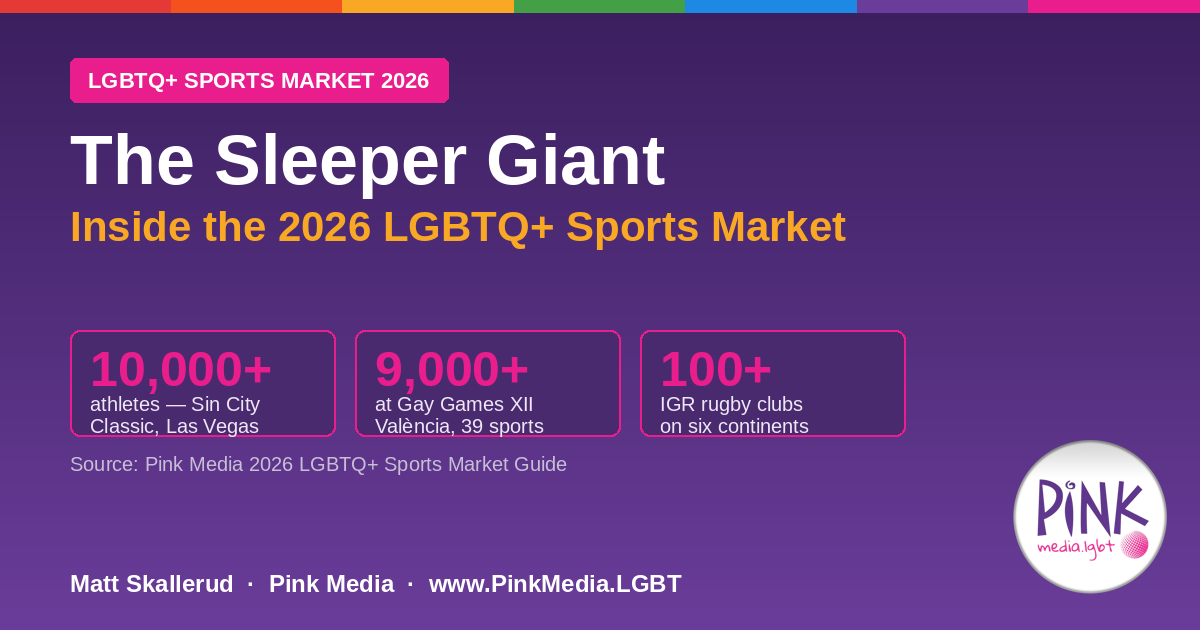
- Sin City Classic — Las Vegas, Jan 16–19 (26 sports, 10,000+)
- Gay Games XII — València, Jun 27–Jul 4 (39 disciplines)
- Bingham Cup rugby — Brisbane, Aug 16–24
- Gay Softball World Series — Columbus, Aug 30–Sep 5
- Gay Bowl XXVI — Twin Cities, Oct 8–11
The Federations Underneath
- International Gay Rugby — 100+ clubs, six continents
- IGLFA soccer — 100+ clubs, 30+ countries
- GLTA tennis · IGLA aquatics · Int'l Pride Softball
- NGFFL flag football — now LA28 Olympic-bound
- Stonewall Sports — 20+ social-sports chapters
Notice the through-line: every group has its event. Softball players, ropers, bowlers, swimmers, flag-football stars — each community's "World Series" is its annual reunion, and sponsorship there reaches the segment at maximum identity. Hotels and airlines should already be here; these are the most bookable, most predictable LGBTQ+ travel events of the year, with hotel blocks literally published on the events' own sites.
The Inclusion Battleground — Read It Clearly
I won't pretend the moment isn't political. Trans-athlete participation is the defining sports-policy fight of the decade: roughly half of U.S. states restrict trans participation in school sports, and elite bodies including the IOC have moved toward tighter eligibility rules heading into LA28. But here's what that does not change — it makes the community-run layer more essential, not less. The Gay Games, the Sin City Classic, and virtually every federation in this guide maintain explicitly trans-inclusive participation policies, many with nonbinary divisions and self-ID registration. As mainstream avenues narrow, these leagues report growing trans and nonbinary membership. The safe-harbor function they were founded to serve is being renewed in real time.
For partners and sponsors, that makes one thing plain: inclusion policy is the first page the community reads. Backing trans-inclusive sport in 2026 carries some political noise — and it earns the deepest loyalty documented anywhere in our research. Precision over panic, athletes over arguments, and — as always — match your message with a mechanism.
Sponsor the Infrastructure, Not the Aesthetic
So what does great LGBTQ+ sports marketing actually look like? After 30 years and a lot of tournament weekends, I'd put it in four rules. One: sponsor the infrastructure, not the aesthetic. Jerseys, field fees, travel funds, and championship titles beat rainbow creative every time — this audience wears its sponsors, literally, for a season. Two: build around the calendar. January in Vegas, spring tours, June–July Pride Runs and Gay Games València, August rugby and softball worlds, October's Gay Bowl — a full-year activation map with published dates and host cities. Three: target like the audience plays. Layer sports data selects onto LGBTQ+ inventory — display, mobile, video, and Connected TV with ACR — geo-targeted to the ZIP codes around venues, host cities, and league bars, then amplify into the strong LGBTQ+ sports communities on social through the #ILoveGay network. Four: show up for the whole season. The league calendar is the original 24/7, 365 channel — a season-long presence at one city league outperforms a one-weekend logo at scale.
"Nobody remembers the ad in the program. Everybody remembers who paid for the trans division's jerseys — and who showed up to the championship game."
Stop Renting. Start Owning.
Here's the line I keep coming back to, and it's really the whole argument of the guide: a Pride float reaches the community for an afternoon; a league sponsorship reaches it every Tuesday night, in uniform, for a decade. Sports is where LGBTQ+ marketing stops renting the community's attention and starts owning it. This community remembers which beer was on the banner when the league had forty players — now that it has four hundred, that brand owns the bar tab. Get in before the growth, stay through the politics.
The full 2026 LGBTQ+ Sports Market Guide goes deep on all of it — the history, the global rugby and soccer federations, the sport-by-sport league universe, the mega-events, the pro-sports and out-athlete story, the inclusion battleground, and the full business-and-marketing playbook with campaign spotlights. This post is the short version. If your brand, destination, league, or event is ready to reach LGBTQ+ athletes and fans where they actually play, we'd love to help you get in the game.