When I talk with brands about LGBTQ+ media, podcasts come up later in the conversation than they should. Social gets the first question. Display and CTV get the budget. Podcasts get a "maybe next quarter."
I think that's backwards. A podcast is the one place in a media plan where the audience chooses to spend half an hour with a specific person, week after week — and when that person tells them about your brand, it lands differently than an ad that interrupts a feed. For LGBTQ+ audiences in particular, the numbers back that up.
Why Podcasts Work So Well for LGBTQ+ Audiences
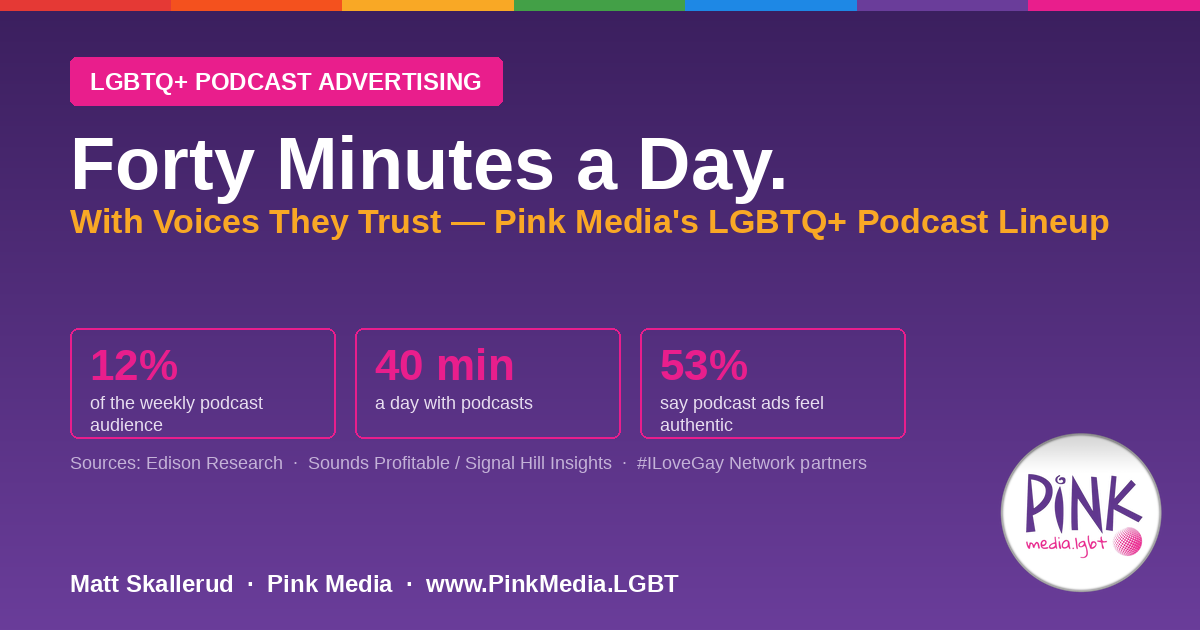
Start with scale. Edison Research's Podcast Consumer 2026 puts U.S. podcast reach at 167 million listeners, or 58% of adults. Within that, Edison Podcast Metrics finds 12% of the weekly audience identifies as LGBT, and Edison's Share of Ear data shows LGBT listeners 13 and older give podcasts about 40 minutes a day.
Then look at how they listen. SiriusXM Media's 2026 Podsurvey of LGBTQ+ podcast listeners found:
| Finding | LGBTQ+ Listeners | What It Means for a Brand |
|---|---|---|
| Follow the same shows weekly | 77% | Frequency builds naturally across a multi-episode buy. |
| Consume more than half an episode per session | 91% | Mid-rolls get heard, not skipped past. |
| Mainly consume long-form podcasts | 84% | Room for a real host-read, not a five-second mention. |
| Prefer free, ad-supported shows over subscriptions | 70% | Ads are part of the deal — and accepted as such. |
| Say podcasts shape how culture and current events are discussed | 84% | A podcast placement sits inside the conversation, not next to it. |
And then there's trust. In Sounds Profitable and Signal Hill Insights' The Advertising Landscape, reported this June, 53% of LGBTQ+ prime podcast users said podcast advertising feels authentic and natural — 14 points higher than the 39% who said the same about social media. That gap is the whole argument for podcasts in one number.
Three Shows, Three Very Different Audiences
Our podcast partners aren't interchangeable, and that's the point. Here are three of the shows we place brands on most — each with a different voice and a different listener. (Partner figures below are as reported in each partner's own media kit or analytics and listed on our network partners page.)
Uncloseted Media — Investigative Journalism, on Video
Uncloseted Media is a nonprofit, LGBTQ-focused investigative newsroom that Spencer Macnaughton launched in 2024. Spencer is an Emmy-nominated, Gracie Award-winning producer, a former 60 Minutes and Wall Street Journal journalist, and an adjunct professor of LGBTQ journalism at NYU. The newsroom's reporting has won awards from the Society of Professional Journalists, the Association of LGBTQ+ Journalists and the NIHCM Foundation, and has been republished or cited by outlets including The New York Times, The Washington Post, CBS News and The Advocate. In February 2026 it launched UNCLOSETED with Spencer Macnaughton, a video podcast that digs into the people, money and power behind anti-LGBTQ ecosystems in the U.S. and Canada, with guests ranging from Drag Race alumni to the reporters behind its months-long investigations. It's distributed on YouTube, Spotify and Apple Podcasts, with full stories on Substack.
Who it reaches: engaged, news-literate listeners who seek out depth — primarily ages 20 to 50, 56% men — and a fast-growing one: the audience is up more than 1,000% since the start of 2025, driven by collaborations with other newsrooms, influencers and celebrities. Its Instagram collaborations regularly top 100K views, and some posts reach more than a million people. How brands show up: a mid-roll read by Spencer himself, sponsored Instagram and Facebook carousels, Instagram and Facebook carousels, inclusion in Spencer's weekly Substack newsletter and banner ads on Uncloseted stories. It's a strong fit for brands that want to be associated with credible, nonpartisan journalism — and for anyone who wants their message heard by people who actually finish the episode.
On the Rocks — Celebrities and Cocktails, 15 Years Running
On the Rocks (@OnTheRocksOnAir) is the weekly entertainment talk show where hosts Alexander Rodriguez and Steven Dehler mix cocktails with celebrity guests — Academy Award, Golden Globe, Tony and Emmy winners among them — and talk entertainment, fashion and pop culture. It's presented by Frontiers magazine, it's been on air for 15 years, and it charts in Apple's top podcasts in the U.S., U.K. and Canada.
Who it reaches: entertainment-loving LGBTQ+ audiences and their friends. How brands show up: host-read ad reads, multi-episode packages, social shorts, and event emcee and red-carpet appearances. Spirits, beauty, fashion, entertainment and travel brands fit naturally here — the cocktail is literally part of the format.
Pride House Media — A Seven-Show Network Led by Peppermint
Pride House Media is a podcast network with seven weekly shows featuring talent including Peppermint, DJ Lina Bradford and Josh Grimm. Its flagship conversation is Queer 101, where Peppermint and historian Hugh Ryan cover queer history, culture and books. Peppermint — a performer, activist and the 2026 NYC Pride Grand Marshal — brings one of the most recognized and trusted voices in the community to every read.
Who it reaches: community-minded listeners across several shows, with a combined monthly podcast audience of 32.7K over the past 28 days. How brands show up: host-read endorsements, cross-platform social, newsletter features and Pride Month integrations. It's the most flexible of the three — one conversation, seven shows, several voices.
The host-read is the ad unit. The trust is what you're buying.
The Bench Behind Them
Those three are the start, not the whole lineup. Our #ILoveGay Network carries a wider set of podcasts and video shows we can build into the same plan:
| Show | Format | Partner-Reported Reach |
|---|---|---|
| The Zach Sang Show | Pop culture, video-first, three episodes a week plus daily radio | 160M+ monthly impressions; 7M+ per episode |
| The Gay Rugby Podcast | Sports and comedy with Jack Higgins and Ozzie Luna | 200M+ views across social; 18–44 audience |
| Gay Code | Weekly red-carpet show with Isaam Sharef | 401K+ direct and partner reach; 1M+ lifetime views |
| Out Loud & Laughing | Comedy and conversation with Jon and Bryan | 60K+ views in 2025; 10K+ followers |
| Queer Travel Chat | Travel, from Two Bad Tourists | Part of a 130K-social, 70K-email travel brand |
| KGAY 106.5 Palm Springs | LGBTQ+ radio | 24K weekly listeners |
That range matters. A travel brand might pair On the Rocks with Queer Travel Chat. A financial-services brand might lead with Uncloseted Media and add Pride House Media. A sports or beverage brand might want The Gay Rugby Podcast front and center. We plan it as one buy and report it as one campaign.
Direct Where It Matters. Programmatic Where It Scales.
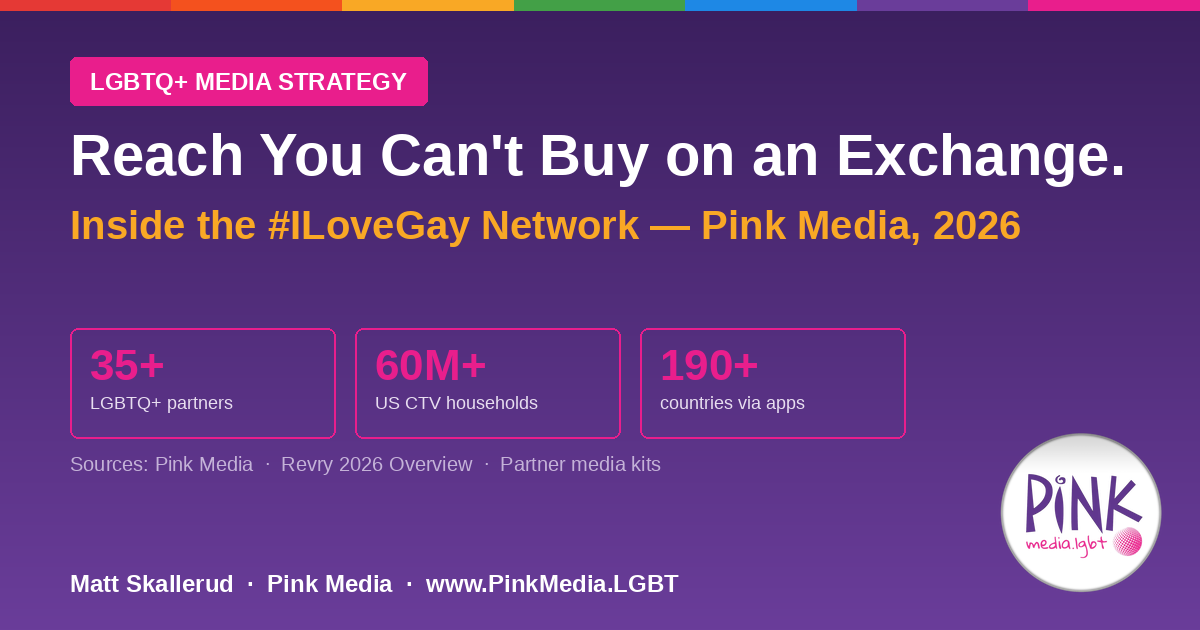
Here's the honest trade-off with independent LGBTQ+ podcasts: the trust is enormous, but each show's audience is finite, and almost none of it is sold through an exchange. I wrote about that gap in Reach You Can't Buy on an Exchange — host-reads are negotiated person to person.
So when a campaign needs reach beyond the shows themselves, we add a programmatic podcast layer through Mission Media, the New York-based media monetization and advertising company. Its proprietary Content Hub gives us show-level planning data, contextual discovery of what shows are actually discussing, live inventory and pricing, and in-platform activation and pacing — across podcasting, streaming audio and CTV.
The piece I care about most is quality. In September, Mission Media introduced a Quality Score that rates each show over time on audience size, ad slots and avails, listener ratings and reviews, and publishing recency, and runs ongoing invalid-traffic verification to confirm real listeners. Inventory is sorted into Premium, Long-Tail and Unverified tiers. For LGBTQ+ campaigns, that means we can find contextually relevant episodes and shows at scale — and keep the budget away from feeds that aren't really being heard.
Direct Host-Read Sponsorships
- The host's own voice and endorsement
- Highest trust and recall
- Social, newsletter and event extensions
- Inside LGBTQ+-owned media, by design
- Finite audience per show
Programmatic Podcast via Mission Media
- Contextual targeting by topic and episode
- Audience segments across 500K+ feeds
- Live inventory, pricing and pacing
- Quality-scored, IVT-verified shows
- Scale that extends the host-read message
Neither replaces the other. The host-read is where the trust comes from. Programmatic is how that message reaches the larger audience that's listening to LGBTQ+ topics across thousands of other shows.
How a Podcast Plan Comes Together
1. Pick the voices first. Match the brand to one or two anchor shows whose hosts can endorse it credibly — investigative, entertainment or community.
2. Buy in runs, not spots. With 77% of LGBTQ+ listeners following the same shows weekly, a multi-episode package does the frequency work for you.
3. Give hosts talking points, not a script. A :30 host-read or a set of talking points is the standard spec in our media kit — the host's own words are what listeners trust.
4. Extend beyond the audio. Most partners include social shorts, carousels and newsletter features, so the sponsorship shows up where the audience scrolls, too.
5. Add programmatic scale. Use Mission Media's contextual and audience targeting to carry the message to LGBTQ+-relevant episodes across the wider podcast universe.
6. Report it as one campaign. Direct and programmatic results come back together, with partner figures clearly labeled as partner-reported.
The practical version: if you're planning Q1 or Pride 2027, start with one anchor show and a four-to-six-episode run, add social and newsletter extensions, and wrap a programmatic podcast flight around it. It's a plan that earns trust where the community already listens — and still reaches the scale a media plan needs.
The Takeaway
LGBTQ+ listeners give podcasts real time and real trust. The shows they choose — an investigative newsroom, a 15-year celebrity talk show, a network led by one of the community's most recognized voices — are exactly where a brand message is heard as a recommendation instead of an interruption.
Pair those host-reads with programmatic reach through Mission Media, and you get both things a media plan usually has to choose between: trust and scale.
You can see the full list of podcast, creator and publisher partners on our #ILoveGay Network page, rates and specs in our media kit, and the broader market picture in the 2026 LGBTQ+ Marketplace Guide.
- #ILoveGay Network Partners — Pink Media. Partner-reported figures for On the Rocks, Pride House Media and the full podcast, creator and publisher lineup.
- How to Reach LGBT Consumers — Edison Research. 12% of the weekly podcast audience identifies as LGBT (Edison Podcast Metrics).
- Share of the Ear Data Details Pride and Podcasts — Radio Online, on Edison Research. LGBT listeners 13+ spend 14% of daily audio time, about 40 minutes, with podcasts.
- Podcast Ads Earn Higher Trust From LGBTQ+ Consumers Than Social Media — Net Influencer, June 15, 2026, on Sounds Profitable and Signal Hill Insights' The Advertising Landscape.
- Pride, Podcasts, and the LGBTQ+ Audience Opportunity — SiriusXM Media, Podsurvey Podcast User Study, Q1 2026.
- Edison's Podcast Consumer 2026 — RAIN News summary. 167 million U.S. podcast listeners, 58% of adults.
- Mission Media Unveils Proprietary Content Hub · Mission Media Quality Score — Podnews. Content Hub capabilities, scale and quality tiers.
- Uncloseted Media Media Kit · Uncloseted Podcast Media Kit · On the Rocks · Queer 101 from Pride House Media — the shows themselves.
- Reach You Can't Buy on an Exchange — Pink Media. Why most LGBTQ+ creator and podcast inventory is sold directly.