I've been in this business since 1995, and there's no part of the LGBTQ+ marketplace I feel more personally about than this one. Before the apps, before the networks, before any of what I do now existed — there was the bar. It was the first place a lot of us found each other, and for a long stretch of American history it was the only place. So when I tell you the new Alcohol, Spirits & Gay Bars Market Guide — the thirty-third companion to our 2026 LGBTQ+ Marketplace Guide — is one of the most important we've published, that's why.
Here's the headline: the gay bar survived police raids, the plague years, and a 45% decline. And it's being reinvented right now by a community that has never been good at disappearing. This is a renovation, not a wake.
The Bar Was Never Just a Bar
In the 1950s and '60s, almost no establishment welcomed openly gay people — except the bar. That made it, as we put it in our ILoveGay.NET editorial series, the courthouse where you could be yourself, the living room where you found family, the message board, the dance floor — and often the only address in town where you weren't alone. It was also dangerous. Bars were raided for decades, and the community's liberation history is written at their doors: the 1967 police raid on LA's Black Cat Tavern sparked a 200-person demonstration that helped give rise to The Advocate; the 1969 raid on the Stonewall Inn ignited the modern movement. In the AIDS years, those same rooms became fundraising halls, information centers, and grief rooms.
I bring this up for a business reason, not a sentimental one. Every drink sold in a gay bar carries that inheritance, and the audience knows it. The spirits category's standing in this community was earned in these rooms. The corollary cuts just as hard: in rooms this historically charged, retreat is remembered as betrayal. The history isn't a garnish for this market — it's the terms of trade.
The 45% Decline — and the Counter-Trend
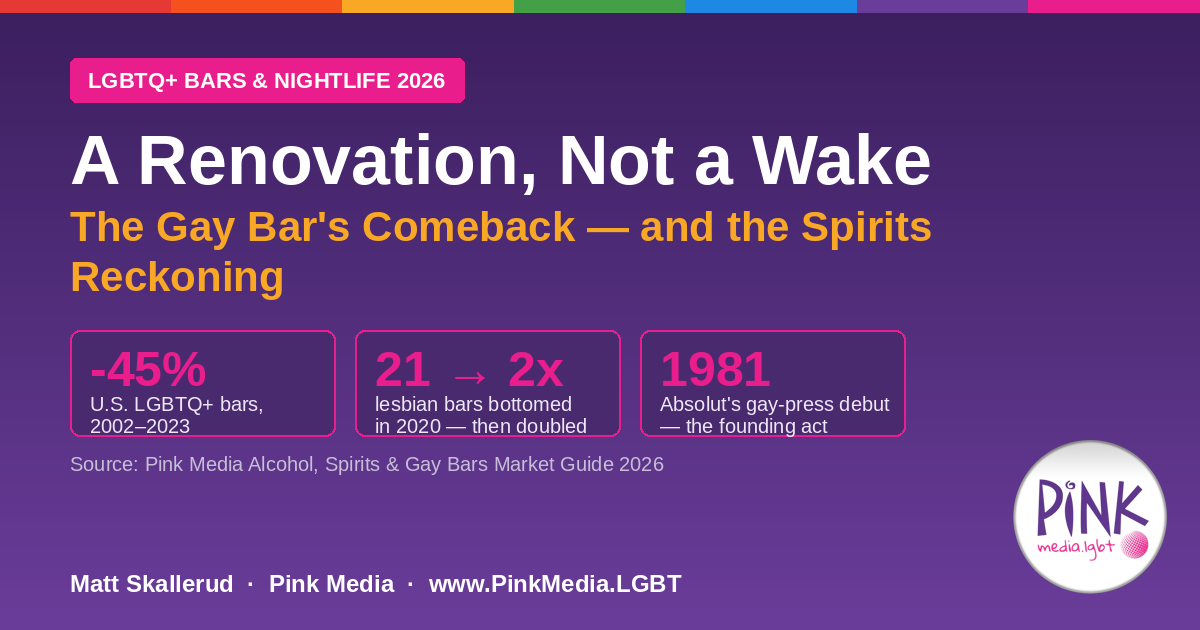
Now the sobering math. Between 2002 and 2023, U.S. LGBTQ+ bars fell by roughly 45% — institutions that survived raids and the AIDS crisis, priced out by rents, gentrification, and the app era's new geography of connection. Lesbian bars fell hardest of all: from around 200 in 1980 to just 21 by 2020.
But the 2020s turned the lesbian-bar collapse into this category's brightest story. The Lesbian Bar Project — filmmakers Erica Rose and Elina Street, and an Emmy-winning docuseries — rallied national support and fundraising, and the count has roughly doubled. Portland's The Sports Bra opened in 2022 and launched an entirely new genre, the women's sports bar, now expanding nationally. And new queer venues increasingly open as broader, more intentional third places — sports bars, cafés, bookstore-bars, event spaces — designed for community first and nightlife second.
Two things follow from that, and both matter commercially. First, the surviving venues are stronger properties — consolidation left the remaining bars with deeper community roles, bigger event calendars, and more concentrated audiences per room. Better sponsorship value per venue than the pre-decline map ever offered. Second, the revival is investable: new venues are opening with community-ownership models, crowdfunding, and brand partnerships built in from day one.
"The 2026 venue map is smaller than 2002's — but it's more intentional, more diverse in format, and more loved per square foot than it has ever been. This is a renovation, not a wake."
How We Found the Door — From FunMaps to the Phone
There's a thread running through this guide that I have a personal stake in. A community that couldn't ask for directions built its own navigation system, era after era. Bob Damron's Address Book used coded language to point travelers to safe doors — historians compare it to the Green Book. Free bar rags were each city's LGBTQ+ media. Alan Beck's Columbia FunMaps put whole gay scenes on free fold-out maps, city after city, for more than 32 years. Then the web arrived — Gay.com, PlanetOut, and my own GayWired.com in May 1995 — and bar listings became living documents. Then the smartphone put the directory in your hand.
The honest accounting is that apps were one force among several behind the decline, alongside rents and gentrification and, frankly, acceptance. But the same era proved the room was never obsolete. And today Art Smith's GayBarchives preserves the memory of the ones we lost — 5,500+ reconstructed logos and a 65,000-member community that never forgets who showed up.
"The coded address book, the bar rag, the fold-out FunMap, the online directory, the app — all of them are the same act of community care, re-tooled for the tools at hand."
The Spirits Reckoning: Absolut vs. Bud Light
Now to the part every beverage marketer needs to sit with. This category has both the deepest heritage and the freshest scars in all of LGBTQ+ marketing, and the two poles have names.
Absolut began advertising in the gay press in 1981 — decades before nearly every corporate rainbow, when no other major brand would buy the page. Four-plus decades of unbroken presence built the category's deepest brand equity and the template every marketer still studies. Then there's Bud Light in 2023: an influencer partnership abandoned under pressure that alienated both sides, cost the brand its #1 position, and taught this market that walking back reads worse than never showing up. The 2025 beverage-sponsor retreat compounded it, thinning the category's traditional funding of queer nightlife exactly when venues needed it — and leaving flagship inventory open.
Forty years of Absolut versus one season of Bud Light is the whole curriculum. In this category, commitment is the brand asset and hesitation is the brand risk. Which is also the opportunity: with legacy sponsors wobbling, brands that commit now inherit four decades of category goodwill at a discount. The Absolut position is, briefly, open for applications.
The Sober Shift — an Opportunity, Not a Threat
The fastest-growing seat at the bar doesn't have a drink in front of it. Gen Z drinks less than any modern generation, and queer Gen Z leads the third-place shift toward venues where the drink is optional — sober Pride spaces, zero-proof drag brunches, café-hybrid queer nights. Recovery also runs deep in LGBTQ+ life, and sober queer socializing has moved from the church basement to the main calendar.
I'd encourage brands to read this as opportunity rather than threat. For venues, a zero-proof menu widens the door without dimming the party — the sober friend chooses where the group goes more often than anyone admits. For alcohol brands, owning a serious NA line and funding sober spaces and harm-reduction programs (water, safe rides, medic support) is the credibility move of the decade: it says the brand serves the community, not just its liver. And for the NA challengers, the LGBTQ+ zero-proof shelf is nearly unbranded territory. First movers with authentic community presence can own it outright.
Bars Are Media — Buy the Programming, Not the Shelf
Here's the reframe I give every beverage client: a gay bar is a media property with a liquor license. Nightly programming, a loyal audience, a talent roster, and a content machine. Drag is the anchor tenant — residencies, brunches, and premiere-night viewing parties are the bar calendar's superbowls. Sports watch culture fills the daytime and early-week gaps. Trivia and bingo keep Tuesday alive. And the circuit and festival layer — Pride season, Market Days, Decadence — are the weeks when a venue's year is made.
Treat it that way and the tactics get obvious: sponsor the drag night rather than the bottle placement, pay the queens and hosts and DJs directly because they carry the goodwill, capture and amplify the nightly content, and geo-target the show nights and event weekends when mobile reach actually converts at the door.
The Headwinds
- Rents that closed a generation of bars haven't eased
- The post-2023 beverage retreat thinned venue funding
- Long-term decline in alcohol consumption
- Security is now a permanent line item
The Tailwinds
- Lesbian bars doubled; the map is growing again
- The room won the argument over digital-only connection
- Heritage compounds — age converts to tourism and press
- The loyalty premium is on the table for brands that commit
The Commitment-First Playbook
If I had to compress the guide's best practices into what I'd actually say on a call, it's this. Commit or don't come — a retreat costs more than absence, so enter this category with board-level resolve. Fund venues visibly: rent relief, renovation grants, insurance, security underwriting. Keeping doors open is the category's premium sponsorship, and organizers rank these needs first. Sponsor openings, not just anniversaries — new-venue partnerships buy founding-family status in rooms that will remember for decades. Serve the whole bar with zero-proof lines and safe-ride programs. Honor the lineage through heritage and archive partnerships. Support the finding layer — directories, maps, and event platforms are the modern bar rag. And stay through the year, because June-only beverage marketing reads exactly as fair-weather as it is.
A responsible-marketing note. Alcohol campaigns in this market should follow category law and platform rules, respect sober and recovery spaces, and pair any nightlife presence with moderation and safe-ride programs — positions this community actively rewards. The fastest-growing part of the room increasingly chooses where the drink is optional.
This Market Rewards the Long Game
The pattern across every best-in-class example in this guide is the same. The brand that stayed forty years. The campaign that saved the bars. The mapmaker who never stopped. The archivist who remembers. This market rewards the long game — and it keeps receipts on everyone who didn't play it.
The full Alcohol, Spirits & Gay Bars Market Guide goes deep across all 15 chapters — the bar as institution, the maps-to-mobile navigation story, the decline-and-revival data, the bar-goer segments, the venue landscape, the spirits category, the sober shift, the revival playbook, bars as media, and the full best-practice playbook with campaign spotlights. This post is the short version. If your brand or your venue is ready to build real, year-round presence in LGBTQ+ nightlife, we'd love to help you pick your model and commit.