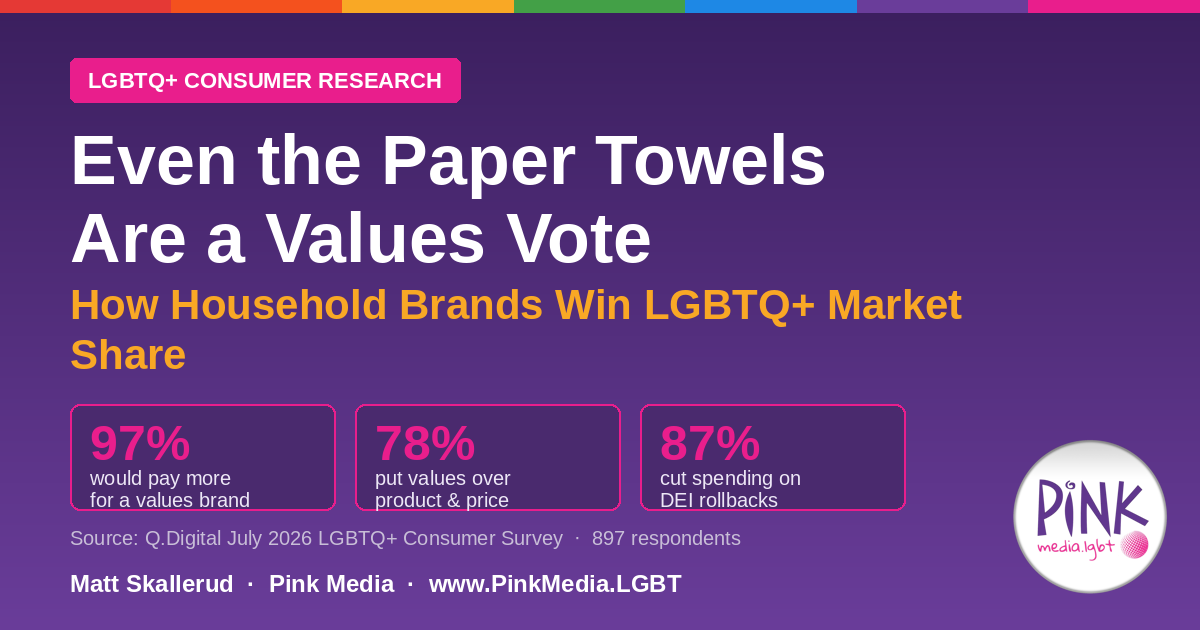
I've been mapping the LGBTQ+ marketplace since 1995, and every so often a data set lands that reframes the whole conversation. This is one of them. Q.Digital — the parent company of Outsports, GayCities, Queerty, LGBTQ Nation and INTO — just completed a survey of 897 LGBTQ+ consumers on media awareness tactics and corporate positions, and the results keep proving out the value of this community — but the finding that stopped me is this: even household brand choice — cleaning supplies, detergent, paper towels — is influenced by a brand's values, not the actual cost of the product. That's the aisle marketers assume is won on price and shelf placement. It isn't. Not with this consumer.
Household brands looking for an edge to attract new consumers have a real opening here. LGBTQ+ people are an estimated 9.3% of the population — and roughly 1 in 4 Gen Z adults. And the consumer changes aren't theoretical or coming someday; they're already happening, based on what people have learned about where corporations stand.
"In these times, brand marketers are being tasked to justify their footing in diverse spaces with more research, more data. The good news is that LGBTQ marketing is a data-backed business case for growth supported by research from every major outlet and hundreds of case studies across industries. This latest survey unpacks one of the harder areas to measure: household products choice. Turns out what we know is now quantified: values in the household translate to a cash register ring. Where brands show up, how they speak to the community, and the media choices they make — are a bridge to that cash register receipt."
The Rollback Receipts Are In
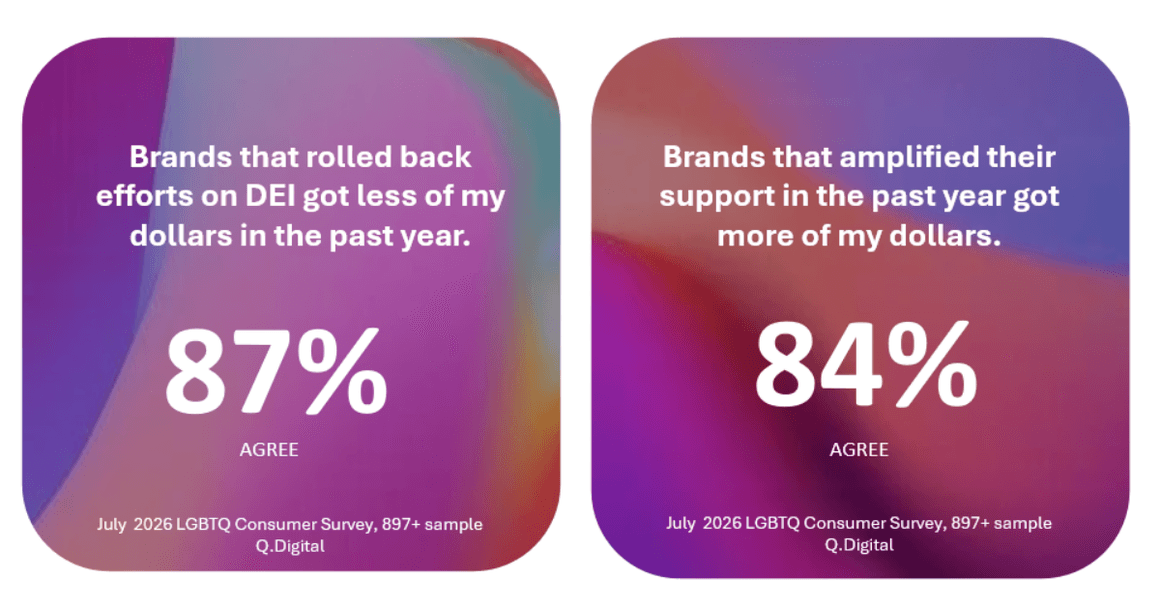
LGBTQ+ respondents say they are making different brand-choice decisions based on what they've learned about corporate positions on DEI over the past year. The community has been keeping score — and it's spending accordingly.
Source: Q.Digital — July 2026 LGBTQ+ Consumer Survey (897+ sample)
These findings echo recent consumer data from the Human Rights Campaign — this isn't an outlier reading. When a brand retreats, this community notices, and the response shows up at checkout. When a brand leans in, the same thing happens in reverse. For a household brand fighting for a point or two of market share, that's not a soft "brand sentiment" metric. That's the whole game.
How Corporations Actually Win LGBTQ+ Consumers
So what earns those dollars? We asked, and the answers should reorder a few marketing budgets. Support of LGBTQ+-owned businesses tops the list — and notice how much of what follows is about where a brand puts its money year-round, not what it says once a year.
Read that list from the top and a pattern jumps out. The tactics the community values most — supporting LGBTQ+-owned businesses, showing up in LGBTQ+ media year-round, funding the non-profits — are the ones that require a real, sustained commitment. The single most Pride-seasonal move on the list, June event sponsorship, sits at the bottom. This community rewards presence, not a logo swap in June.
Values Over Cost — Even in the Cleaning Aisle
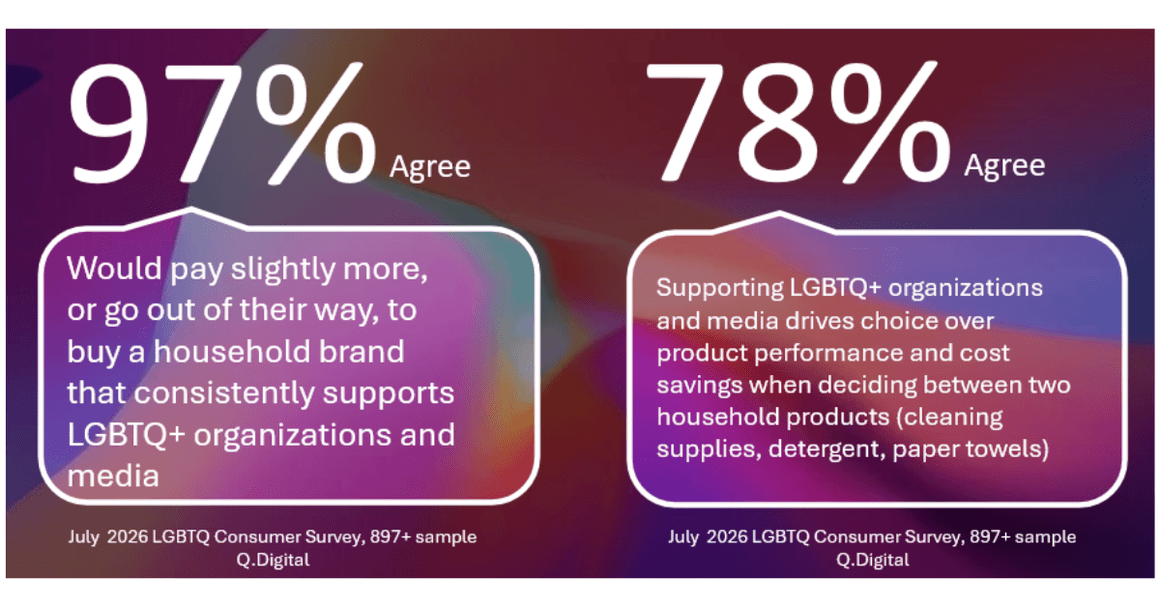
Here's where it gets uncomfortable for the "features and benefits" school of marketing. Plenty of household brands lean on product performance to drive the sale — whiter whites, more absorbent sheets, a lower price per load. With a consumer who's paying attention to what corporations do with their influence and investment, that may simply not be enough.
Source: Q.Digital — July 2026 LGBTQ+ Consumer Survey (897+ sample)
"When 78% of a community will choose your detergent over a cheaper, better-performing one because you show up for them — that's not a niche. That's a market share strategy hiding in the cleaning aisle."
So How Should Brands Connect With This Consumer?
Knowing values drive the purchase is only half of it. The other half is where the persuasion actually needs to happen — and the research points to a clear combination: LGBTQ+ media at scale, trusted influencers in the right environments, and content that feels authentic to both the brand's product and the platform it lives on. Three findings map the route.
First, LGBTQ+ Media Drives Trust
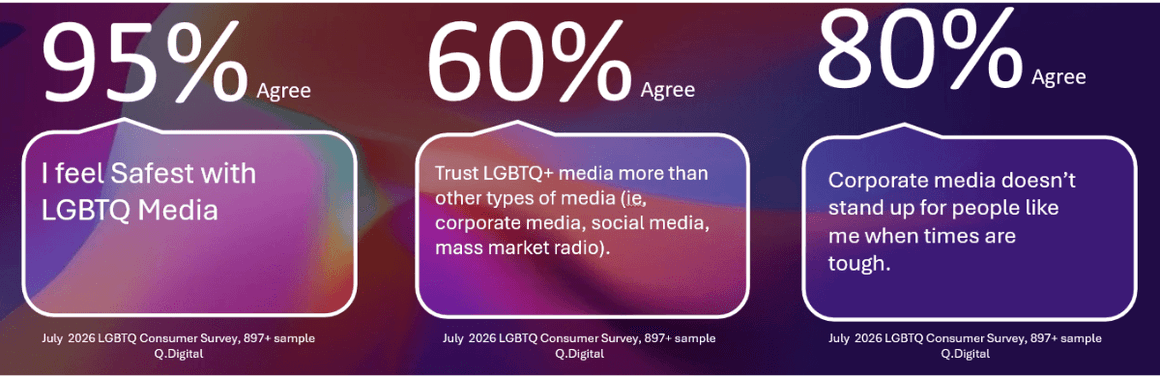
In a fractured media landscape — and at a moment when the rights of LGBTQ+ people are genuinely in question — respondents overwhelmingly expressed concern about mass-market and corporate media, and a strong preference for LGBTQ+ media as the safe place to be reached.
Source: Q.Digital — July 2026 LGBTQ+ Consumer Survey (897+ sample)
Put simply: the environment your message runs in is doing part of the persuading. A product truth that lands as generic in mass-market media reads as real when it runs in a space the community already trusts.
Second, Influencers Are Trusted — Platforms Are Not
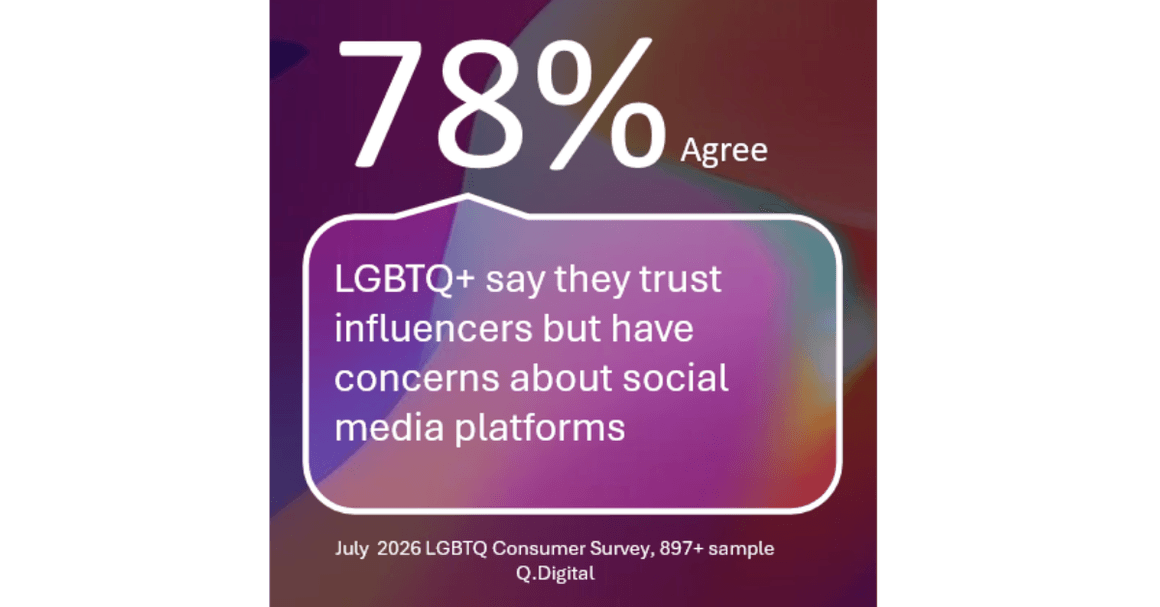
78% of LGBTQ+ respondents say they trust influencers, but have real concerns about social media platforms. Why the split? GLAAD has pointed it out each year in its Social Media Safety Index: platforms like Meta, X, and TikTok repeatedly fail to provide enough safeguards against hate on open social. So the trust attaches to the person, not the pipes. The data points to leveraging influencers on LGBTQ+ media, and on closed social, for the strongest and safest position.
Source: Q.Digital — July 2026 LGBTQ+ Consumer Survey (897+ sample)
Third, the Content Topic Makes the Difference
We asked what makes people trust an influencer's recommendation on household products the most. The answer isn't polish — it's authenticity and everyday life. This is the creative brief, straight from the consumer.
The takeaway is a working model, not a mystery: collaborate with trusted LGBTQ+ media companies to create content that's authentic to LGBTQ+ lives — everyday household moments, personal and chosen-family stories, a little humor — with the product woven in naturally, then distribute that content in trusted LGBTQ+ media spaces. That's Content as Advertising, and it's exactly how this consumer wants to be reached.
What Media Buying Choices Will Drive Awareness?
When we moved from message to media plan, the format rankings ran against a lot of conventional wisdom. Across every format, content aligned with an authentic voice tops the list at 60% — narrowly ahead of display at 58%. Social posts follow at 46%, short-form video at 35%, online video at 34%, and CTV trails at just 13%. That ranking should reorder a lot of plans that currently treat connected TV as the premium buy and display as an afterthought.
And the type of content alignment matters just as much. Home and lifestyle content is the intuitive fit for a household product (57%) — but it's also a space cluttered with competition. The surprise is what sits right beside it: LGBTQ+ news is in one of the strongest positions at 54%, followed by LGBTQ+ entertainment and pop culture (39%), travel (26%), and sports (23%) — environments most household brands overlook entirely.
Where To Align Your Content
- Home & lifestyle — 57% (intuitive, but crowded)
- LGBTQ+ news — 54% (high trust, under-bought)
- Entertainment & pop culture — 39%
- Travel — 26%
- Sports — 23%
The Plan Most Brands Run
- CTV treated as the premium buy — ranks last at 13%
- Display bought as an afterthought — actually 58%
- Authentic content underweighted — actually #1 at 60%
- Home & lifestyle only — missing the news environment
"The content alignment tells you exactly where the persuasion needs to happen. For household brands, that's LGBTQ+ news and authentic voices — not the connected-TV line item everyone's overspending on."
The Bottom Line for Household Brands
When 94% of a community consider it an important cause for corporations to support LGBTQ+-owned businesses through real advertising spend and supplier diversity — not just messaging — that's an indicator that media plans need to be re-written to include segments they've long overlooked. The household aisle has quietly become a values vote, and the brands that treat it that way get to steal share from the ones still competing on price alone.
None of this requires a brand to shout. It requires showing up in the right places, with authentic content, consistently — the storytelling, the media planning, and the corporate positions all pulling in the same direction. That's the work we do at Pink Media every day: helping brands build authentic, year-round LGBTQ+ presence through trusted media and the right creator partnerships. With gratitude to Q.Digital for the research behind this piece — if your household brand is ready to turn these numbers into a plan, we'd love to help.