If you want to see where the smart marketing money is going in 2026, don't watch the brands that are pulling back — watch the ones stepping forward to take their place. All Pride season I've watched national consumer brands go quiet, soften their language, and hedge their bets. And I've watched a different category walk right into the space they vacated: destinations and travel brands. They're filling the Pride marketing gap, and they're doing it because travel has a structural advantage nobody else has — for a destination, welcoming LGBTQ+ visitors isn't a campaign bolted onto the business. It is the business.
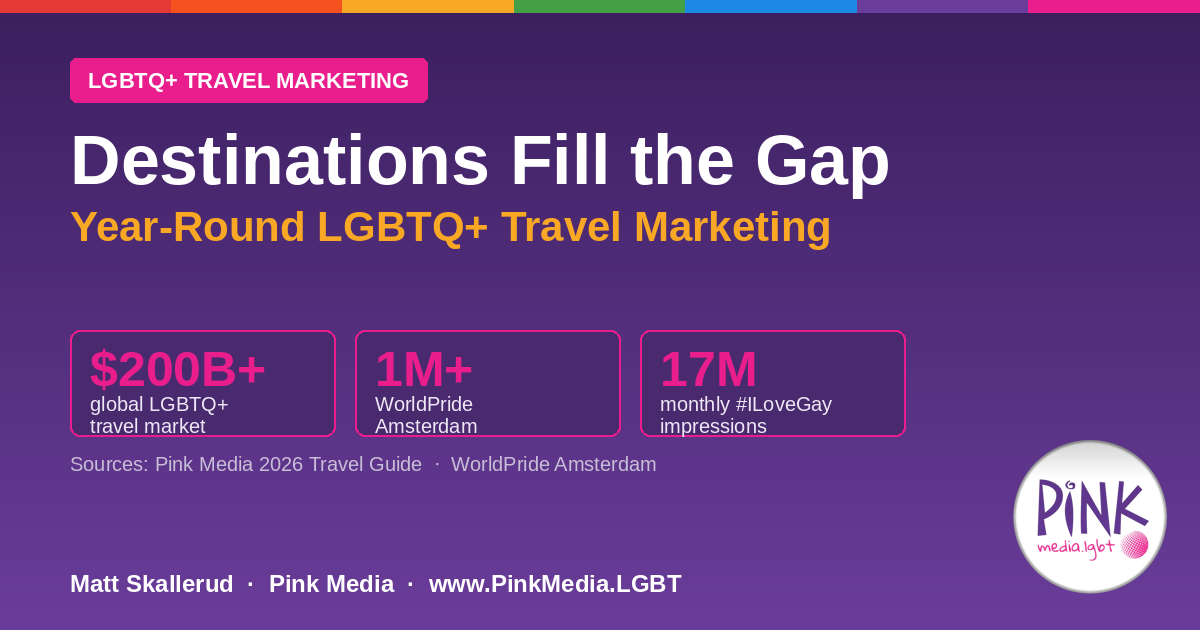
The prize is enormous: a $200 billion-plus global LGBTQ+ travel market, and one of the most loyal, high-value, well-researched audiences in all of tourism. LGBTQ+ travelers take more trips, spend more, index far higher on international travel, and reward the destinations that make them feel genuinely welcome — with bookings and with word of mouth. We map the whole market in our 2026 LGBTQ+ Travel Market Guide. But the fastest way to understand the moment is to look at three destinations and travel brands that got it right in the last few weeks — and pull the playbook out of what they did.
Case #1 — Taiwan: A Destination Debut That Became a Funnel
On June 28, the Taiwan Tourism Administration and the Taipei Economic and Cultural Office in San Francisco made a historic debut at the 56th San Francisco Pride Parade — Taiwan's first-ever themed float, under the "Taiwan in SF" banner. From the curb it looked simple. Underneath, it's a masterclass. Taiwan led with its single strongest credential — the first country in Asia to legalize same-sex marriage — because in a market where LGBTQ+ travelers weigh safety and acceptance before anything else, that's the headline, not the footnote. It reached the community exactly where the community was. And the creative was gloriously specific: Taipei 101, Pingxi sky lanterns, the Alishan Forest Railway, bubble tea, OhBear the mascot — a place you could actually picture visiting.
The move most destinations miss: the funnel
Taiwan didn't stop at the parade. It aligned its float to SF Pride's 2026 theme, "Resistance in Action!", then used the moment to invite Bay Area travelers onward to Taiwan LGBT Pride in Taipei on October 31. The San Francisco parade wasn't the destination of the message — it was the top of it. Show up where the community celebrates now, connect authentically, and point people toward a specific next step, on a date, half a world away. Most destination Pride activations end at the parade route. Taiwan's began there.
Case #2 — SWISS: Visibility That Travels, Framed Year-Round
On June 1, Swiss International Air Lines rolled out rainbow-themed livery across its global network — but the livery was only the headline. SWISS carried the welcome inward: onto seat-back screens, into cabin announcements, across digital signage, so the message a plane-spotter sees on the tarmac is the same one a passenger sees settling into their seat. Around it, a full-funnel social push on Instagram, X, and Facebook. An airline is a uniquely powerful Pride partner precisely because a rainbow livery is mobile, public, and crosses borders by design — few brands get to fly their values 40,000 feet in the air across a continent.
The framing that gave it staying power
SWISS positioned the activation as an expression of values it carries year-round — not a seasonal flourish. In a year when plenty of brands are quietly shrinking their rainbows, that framing is a deliberate, meaningful choice: a claim the airline can be held to in September and December, not just June. The rainbow livery gets the photo. The onboard experience and the year-round framing are what turn a photo into a relationship — the difference between decoration and a story to tell.
Case #3 — WorldPride Amsterdam: The Global Moment Is Here
And then there's the main event. WorldPride Amsterdam 2026 runs July 25 through August 8, with approximately 1 million visitors expected — a majority-LGBTQ+, internationally diverse, deeply engaged travel audience that planned this trip and booked flights to have it. WorldPride is the world's largest dedicated LGBTQ+ event, awarded by InterPride roughly every two years, and its return to Europe is a genuine tentpole. The official campaign, "The New Dutch Masters" by agency Geminaes — a black-and-white-to-technicolor hero film with more than 70% of its makers identifying as LGBTQIA+ — reset the creative bar for the entire industry.
Travel and hospitality are the first movers — and there's still room
Airlines, hotel groups, and tourism boards are historically the first to activate around WorldPride, and Amsterdam is no exception. What's notably absent — and where the opportunity sits — is US-based brands that assume WorldPride is "for European brands." It isn't: one million visitors means a massive segment of Americans abroad, and the campaign's digital reach extends far beyond the canals. The high-leverage windows are before (now through July, while travelers plan and book), during (July 25–Aug 8, geo-targeted mobile in-market), and after (recaps and community stories that circulate for weeks).
Read the full WorldPride Amsterdam brief on the #ILoveGay Network →
"When corporate sponsors retreat from Pride, they don't take the audience with them. The LGBTQ+ traveler is still booking flights, still filling hotel blocks, still deciding where to go next. The destinations that show up now inherit an audience the retreating brands abandoned."
Why Travel Wins This Moment
Put the three together and the pattern is unmistakable. Taiwan solved invitation. SWISS solved consistency. Amsterdam is the global stage. And all three share the thing that makes travel the natural home for authentic LGBTQ+ marketing right now: the product itself is the proof. A destination that's genuinely welcoming can demonstrate it; a rainbow logo can only claim it. LGBTQ+ travelers can tell the difference between a place that slapped a rainbow on an ad and a place that welcomes them and can prove it — and they reward the second kind with the loyalty this category is famous for.
What Winning Destinations Do
- Lead with proof of a genuine welcome (safety & acceptance first)
- Show up where the community actually gathers
- Make the creative specific to the place — imaginable, bookable
- Build a funnel: parade moment → a real next step with a date
- Sustain presence year-round, not one Pride month
What Leaves the Booking on the Table
- A generic rainbow ad broadcast to everyone
- June visibility that vanishes on July 1
- Safety and welcome treated as an afterthought
- A one-day event presence with no next step
- Assuming a global moment "isn't for us"
How to Reach LGBTQ+ Travelers Year-Round — Through the #ILoveGay Travel Channels
This is where Pink Media comes in, and it's exactly the work we've done since 1995. Reaching LGBTQ+ travelers isn't about buying broad, untargeted tourism ads and hoping the right people see them — it's broader yet more targeted: putting your destination content in front of the exact travelers deciding where to go next, in the moments they're most receptive. We do that through the #ILoveGay travel channels — 17 million monthly LGBTQ+ impressions across display, social media (25M reach), email (250,000 recipients), mobile apps, and connected TV. It's Content as Advertising: we take your destination story and run it as advertising to the community that's planning its next trip.
And because travel is a planning cycle, we build it in three windows. Before the moment — while travelers are booking flights and hotels — is the highest-leverage window for destination content and travel-adjacent brands. During the event, geo-targeted mobile advertising in-market — including full-screen mobile placements that regularly deliver near-5% click-through — reaches attendees on the ground. After, recaps and community stories keep your destination in the conversation for weeks. That's the 24/7, 365 approach in travel form: not a June flag, but a year-round relationship with the most loyal audience in tourism.
"The corporate retreat from Pride didn't shrink the LGBTQ+ travel market. It just opened a lane. The destinations that drive into it now are the ones travelers will remember for years."
The gap is real, the audience is ready, and the models are already on the road, in the air, and on the canals of Amsterdam. If you're a destination, tourism board, DMO, airline, hotel group, cruise line, or tour operator ready to reach LGBTQ+ travelers authentically — this Pride season and all 365 days around it — that's exactly what Pink Media and the #ILoveGay travel network are built for. Let's put your destination in front of the travelers most likely to book.