I've been watching the corporate retreat from LGBTQ+ visibility for a while now — since at least the summer of 2023, when the double boycott cycle around Bud Light, Target, and Disney sent a chill through every boardroom in America. What happened next wasn't surprising to those of us who have been in this space for 30 years: a lot of companies decided that the path of least resistance was to step back, go quiet, and wait for "better conditions" to return to LGBTQ+ support. The problem, of course, is that for us in the LGBTQ+ community, there's no waiting. We don't have the luxury of just pulling back, jumping back into the closet and waiting for a better day.
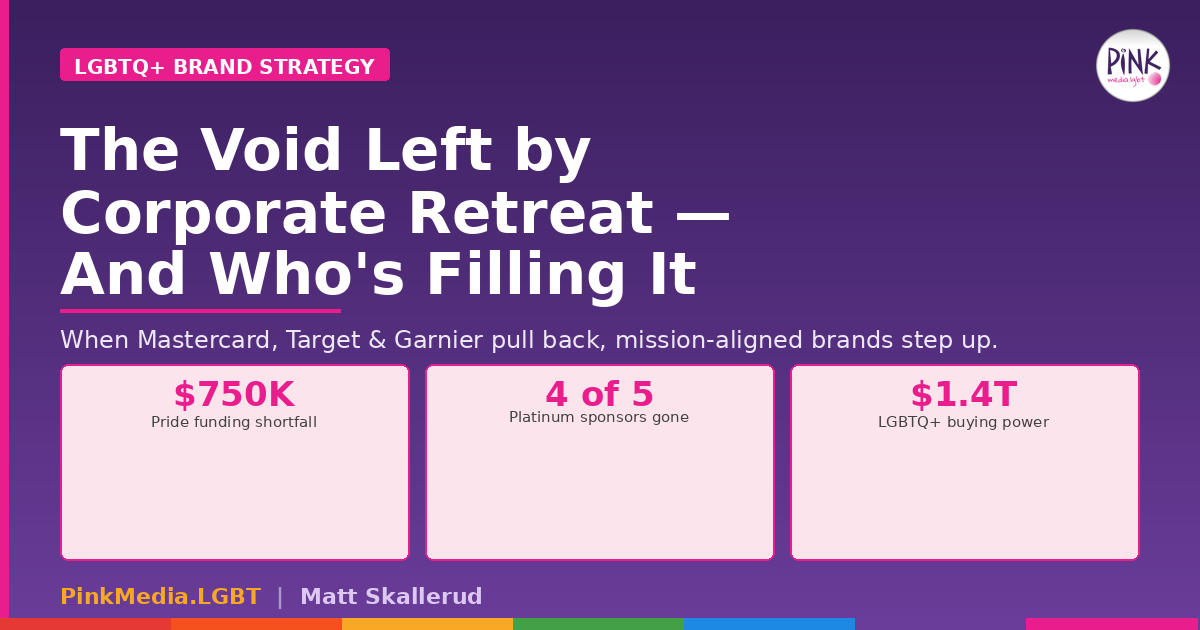
So here we are in 2026, with NYC Pride facing a $750,000 budget shortfall — and four of last year's five Platinum corporate sponsors either gone entirely, drastically reduced, or hiding as "silent partners." Mastercard. Target. Garnier. Skyy Vodka. All Platinum-level last year. All either out or unpublicized this year. Citi, Nissan, PepsiCo, and PricewaterhouseCoopers have drastically reduced their support for Heritage of Pride as well. The fear, as company representatives have put it, is blowback from the current political climate.
I've said this to The New York Times and I'll say it again here: "A lot of bigger companies are taking a back seat because they are afraid to be boycotted from either the left or the right." That fear is real. But what those companies are getting wrong — strategically wrong, not just morally wrong — is what that fear actually costs them.
What the Community Is Seeing — And Saying
Here's the thing about the LGBTQ+ community and brand loyalty: it's long. This is a community that remembers who showed up when it mattered. The brands that came to Pride in 2015, in 2018, in 2021 — and kept showing up — those brands have built something that can't be bought with a single sponsorship check. Conversely, the brands that are suddenly "silent partners" or whose names simply don't appear in the sponsor lists this year? That's being noticed too. It's being talked about. It spreads across social media faster than any press release.
LGBTQ+ consumers are among the most brand-conscious, brand-loyal, and socially networked consumers in any market. Studies consistently show that 71% of LGBTQ+ consumers are more loyal to brands that affirm their identity — and equally more likely to actively redirect their spending away from brands that pull back. When a company goes from Platinum sponsor to "silent" in the span of 12 months, the community doesn't just notice the absence. They remember the retreat. And they talk.
"Some companies were only in it halfheartedly, and they weren't completely our partners. The pullback reveals that — and the community is taking note."
Who Stayed — And What They Have in Common
Now here's the part that I think gets under-reported, because it's easy to write the headline about the brands walking away. The more interesting story — strategically, at least — is about the ones who didn't.
L'Oréal is the only remaining Platinum sponsor from last year's lineup, held through its Out @ L'Oréal LGBTQ+ employee group. Deutsche Bank stepped up — committing $100,000 and moving to Platinum level. Marriott has maintained its long-standing LGBTQ+ commitments, including its #LoveTravels program, which has been a genuine, year-round engagement with the queer travel community — not a Pride Month activation, but a permanent brand stance. Hilton continues its LGBTQ-friendly destination and travel program. Wegmans, the regional grocer, has been showing up authentically for years. Giant Food. VIDA Fitness. The Human Rights Campaign. And a collection of smaller, mission-aligned companies that were never chasing the optics of a big Pride sponsorship — they were in it because the LGBTQ+ community IS their community.
Pulled Back or Gone Silent
- Mastercard — Platinum last year, out in 2026
- Target — "silent partner," no public mention
- Garnier — Platinum last year, out in 2026
- Skyy Vodka — Platinum last year, out in 2026
- Citi — drastically reduced support
- Nissan — drastically reduced
- PepsiCo — drastically reduced
- PricewaterhouseCoopers — drastically reduced
Stayed or Stepped Up
- L'Oréal — sole remaining Platinum sponsor
- Deutsche Bank — increased to Platinum, $100K commitment
- Marriott — #LoveTravels, long-term LGBTQ+ program
- Hilton — LGBTQ+ travel program, continued
- Wegmans — consistent community presence
- Giant Food — continued Pride commitment
- VIDA Fitness — standing by the community
- Human Rights Campaign — year-round partnership
Look at the left column. What do those brands have in common? They were, by and large, in it for the optics — the visibility, the quarterly DEI metrics, the association with a premium cultural moment. When the political optics shifted, their calculus shifted. That's not a community partnership. That was a transaction.
Now look at the right column. What do those brands have in common? Year-round programs. Employee resource groups. Long-standing relationships that predate the political moment. These aren't brands that signed a check in May and disappeared in July. These are brands that built something real — and they didn't abandon it when conditions got harder. That's the difference between a sponsor and a partner.
The Void Is Real. So Is the Opportunity.
Here's where I want to push back a little on the doom-and-gloom framing of this story, because I think there's something important being missed. Yes — Heritage of Pride is facing a serious funding shortfall, and the loss of major corporate visibility at NYC Pride is a real setback for the organizations that rely on those relationships. That's genuinely difficult, and it matters.
But the void those brands left behind? That space is now open. And the brands that walk into it — authentically, with genuine LGBTQ+ community engagement and a long-term commitment — those brands are going to build the kind of LGBTQ+ consumer loyalty that the departing companies have just forfeited. In adversity lies opportunity. That's something we've believed at Pink Media and the #ILoveGay Content Marketing Ad Network for a long time — and the current moment is one of the clearest examples of it we've seen.
The LGBTQ+ community is not going anywhere. $1.4 trillion in U.S. purchasing power doesn't disappear because some Platinum sponsors got nervous. What changes is which brands those dollars flow toward. The brands that step into visible LGBTQ+ leadership right now — mission-aligned, authentic, year-round in their engagement — are not just doing the right thing. They are positioning themselves to capture a market that the retreating companies are actively abandoning.
"When businesses pull back from their support of the LGBTQ+ community, the pullbacks feel like a reaction not well thought through — but for us, this is our lives, it's personal. We don't have the luxury of just pulling back, jumping back into the closet and waiting for a better day."
What "Authentic" Actually Means in This Context
I want to be precise about what I mean when I say authentic LGBTQ+ engagement — because I think this is where a lot of brands get it wrong even when they're trying to get it right. Authenticity isn't about the size of the sponsorship check. It's not about whether your logo appears in a Pride parade program. It's about whether your LGBTQ+ engagement is connected to your actual business, your actual employees, your actual community — and whether it shows up 24/7, 365 days a year, not just in the month of June.
Deutsche Bank stepping up to Platinum isn't just a financial decision. It's a signal. It says: we know who our clients and employees are, and we're not going to pretend otherwise when the political moment gets uncomfortable. L'Oréal staying through Out @ L'Oréal — an actual employee group driving that sponsorship — is authentic. Marriott's #LoveTravels program, which has been running for years and is woven into the actual hospitality experience the brand provides to LGBTQ+ travelers, is authentic. These are year-round programs with real community roots. They're not marketing activations. They're operating philosophy.
That's the standard. And that's exactly the kind of engagement that Pink Media and the #ILoveGay Network has been helping brands build since 1995 — authentic, year-round LGBTQ+ community presence that starts with Content as Advertising and amplifies outward across every channel where the LGBTQ+ community actually lives online.
Where Pink Media Comes In
The brands that are looking at this moment as an opportunity — and there are smart ones out there doing exactly that — need two things. They need a strategy for authentic LGBTQ+ engagement that goes beyond a Pride-month sponsorship check. And they need a distribution network that actually reaches the LGBTQ+ community at scale, in context, with the kind of trusted platform relationships that turn reach into response.
That's what Pink Media does. Our #ILoveGay Content Marketing Ad Network delivers 17 million monthly LGBTQ+ impressions across a trusted network of LGBTQ+ publishers and content creators. Our social media reach spans 25 million. Our email list reaches 250,000 LGBTQ+ recipients directly. Our mobile app advertising on Grindr and Sniffies delivers geo-targeted, full-screen ads with click-through rates approaching 5% — some of the highest-performing LGBTQ+ ad formats available anywhere. And our LGBTQ+ B2B outreach program reaches 31,000+ LGBTQ+ business professionals through the largest LGBTQ+ advertising LinkedIn group online.
I'll say it plainly: the brands that are nervous right now about LGBTQ+ visibility — the ones quietly downgrading from Platinum to nothing — are making a strategic error. They're trading long-term community loyalty for short-term political risk mitigation. The brands that see this moment clearly, that understand the community is still here and still spending and still deeply loyal to authentic partners? Those brands have an opening. A real one.
And we'd love to help them step through it.
"The brands that step into the void with authentic LGBTQ+ engagement right now are not just doing the right thing. They are building a competitive moat — community loyalty that the retreating brands are actively walking away from."
The Bottom Line
NYC Pride 2026 has a $750,000 gap where Mastercard, Target, Garnier, and Skyy Vodka used to be. That's real, and it matters. But what it also reveals — clearly, without ambiguity — is which brands were in it for the community and which were in it for the optics. The community is watching. It always has been.
The story here isn't just about who left. It's about who stayed, who stepped up, and what that loyalty is worth over the next five, ten, twenty years of LGBTQ+ purchasing decisions. Community trust isn't a line item that turns on and off with the political weather. It's something you build year by year — or you don't build at all.
If your brand is looking at the void and seeing an opportunity — if you're the kind of company that understands the LGBTQ+ community is not a liability to manage but a market to serve, authentically and with staying power — let's talk. Give us a try and let us prove to you we can get LGBTQ+ folks to both SEE your advertising and ENGAGE with it, in the form of real community conversation and real brand loyalty. Pink Media — a company with INFLUENCE.