You've almost certainly watched one this week without thinking about it: a sharp 30-second slice of a much longer podcast or livestream, dropped into your feed with a punchy caption, racking up views. It felt organic. It may not have been. What you were watching has a name in the industry now — clipping — and over the past two years it has gone from an insider growth hack to a real line item in some advertisers' media mix.
I've been getting the same question from a few different directions lately, including from people trying to figure out how it applies to our world: are LGBTQ+ influencers posting clipping campaigns? The short answer is yes — and the more interesting answer is that clipping has arrived at almost exactly the same moment as its opposite. This week, the agency giant Dentsu announced a deal with Meta to build the infrastructure for activating creators at massive scale. Put those two stories side by side and you get a clear picture of where creator marketing is heading in 2026 — and where authentic queer creators fit in it.
First, what exactly is clipping?
Clipping is the practice of taking short bites from longer content — a podcast, a livestream, a YouTube video — and distributing them across social platforms to boost the original or promote a brand. It started, as Digiday has documented, as a way for big creators to grow their audiences: they'd pay other people to cut and post their best moments. In 2025 and into 2026, brands noticed — and started pouring real money in.
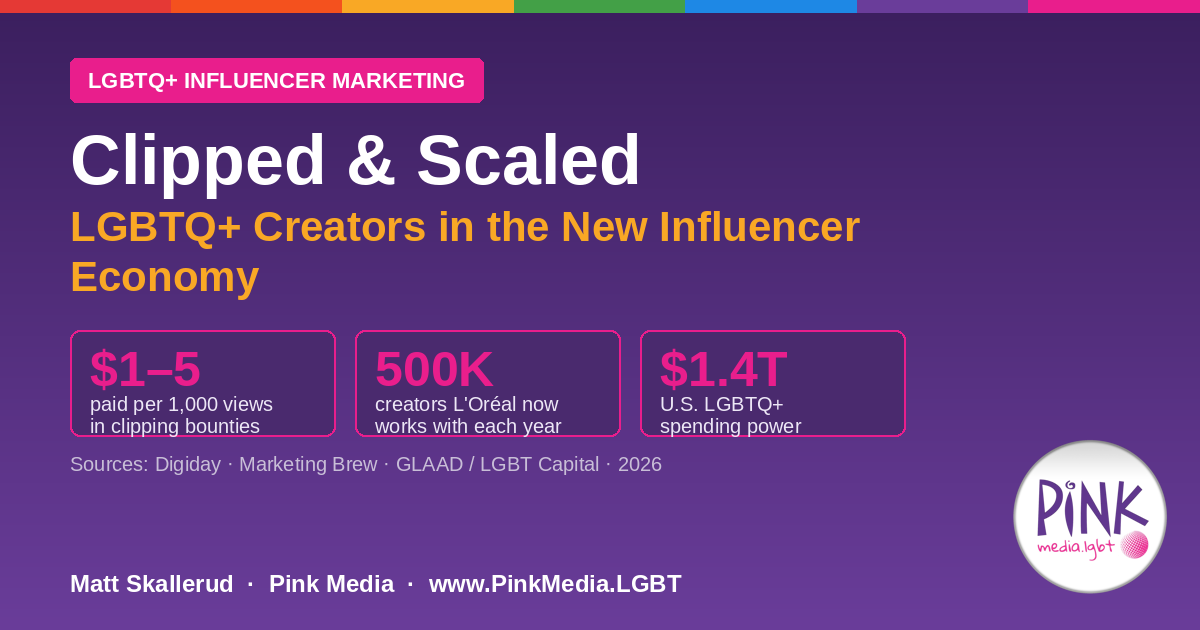
The mechanics are refreshingly simple, which is exactly why it spread. There are two roles: marketers, who want their clips posted, and clippers, who do the posting. A marketer shares video files and posts a "bounty," paying clippers a set rate — usually between $1 and $5 per 1,000 views, up to a capped maximum. Clippers then race to post those cuts across TikTok, Instagram, YouTube Shorts, and X, and share verified view counts to collect. For years this ran through invite-only Discord servers; more recently, platforms have opened it up to the public, formalizing the bounties, the view verification, and the payouts. One such platform told Digiday it was averaging over 100 million views a day.
The money at the creator level is not trivial. The operator of one viral account described making roughly $60,000 in seven months from clipping, and estimated there are people quietly pulling in $15,000–$20,000 a month doing nothing but this. As one executive in the space put it, "clipping is effectively curation" — here's the pinpointed 30 seconds that captures the whole four-hour stream.
"Clipping works because it taps the parasocial bond between a creator and their audience. Fans see creators as tastemakers — so a shared clip reads as a recommendation, not an ad."
Are LGBTQ+ creators doing this? Yes — in three different ways.
Clipping isn't happening in some separate universe from the LGBTQ+ creator economy. It's woven right through it, and it's worth being precise about how, because the three modes carry very different implications.
1. Organic reach and growth
Plenty of queer creators use clipping the original way — to maximize the reach of their own long-form work. A creator with a weekly show or livestream can turn one recording into dozens of short, feed-native moments, and either cut them in-house or pay clippers to blanket the platforms. For a community whose culture has always traveled through quotable, shareable moments, this is a natural fit.
2. Fan-driven clipping and monetization
Just as often, the clippers aren't the creators at all — they're fans. Everyday viewers and smaller accounts clip their favorite LGBTQ+ personalities and post those moments, sometimes monetizing through affiliate links or performance-based payouts. This is fandom doing the distribution, and it's a big part of why queer internet moments spread the way they do.
3. An income stream when brand deals wobble
This is the one worth watching. As I wrote earlier this year, LGBTQ+ creators have felt Pride-season brand deals get less reliable and more skittish heading into 2026. When corporate sponsorship gets nervous, performance-based clipping and independent monetization look more attractive — they don't require a brand's legal team to sign off on working with a queer creator. That's opportunity and caution in the same breath, and we'll come back to why.
Clipping is a distribution engine, not a magic wand
It's tempting to hear "pay per view" and picture guaranteed virality. It isn't. As Marketing Brew reported, the marketers seeing results are the ones designing content worth clipping in the first place — brands like Skittles built entire livestream stunts with multiple camera angles specifically to generate good clips. One practitioner estimated a real clipping campaign starts at $25,000 to $100,000 "if you want to do it right," and warned that for a brand just starting out, "clipping probably doesn't make sense, because clipping is a massive awareness play." Great editors who understand the trends matter as much as the distribution.
Now the other end of the spectrum: Dentsu builds the "plumbing"
If clipping is the scrappy, bottom-up version of creator marketing, the news out of the agency world this week is its polished, top-down twin. Dentsu announced a partnership with Meta that integrates Meta's Creator Marketplace and Partnership Ads directly into Dentsu's own operating system through an API. In plain terms: social listening, creator selection, and paid activation all live in one dashboard, blending the agency's data with Meta's.
The point of the exercise is scale and speed. Dentsu's own executives described the goal as making creator marketing "more scalable, more predictable… a growth engine." Connecting with creators, contracting them, and getting paid partnership posts live — work that "would have taken days," one said — "now it happens in hours." Digiday called it building the "plumbing" for mass influencer activation, and the number that frames why: leading advertisers are now marshaling armies of small creators — L'Oréal reportedly works with roughly 500,000 a year, Unilever deployed 50,000 for a single World Cup campaign — and micro- and nano-influencers are projected to take nearly half of U.S. influencer investment this year.
The tell is in an analyst's read of why Dentsu is doing it at all: "There's a defensive need… They would like to remain the fulcrum, the entry point for clients, into this world." Agencies are racing to own the infrastructure so brands don't build it themselves. That's a very different motivation from a fan clipping their favorite streamer — but it's aimed at the same destination.
Two models, one shift
Line them up and the contrast is clarifying. These aren't rivals so much as two ends of the same rope — and knowing which end you're holding changes how you use it.
Clipping — Bottom-Up
- Decentralized: fans and independent clippers do the posting
- Low cost of entry, paid per 1,000 views
- Optimized for raw virality and awareness
- Fast, messy, culture-native
- Loose disclosure — often no "#ad" in sight
- Trust flows from the parasocial bond with the creator
Mass Activation — Top-Down
- Centralized: an agency selects and manages the roster
- Higher investment, built on platform APIs and data
- Optimized for scale, predictability, and control
- Fast because it's engineered to be — days into hours
- Brand-safety and compliance baked into the workflow
- Trust is a KPI to be measured and protected
Notice what both share: the creator is now the front door to discovery, full stop. Whether a brand reaches you through a fan's clip or an agency's dashboard, the moment that earns your attention is a person you already chose to follow. That's the shift underneath both stories — and it's the reason the LGBTQ+ community matters here out of proportion to its size.
Why this lands differently for the LGBTQ+ community
The engine that makes both models run is parasocial trust — the sense that a creator is a friend whose taste you share. Queer audiences have that bond in abundance, often because mainstream media spent so long not reflecting our lives back to us; we built our own tastemakers, and we're loyal to them. That loyalty is a genuine asset, and it's part of why LGBTQ+ creators punch above their weight and why the community's estimated $1.4 trillion in U.S. spending power is so reachable through the right people.
Which is exactly why the disclosure question isn't a footnote. FTC guidelines require paid promotion to be labeled, but a great deal of clipping happens through faceless accounts with no disclosure at all — a legal gray area that, as one IP lawyer told Digiday, the FTC currently lacks the bandwidth to police. For most industries that's an abstract compliance risk. For ours, it's more personal: if "organic" enthusiasm for a product turns out to have been quietly bought, the thing that gets spent isn't a media budget — it's the community's trust. And trust, once extracted rather than earned, is very hard to win back.
"The community's trust is an asset to earn, not a resource to extract. Clipping and mass activation both run on that trust — so the brands that win long-term will be the ones that treat it as something they're borrowing, and label it honestly when they do."
What this means if you're a brand — or a creator
If you're a brand: both models can work, but they reward different things. Clipping is an awareness play that needs genuinely clippable content and honest labeling — don't treat it as a cheap shortcut to fake buzz. Mass-activation infrastructure is powerful for scale, but scale with no cultural fluency just means being ignored faster and in more places. Reaching the LGBTQ+ community well still comes down to the same fundamentals it always has: work with queer creators rather than around them, disclose the relationship, and show up past a single campaign window.
If you're a creator: clipping is a real, accessible tool for stretching your reach and your income, especially in a year when brand deals feel less certain. Use it — and protect the thing that makes you valuable by being straight with your audience about what's paid and what isn't. Your disclosure isn't a tax on your credibility; it is your credibility.
The clip economy and the activation machine are going to keep growing, and they'll keep shaping which moments you see and which you don't. The good news is that the oldest rule in this business still holds under both of them: audiences reward the people and brands who are actually there for them. That's the part no dashboard and no bounty can automate — and it's the part we've spent three decades helping brands get right with the LGBTQ+ community, year-round.