I've been saying it for 30 years, and 2026 is finally proving it out on a whiteboard: authentic LGBTQ+ engagement is a 365-day commitment, not a June activation you switch on for four weeks and pack away on July 1. This year, with national Pride sponsorships shrinking and a lot of companies looking for reasons to do less, that principle stopped being a nice sentiment and became a survival strategy. When the big centralized splash gets riskier and more expensive, the brands that win are the ones with structure — year-round mechanisms the community can count on.
So I'm kicking off a short Pink Media case-study series I'm calling "365, Not Just June" — real 2026 programs that show what year-round actually looks like in practice. Two to start, because between them they cover both halves of the problem: Chipotle, which solved when you show up, and Lime, which solved where. Here's the playbook underneath them.
Case Study #1 — Chipotle: The Two-Date Calendar
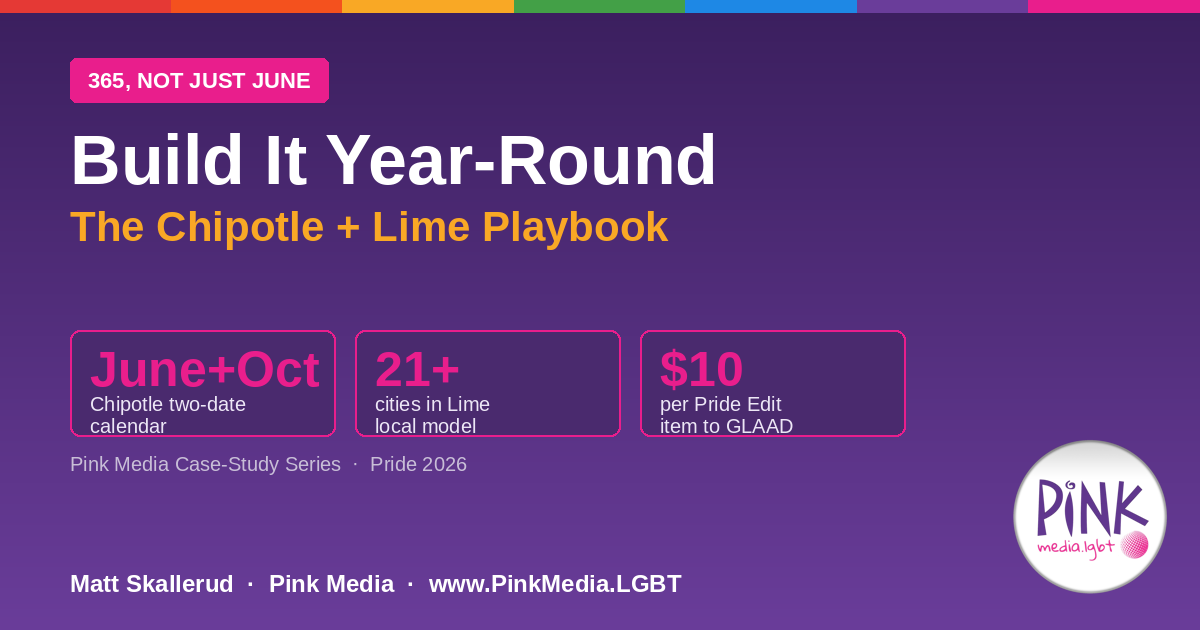
The single most instructive thing a brand did this year is almost invisible on paper: Chipotle put a second date on its Pride calendar. Its "Love What Makes You Real" platform spans both Pride Month in June and LGBT History Month in October — and that October anchor changes everything.
Here's why. A June-only program, no matter how sincere, quietly undercuts its own message: if you're visible for exactly the weeks Pride is trending and invisible the other eleven months, the community reads that pattern accurately — as seasonal marketing. The calendar tells on you. October gets none of June's automatic cultural tailwind, which is precisely why showing up then reads as real. You don't do October for the applause. You do it because you meant it in June.
What made it a commitment, not a campaign
The money is specific: $10 from every "Pride Edit" item goes to GLAAD — a named nonprofit and a concrete per-item number, not a vague "proud to support." It starts internally: limited-edition Pride uniform shirts for employees who want to wear them — inclusion the brand lives, not just broadcasts. It puts people in the street: employee activations at Stonewall Columbus Pride in June and OC Pride in Costa Mesa in October — presence you can't fake with a logo swap.
Read the full Chipotle case study on the #ILoveGay Network →
The takeaway isn't "copy the burrito company." It's a question to put on the table in your next planning meeting: what does our brand do for this community in the months that aren't June? You don't need October specifically — you need a second date. A year-round nonprofit partnership, an ongoing internal practice, a recurring community activation. The vehicle matters less than the principle.
Case Study #2 — Lime: One Campaign, Lived Locally
If Chipotle solved when, Lime solved where. The e-scooter and e-bike company launched "Pride in Motion" across more than 21 cities worldwide — and the smart part isn't the rainbow-wrapped vehicles, it's the architecture underneath them. Lime paired those wraps with transportation-access initiatives to get riders to Pride events, and partnered with local Pride organizations in the cities where it operates. The product itself does the community work: Lime's whole business is getting people from A to B, and they pointed that at the practical question every attendee faces — how do I get to Pride?
This is the hyper-local playbook at global scale. It's one campaign, but it lives locally in 21+ different cities, each with its own org partnership and its own riders. As HRC's Jonathan Lovitz has noted, most people who interact with your brand aren't at the big parade — they meet you in daily life. A rainbow-wrapped scooter on a Tuesday in the neighborhood does exactly that: broader yet more targeted, 24/7, 365.
Three transferable moves
Make your product the activation. Lime didn't bolt Pride onto its business — it used mobility to solve a real Pride-season need. A hotel does this with room blocks; a destination with welcome programming; an airline with route-level partnerships. Partner city by city, not campaign by campaign. Local orgs know their communities, and dollars go further — and mean more — locally, especially as national funding pulls back. Build for year-round presence. Vehicles on the street don't disappear July 1; the campaigns that earn trust are the ones still visible in October.
"A campaign has a start date and an end date. A commitment has a rhythm you can count on. Chipotle built a rhythm across the calendar; Lime built one across the map. Either way, the structure is the message."
The Playbook: Year-Round Structures You Can Adopt Now
Put the two case studies together and a repeatable framework falls out. This is the part to bring into your own planning — six structural moves that turn a one-month campaign into a year-round commitment, and hold up even as national sponsorship budgets shrink.
Build These In
- A second date outside June (LGBT History Month in October is the natural one)
- Your core product as the activation — solve a real community need
- City-by-city partnerships with local Pride organizations
- A named nonprofit and a specific dollar figure behind the giving
- An internal-first practice — start with your own employees
- Always-on local presence & media through the #ILoveGay Network
Leave These Behind
- A June-only calendar that goes dark on July 1
- Pride bolted onto the business instead of built from it
- One centralized national splash that draws centralized fire
- "A portion of proceeds" with no name and no number
- Outward messaging with no internal practice behind it
- A logo swap standing in for actual presence
Notice that none of these require a Fortune 50 budget. A second date is a calendar decision. Making your product the activation is a creative decision. City-by-city partnership is often cheaper than one national buy — and it's a hedge against the political risk that comes with going big and centralized. That's the quiet good news of 2026: the year-round approach isn't just more authentic, it's frequently more affordable and less exposed.
"One month of visibility is a campaign, and the community knows it. Two or more, spread across the year, start to look like a relationship."
Where Pink Media Comes In
This is the thesis we come back to again and again, because it's the one that separates the brands who keep the community's trust from the ones who lose it: the community doesn't stop existing on July 1. The brands still standing in its good graces years from now are the ones that showed up in October, in February, in the quiet months with no marketing hook. Chipotle and Lime built structures that do that. Yours can too — and it's exactly the kind of year-round program Pink Media and the #ILoveGay Network are built to design, run, and amplify, 24/7, 365.
This is the first entry in our "365, Not Just June" case-study series — more to come as we spotlight the brands getting year-round right. If you're thinking about how to turn a one-month Pride campaign into a genuine year-round commitment — and how to make it visible and credible to the community — that's a conversation we have every day, and we'd welcome yours.