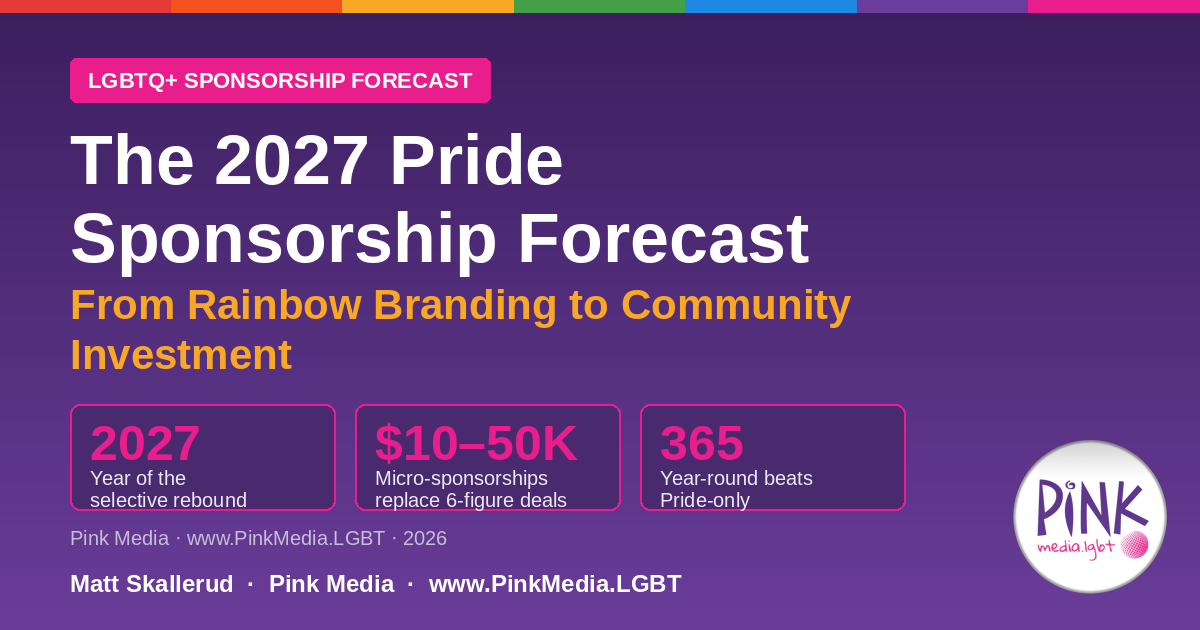
Let me give you the honest read first, because the headline number matters: 2027 will be a transitional year where Pride sponsorships begin to rebound — but not to pre-2023 levels. The brands that return will be different from the ones that left. The activations will be smaller. And the center of gravity will shift toward travel, entertainment, tech, and community-aligned companies, not the Fortune 50 consumer brands that defined the rainbow-logo era.
That's not a pessimistic forecast. It's a realistic one. And if you work in LGBTQ+ travel, media, or sponsorship the way I do, it's actually a hopeful one — because the money that comes back in 2027 will be looking for exactly the kind of authentic, year-round, community-rooted partnerships that have been undervalued for the last decade.
Here's the full picture: what won't reverse, what will, and where the opportunity sits.
The 2024–2026 Pullback Won't Fully Reverse
Start with what isn't changing. The forces that drove the sponsorship retreat aren't disappearing overnight, and any forecast that pretends otherwise isn't worth reading.
- Political polarization remains high. The cultural temperature that made brands nervous hasn't dropped enough to make them comfortable again.
- DEI rollbacks continue to chill corporate risk-taking. When internal diversity commitments get quietly walked back, external Pride spend is usually the first casualty.
- Pride backlash is still a reputational calculation. The Bud Light effect didn't end in 2023 — it became a permanent line item in every brand's risk model.
- Legal threats around "youth content" still scare brands. Ambiguity here keeps cautious legal teams pulling activations rather than defending them.
- Pride budgets were cut and reallocated internally. Money that leaves a line item rarely returns at full strength the following year.
So here's the forecast on the pullback itself: in 2027, most large corporations will not come back to splashy, high-visibility Pride campaigns. But many of them will return to quiet, targeted, lower-visibility LGBTQ+ support. The retreat doesn't reverse. It reshapes.
Expect a "Selective Rebound" — Led by Certain Industries
The rebound won't be evenly distributed. Three sectors are positioned to lead it, and they're the ones that face less political exposure while still seeing clear returns from LGBTQ+ audiences.
Travel & Tourism
Destinations, DMOs, cruise lines, and airlines step in because LGBTQ+ travelers remain high-value, Pride tourism is a real economic driver, and travel brands face less political backlash than consumer packaged goods. Tourism is becoming the new backbone of Pride sponsorship.
Entertainment & Streaming
Pride is content. Content is engagement. Engagement is subscriptions. Studios and streamers return because LGBTQ+ audiences are loyal, vocal, and over-index on the platforms these companies are fighting to grow.
Tech & Digital Services
Tech supports Pride through creator partnerships, digital activations, and virtual events — low-risk, high-ROI, and far less likely to trigger a boycott than a national TV spot or in-store rainbow display.
Lower Exposure, Clearer ROI
What these three sectors share: they can show up for the community in ways that are measurable, defensible, and digital-first. That combination is what makes a brand comfortable saying yes in a still-cautious climate.
From "Branding" to "Community Investment"
This is the structural shift, and it's the heart of the forecast. The era of rainbow logos, parade floats, and branded Pride merch is fading. It isn't being replaced by nothing — it's being replaced by something more durable.
"The brands that win in 2027 won't be the ones with the biggest float. They'll be the ones funding the queer artist, the youth program, and the community stage — every month, not just in June."
The 2027 model looks like funding queer artists, supporting LGBTQ+ youth programs, sponsoring community stages, investing in queer creators, backing LGBTQ+ travel initiatives, and supporting local queer-owned businesses. It's quieter than a parade banner. It's also far harder to accuse of rainbow-washing — because it's real, ongoing, and visible to the community whether or not it ever shows up in a press release.
This is the model I've spent years analyzing and building toward at Pink Media. The market is now moving to where the most authentic partnerships already were.
Smaller Budgets — But More Targeted
Brands will spend less overall in 2027, but they'll spend more deliberately. The shape of the spend changes more than the willingness to spend.
- Fewer six-figure Pride deals. The trophy sponsorship is no longer the default flex.
- More $10K–$50K micro-sponsorships. Smaller commitments, spread across more partners, with less risk attached to any single one.
- More multi-city "regional" Pride partnerships. Local activations hedge national polarization and meet communities where they actually are.
- More year-round LGBTQ+ content budgets. Money moves out of one-month spikes and into twelve-month presence.
- More creator licensing instead of big activations. Reusable, authentic creator content delivers better economics than a single tentpole moment.
And here's who that's good news for: mid-size Prides, LGBTQ+ media companies, travel brands, and queer creators. The money getting smaller and more distributed is the money these players are best positioned to capture.
Pride Organizations Will Diversify Revenue
Because corporate funding won't fully return, Pride organizations won't sit and wait for it. The smart ones are already building revenue models that don't depend on corporate whims.
- Expanded ticketed events and VIP experiences — turning attendance into a reliable revenue base.
- Travel-brand partnerships — aligning with the sector most willing to invest in Pride tourism.
- Creator-driven content packages — monetizing the storytelling the community already wants to see.
- Year-round programming — extending value and sponsor touchpoints well beyond June.
- Grants, philanthropy, and monetized digital Pride content — diversified, less volatile funding sources.
The end result is a Pride ecosystem that's less fragile — and less hostage to whichever way a Fortune 50 marketing department happens to be leaning in any given year.
The Political Climate Will Shape 2027 — But Not Define It
2026 is a politically charged year, and that backdrop carries into early 2027. But by mid-2027, the pressures begin to ease at the margins.
Brands start to feel safer re-engaging. DEI policies stabilize after the churn. Consumer fatigue around the culture wars grows — and that fatigue cuts in favor of brands that simply stayed consistent. LGBTQ+ audiences, who have very long memories about who showed up and who vanished, begin to reward the companies that never left. The pendulum starts to swing back. Slowly, but it starts.
2027 Sponsorship Levels: A Realistic Projection
Here's how I'd map the trajectory from the pre-backlash peak through next year:
| Year | Sponsorship Level | Trend |
|---|---|---|
| 2022 | Very High | Pre-backlash peak |
| 2023 | Sharp Decline | Bud Light effect |
| 2024 | Continued Decline | DEI retreat |
| 2025 | Stabilization | Quiet allyship |
| 2026 | Mixed | Some rebound |
| 2027 | Moderate Rebound | New industries step in |
2027 will not be a full recovery. But it will be the first year of meaningful upward movement — and the first year the composition of Pride sponsorship visibly changes for the better.
What This Means for LGBTQ+ Travel & Media
This is my space, so let me be specific about where the forecast lands for the people reading this who work in it.
Travel brands become top-tier Pride sponsors
- LGBTQ+ travelers are high-spend and loyal
- Pride tourism is resilient through downturns
- Destinations want and need LGBTQ+ visibility
LGBTQ+ media companies gain influence
- Creator licensing and video storytelling
- Community amplification at scale
- B2B LGBTQ+ reach — the Pink Media ecosystem
Pride orgs seek new partners
- Travel and hospitality brands in demand
- LGBTQ+-owned businesses step up
- Multi-year, multi-touch relationships
Creator-driven Pride content explodes
- Brands prefer small, authentic creators
- Reusable content over one-off activations
- Low-risk, digital-first, year-round
The companies that win in 2027 will be the ones that invest in LGBTQ+ creators, support community organizations, partner with LGBTQ+ travel brands, and build trust — not just visibility. The brands chasing a parade photo are fighting the last war.
The Big Picture for 2027
Pride sponsorship isn't dying. It's evolving. The brands that return will be more cautious, more community-aligned, more digital, more year-round, and more focused on safety and authenticity than spectacle.
That shift rewards a very specific kind of partner: the one that was never in it for the one-month logo swap in the first place. If you've been building real, durable LGBTQ+ relationships — in travel, in media, in your local community — 2027 is the year the market finally moves toward you. The work doesn't change. The market's appetite for it does.
Planning Your 2027 LGBTQ+ Strategy?
Pink Media works with brands, destinations, and organizations on year-round LGBTQ+ marketing — creator licensing, community investment, paid media, and authentic Pride partnerships built to last beyond June. 30+ years of LGBTQ+ marketing expertise. Packages starting at $495.
Get In Touch →