Every August I go back through the season and ask the same question: what actually happened, as opposed to what got reported? Because "brands pulled back from Pride" is the sentence everyone ran in 2026, and it's true enough to repeat and vague enough to lead you into a bad 2027 budget.
So here's the sharper version, and I think it's the single most useful structural read of this year. Brands got nervous about the merchandise. They did not get nervous about showing up. Presence held while product retreated — and once you see the split, a lot of decisions get easier.
I laid out the case study version of this over on ILoveGay.NET. This is the strategy version: why the split happened, what it costs to land on the wrong side of it, and how it should change a media plan.
Look at What Actually Got Cut
Start with the four brands that tell the story, because they were all physically present and only one of them led with a product line.
IKEA — the owned-property model
Staged in-store Pride parades across multiple U.S. locations through June, with co-workers marching flags through the aisles. Rainbow STORSTOMMA bag sales sent up to $50,000 to The Trevor Project, with $1 from every rainbow cake going to Rainbow Railroad. IKEA Canada renewed its Rainbow Railroad partnership for a third consecutive year, projecting roughly $600,000 in cumulative contributions.
MAC Cosmetics — the borrowed-partnership model
A bedazzled double-decker bus at NYC Pride on June 29, themed around its existing Chappell Roan partnership, oversized Viva Glam lipstick on board, drag performers dancing on the top deck. Big visibility, built on a partnership already paid for.
Sally Beauty — presence with no product at all
"Get the Sally Beauty Scoop" on 4th Avenue along the NYC Pride route: free ice cream, rainbow gift bags, nail polish and glitter body spray for the first 200 people, plus sampling at WeHo Pride. No capsule, no collection, no shelf.
Tinder × Diesel — the co-branded exception
The one real product play of the four: a 17-piece "For Successful Loving" collection, a JoJo Siwa performance at their NYC Pride party with Drag Race alumni and TikTok creators, and $200,000 to Outright International. Note the structure — a named partner, a defined drop, a specific donation. Not a general rainbow assortment.
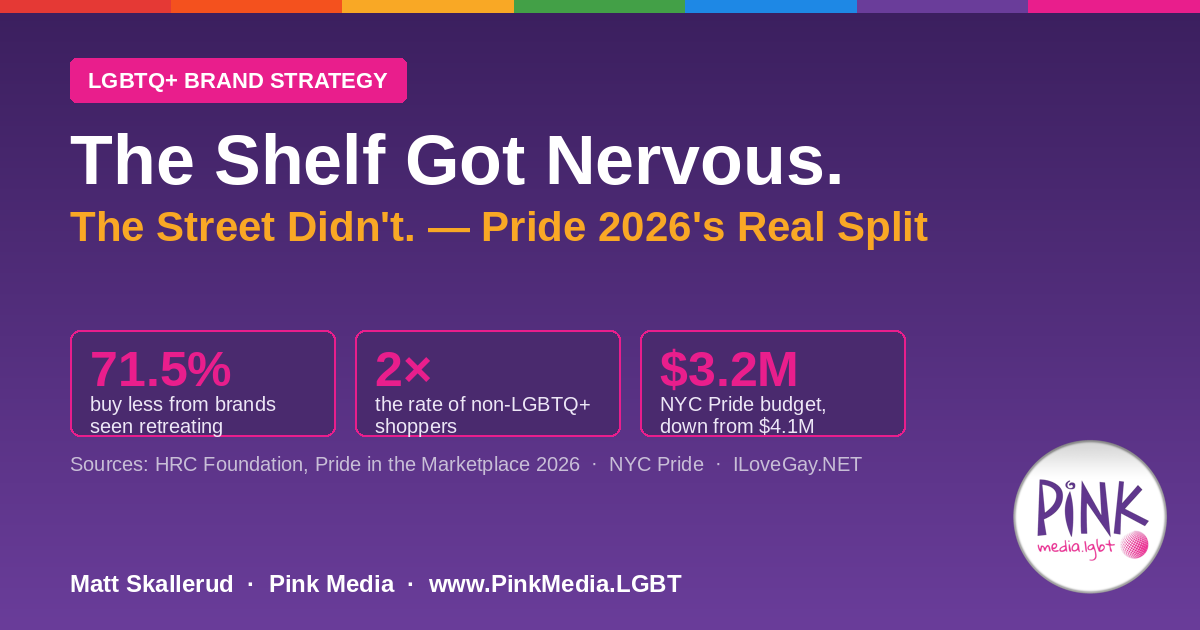
Now the other side of the ledger. Target cut shelf space — the continuation of a retreat that started after the 2023 double boycott and has never really reversed. And the event economy did tighten: NYC Pride ran on roughly $3.2 million in 2026, down from $3.8 million in 2025 and $4.1 million in 2024, with around 90 corporate sponsors. That's about a quarter of the funding gone in two years, and I don't want to wave it away.
But look at the composition of what left. It's overwhelmingly the shelf. The dollars didn't leave the community so much as they changed shape — out of merchandise margin, into experiences and giving.
Why the Shelf Is the Risk and the Street Isn't
This isn't cowardice, and it isn't really about values. It's two very different risk profiles, and any brand manager can do the math in about thirty seconds.
A Pride product is a physical object that sits on a shelf in every market you operate in — including the ones where somebody is looking for something to be angry about. It can be photographed. It can be filmed. It can be turned into a thirty-second clip that runs for three weeks. And if it doesn't sell in a hostile market, you're now holding inventory and a news story.
An activation happens in one place, on one day, in front of people who chose to be there. It generates content the brand controls, and it leaves nothing behind to boycott. There's no barcode. There's no display. By Monday it's a set of photographs.
So the risk calculus in 2026 effectively decoupled retail SKUs from experiential presence — and that decoupling is the thing worth planning around, because it means "we're pulling back on Pride" and "we're pulling the collection" have become two completely different sentences that a lot of brands are using interchangeably.
What Retreated
- Rainbow merchandise lines and general Pride assortments
- Retail shelf space and in-store product displays
- Rainbow logo swaps on national brand channels
- Event budgets: NYC Pride $4.1M → $3.8M → $3.2M
What Held
- Parades, floats and route-level street presence
- In-store and owned-space activations
- Named donations to verified organizations
- Sponsorships, partnerships and creator programs
IKEA Ran the Cleanest Version of It
Of everything I watched this season, IKEA's in-store parade is the model I'd hand to a client with a physical footprint, because it solves four problems at once.
You own the property. No parade permit, no sponsorship tier, no negotiating with a committee — you decide, you schedule it, you run it. Your backlash exposure is minimal. There's no product to boycott and no ad buy to screenshot; a parade through your own aisles is an internal event that happens to be visible. The internal ROI is real. Employees marching flags through the store is a genuine morale moment, especially for your LGBTQ+ staff, and it costs almost nothing. And it scales down. A regional chain can do this. A single-location retailer can do this. A clinic, a dealership, a brewery, a bank branch — this is available without a media budget.
"The dollars didn't leave the community. They changed shape — out of merchandise margin, into experiences and giving."
The one gap in the model, and I'd be a bad partner if I didn't name it: an in-store parade reaches the people already in your store. That's a great start and a small audience. The activation is the asset; getting it in front of the broader community is a separate job.
And Then the Receipts Arrived
Here's where the pattern stops being an interesting observation and starts being a number on a P&L.
The Human Rights Campaign Foundation released Pride in the Marketplace 2026, built on three decades of research from Community Marketing & Insights, and it prices the retreat directly. ILoveGay.NET broke down the findings, and they're blunt.
And the comparison that should end the debate in any marketing meeting: LGBTQ+ shoppers were more than twice as likely as non-LGBTQ+ shoppers to both refuse purchases from and reduce spending with companies seen as backing away. This is a $1.4 trillion U.S. market — more than $3.9 trillion globally — behaving with unusual coordination.
Now the part I want every brand that "went quiet to be safe" to sit with. These findings are driven by perception, not by what's actually in your files. HRC's respondents named Target, Walmart, Amazon, Chick-fil-A and Home Depot as brands they perceive as retreating, and named Costco, Apple, Ben & Jerry's, Delta and Kroger as brands they perceive as increasing support. Plenty of companies in the first group kept programs, benefits and policies fully intact. They just stopped saying anything — and silence got scored as departure.
"You don't get graded on your internal policy documents. You get graded on what the community can see. A company that quietly kept everything and said nothing is paying the same price as a company that actually left."
That's the strongest argument I know for year-round media presence, and it has nothing to do with sentiment. If going silent is scored as retreat, then visibility isn't a nice-to-have on top of the program — visibility is how the program gets credited.
The Categories That Never Wobbled
Worth noting who didn't have this problem at all in 2026, because the pattern is consistent: the categories where the connection to this audience is structural rather than symbolic barely flinched.
Pharma kept going, and got tested on it. ViiV Healthcare launched its "PrEP Wisdom" campaign with Michelle Visage on June 1, aimed at decision-making literacy around long-acting PrEP options — roughly 2.2 million Americans could benefit from PrEP and only about 25% use it. When a petition campaign with more than 10,000 signatures went after the spots in August, ViiV had already launched a second campaign days earlier. The pressure didn't work, in part because the medical rationale removes the "why are you talking to them" question entirely.
Spirits and nightlife kept going through four distinct models — the long-tenured ambassador, the portfolio player reallocating rather than exiting, the specialist agency layer, and community founders building brands from inside the audience. As that piece put it: in LGBTQ+ nightlife, commitment is the brand asset and hesitation is the brand risk.
And outdoor retail showed the both/and is still available. REI's "Made With Pride" paired a real product line — apparel, bags, camping chairs, bottles designed by nonbinary illustrator Alva Skog, who led the creative rather than being handed a brief — with pop-ups in Denver, Seattle and Washington, D.C., and year-round programming to widen outdoor access. Product didn't have to go away. It had to get more specific, more collaborative, and more clearly authored.
What This Means for a 2027 Plan
Here's how I'd translate all of it into where the money goes.
| Product tie-in | Presence & media | |
|---|---|---|
| Exposure window | Full season, every market | Chosen dates and channels |
| Backlash surface | High — physical, photographable, permanent | Low — ephemeral, controlled, on your terms |
| Downside risk | Unsold inventory plus a news story | A quiet result |
| Community read | Judged on margin and motive | Judged on showing up |
| Reach beyond the room | Built in via retail footprint | Requires media — this is the gap to fund |
Five moves, in the order I'd make them.
1. Lead with an owned-space activation, not a product line. You control the property, the date, and the exposure. Start there and add product only if you have a reason beyond "it's June."
2. If you do product, do it as a partnership. Tinder × Diesel and REI × Alva Skog both work because there's a named creative partner and a defined drop. A generic rainbow assortment is the highest-risk, lowest-credit version of this available.
3. Attach a specific number to a named organization. "$200,000 to Outright International" is a receipt. "A portion of proceeds" is not, and this community has been reading that difference for a long time.
4. Commit for more than one season. IKEA Canada's third consecutive year with Rainbow Railroad reads completely differently than a first-time gesture, and it costs the same per year.
5. Fund the reach. This is the one that gets skipped. The activation is the asset; media is what makes it count with the 99% of the community who weren't in your store that Saturday. Given what HRC just published about perception, an unamplified program is a program the market may never learn about.
The practical version: if you were planning to spend on a Pride collection in 2027 and you're now nervous about it, don't read that as a reason to spend less on this market. Read it as a reason to move the same money from the shelf into presence, giving and media — where the risk is lower, the audience credit is higher, and the visibility runs past June instead of ending with the season.
The Takeaway
The clean read on 2026 is not that brands left. It's that brands moved the spend out of the highest-risk, most photographable format and into formats they could control — and then, in a lot of cases, forgot to tell anybody. That second half is the expensive mistake, and it's fixable.
Presence held. Product retreated. If your 2027 plan understands the difference between those two sentences, you're already ahead of most of the market.
Our 2026 LGBTQ+ Marketplace Guide covers the full landscape behind this — the audience, the categories, the channels and the year-round calendar. And if you're rebuilding a 2027 plan around presence and media rather than product tie-ins, that's exactly the conversation we like having.
- Brands Got Nervous About the Merch — Not About Showing Up — ILoveGay.NET, August 20, 2026. The IKEA, MAC, Sally Beauty and Tinder × Diesel case studies in full.
- Consumers Are Keeping Receipts: New HRC Data Shows Retreating Brands Lose LGBTQ+ Shoppers at Twice the Rate — ILoveGay.NET. The Pride in the Marketplace 2026 numbers and the brands named on both sides.
- Pharma Is the Category Still Showing Up: ViiV's "PrEP Wisdom," Michelle Visage, and the Backlash That Didn't Work — ILoveGay.NET, August 14, 2026.
- Who Actually Shows Up: The Four Models Behind LGBTQ+ Spirits Marketing in 2026 — ILoveGay.NET, August 14, 2026.
- REI — "Made With Pride" — ILoveGay.NET, June 10, 2026. Product and activation done together, with the artist leading.
- LGBTQ+ Marketing in 2026: The Brands That Are Doubling Down — and the Ones That Are Running Away — ILoveGay.NET. Background on how backlash exposure became a planning input.
- Pink Media's 2026 LGBTQ+ Marketplace Guide — the full market landscape, categories and year-round calendar.