I've sat in a lot of meetings over the past thirty years where someone makes the case for LGBTQ+ marketing, and I can usually tell within a minute whether it's going to land. When it's framed as the right thing to do, people nod. When it's framed as a number with a dollar sign in front of it, people start taking notes.
Last week in the UK, Outvertising — the advertising industry's LGBTQIA+ advocacy group — skipped the meeting entirely and put the note-taking version on billboards. The campaign, covered today on ILoveGay.NET, ran across digital and physical sites from London to Edinburgh during National Inclusion Week. The headline poster reads: "33 billion reasons to get our pronouns right."
That's not a slogan about feelings. It's a revenue line. And I think it's one of the clearer pieces of inclusion advocacy I've seen from anyone this year.
Four Posters, Four Arguments
The work comes from the agency Hijinks, done pro bono, with media donated through the JCDecaux Community Channel and BUILD HOLLYWOOD, and digital display support from Haymarket. Each poster carries one line and one data point. Here's what each one says — and the closest US equivalent.
“33 billion reasons to get our pronouns right” — the customer case
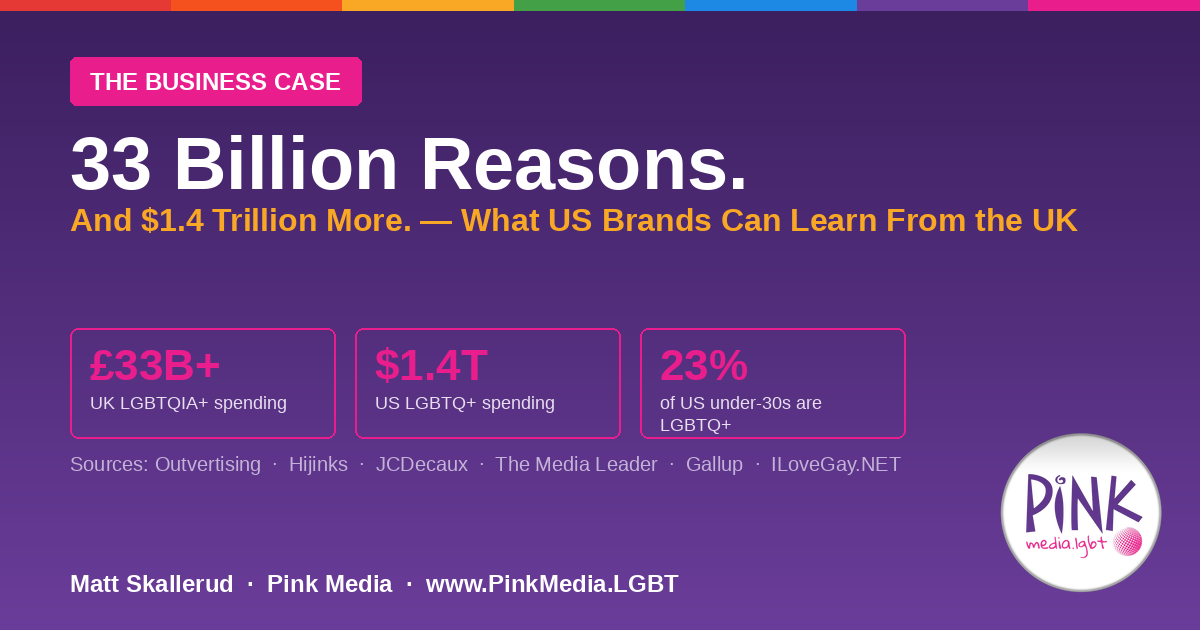
UK LGBTQIA+ spending power of more than £33 billion. In the US, the number most planners use is roughly $1.4 trillion a year in LGBTQ+ consumer spending. Different country, different methodology, same point: this is a market, not a mention.
“She wins, he wins, they win, you win” — the future-customer case
Gen Z is twice as likely to be queer. The US data is even sharper: Gallup's latest figures put LGBTQ+ identification at about 9% of all US adults and 23% of adults aged 18–29, more than double any older group. Nearly one in four of the people you most want to win over for the next thirty years.
“Shantay, we won't stay” — the retention case
65% of employees said they would leave a job where they couldn't be openly out. The US picture from the HRC Foundation's workplace research: 4 in 10 LGBTQ+ workers have hidden their identity at work out of fear of stigma. Every one of them is a retention risk you're paying for.
“Out at work, in it for the long haul” — the recruiting case
1 in 5 UK workers won't work somewhere LGBTQIA+ employees aren't supported — and that's all workers, not just queer ones. In the US, the same HRC research found 84% of LGBTQ+ workers are now out to at least one person at their job, up from 54% in 2018. The workforce has already moved. The question is whether employers have caught up.
What I like about the structure is that two posters talk to the CMO and two talk to the CHRO, and nobody has to translate. Hijinks co-founder Marc Allenby described it as a campaign that "celebrates the joy of queerism – but makes a clear, tangible business case for inclusion." That's exactly the balance.
The New CEO Is Speaking the Same Language
The campaign lands just weeks into a leadership change. Tash Beecher took over as Outvertising's CEO from Chris Dunne, who spent four years building the organization on an entirely volunteer basis — a national LGBTQIA+ consumer census with YouGov, the first comprehensive inclusion playbook for UK advertising, and more than 100 free mentoring pairs. Beecher is the first creative leader to hold the role, and she's been direct about where she wants to take it.
In an interview with The Media Leader, also covered on ILoveGay.NET, she put it this way:
"Intersectional, inclusive advertising isn't just a moral imperative; it's a commercial superpower for brands."
And on the billboard campaign itself: "Inclusion isn't a niche consideration – it's good for brands, people, culture and business."
Two things in her agenda stand out to me for a US audience. First, she wants Outvertising to be "the champion of pure creative intersectionality, with a specific focus on Black and Brown LGBTQIA+ inclusion." That's a gap in US advertising too, and one that shows up in the creative long before it shows up in a media plan. Second, her message to nervous brands is gentle and practical: your audience is "going to appreciate it more if you're trying." Perfection isn't the bar. Presence is.
"The UK just put £33 billion on a billboard and let the number do the arguing. In the US that number is $1.4 trillion — and most American brands still make the case in a whisper, in June, on a slide nobody outside the ERG sees."
Six Things US Brands Can Borrow
1. Lead with the number. Every one of the four posters opens with commercial logic. If your internal case for LGBTQ+ marketing starts with values and gets to revenue on slide nine, flip it. Start with $1.4 trillion and 23% of adults under 30, then talk about why it matters.
2. Make the customer case and the workforce case together. Outvertising didn't split them. The same brand that wants LGBTQ+ customers needs LGBTQ+ employees to build credible work for them — and the Gen Z customer and the Gen Z new hire are the same person.
3. Show up outside June. This ran in September, tied to National Inclusion Week. The US doesn't have a direct equivalent, but it has plenty of moments — National Coming Out Day on October 11, LGBTQ+ History Month in October, travel planning seasons, the holidays. The brands that earn trust are the ones that are there when there's no parade.
4. Keep the joy. "Shantay, we won't stay" is funny. It's also a warning about attrition. Humor and confidence make a business case easier to hear than an apology does, and they read as insider rather than tourist.
5. Build it as a coalition. Pro bono agency, donated out-of-home inventory, an industry body carrying the message. US trade associations, chambers of commerce and destination marketing organizations could run this exact model — and the case would be more persuasive coming from the industry than from any single brand.
6. Make intersectionality part of the plan. Beecher's focus on Black and Brown LGBTQIA+ inclusion isn't an add-on. It's where the representation gap is widest, and where brands that get it right will stand out.
How the Case Usually Gets Made in the US
- Values first, revenue somewhere near the end
- Consumer and workforce inclusion handled by different teams
- Concentrated in June, quiet the rest of the year
- Careful, cautious tone that reads as defensive
- One brand carrying the message alone
How Outvertising Made It
- A spending-power number in the headline
- Customer, Gen Z and retention data side by side
- Timed to a September inclusion moment
- Bold color, cheeky lines, zero apology
- Agency, media owners and industry body together
A note on comparing the numbers. The £33 billion UK figure and the $1.4 trillion US figure come from different sources and methodologies, and the US market is far larger to begin with, so they aren't a like-for-like comparison. Treat them as what they are — the headline number each market uses to make the case. For a deeper breakdown of US audience size, segments and spend, our LGBTQ+ Marketplace Guide lays it out.
Why It's Worth Paying Attention To From Here
A lot of US brands spent the last two years getting quieter. Some pulled back on Pride, some pulled back on product, many simply stopped talking. The UK industry has faced its own version of that pressure, and its answer wasn't louder rhetoric. It was a better argument, stated plainly, in public, with the numbers attached.
Outvertising's own consumer research with YouGov found LGBTQIA+ consumers more likely than the general population to recommend products they see advertised — 67% versus 49% — and more likely to reject brands whose values don't line up with theirs, 64% versus 50%. That's the other half of the equation. The audience rewards showing up, and it notices when you leave.
I've been working in this space since we launched GayWired in 1995, and the fundamentals haven't changed much: the brands that treat LGBTQ+ people as a market worth understanding, year-round, tend to be the ones still standing when the cycle turns. Outvertising just made that case in four posters. It's a conversation that fits naturally on LinkedIn and across #ILoveGay, and one I'd love to see an American industry group pick up and run with.
Thirty-three billion reasons over there. A trillion and change over here. The case makes itself — someone just has to put it on the billboard.
- 33 Billion Reasons: Outvertising Just Put the LGBTQ+ Business Case on a Billboard — ILoveGay.NET, September 23, 2026. The four posters, the data behind each one, and what the model could mean for US trade groups and DMOs.
- Not a Moral Add-On: Outvertising's New CEO Calls Inclusion a ‘Commercial Superpower’ — ILoveGay.NET, September 23, 2026. Tash Beecher on year-round inclusion, intersectionality and agency accountability.
- Inclusive advertising is a ‘commercial superpower’, says new Outvertising CEO — The Media Leader. Beecher's full interview.
- 33 billion reasons to get pronouns right — Roastbrief. Campaign credits, media partners and poster lines.
- Outvertising puts LGBTQIA+ inclusion centre stage in OOH drive — Mediashotz, September 14, 2026.
- “I’d Take a Few Rainbow Logos Right Now” — What Outvertising Built While the Brands Went Quiet — ILoveGay.NET, September 9, 2026. The leadership transition and Outvertising/YouGov consumer census figures.
- LGBTQ+ Identification Holds at 9% in U.S. — Gallup, February 2026. 9% of US adults and 23% of adults aged 18–29.
- Equality Rising: LGBTQ+ Workers and the Road Ahead — Human Rights Campaign Foundation. 84% of LGBTQ+ workers out to at least one person at work; 4 in 10 have concealed their identity.
- Outvertising — the UK advertising industry's LGBTQIA+ advocacy group.
- LGBTQ+ Marketplace Guide — Pink Media. US audience size, segments, spending and the year-round calendar.