
Folsom Street Fair wrapped on Sunday. Southern Decadence was four weeks ago. Market Days was in August. If you work in this industry and your Pride planning stopped in June, you just missed most of the year.
That's the first thing our new guide is meant to fix — the Pride, Circuit Parties & Events Market Guide summary is here, a companion to the 2026 LGBTQ+ Marketplace Guide. But the bigger reason to read it this year is that 2026 is the year the sponsorship side of this market broke and started putting itself back together, and what's left behind is the clearest buying opportunity I've seen in a decade.
Start With the Size of It
Most marketers dramatically underestimate the economics here, so let's put real numbers on it.
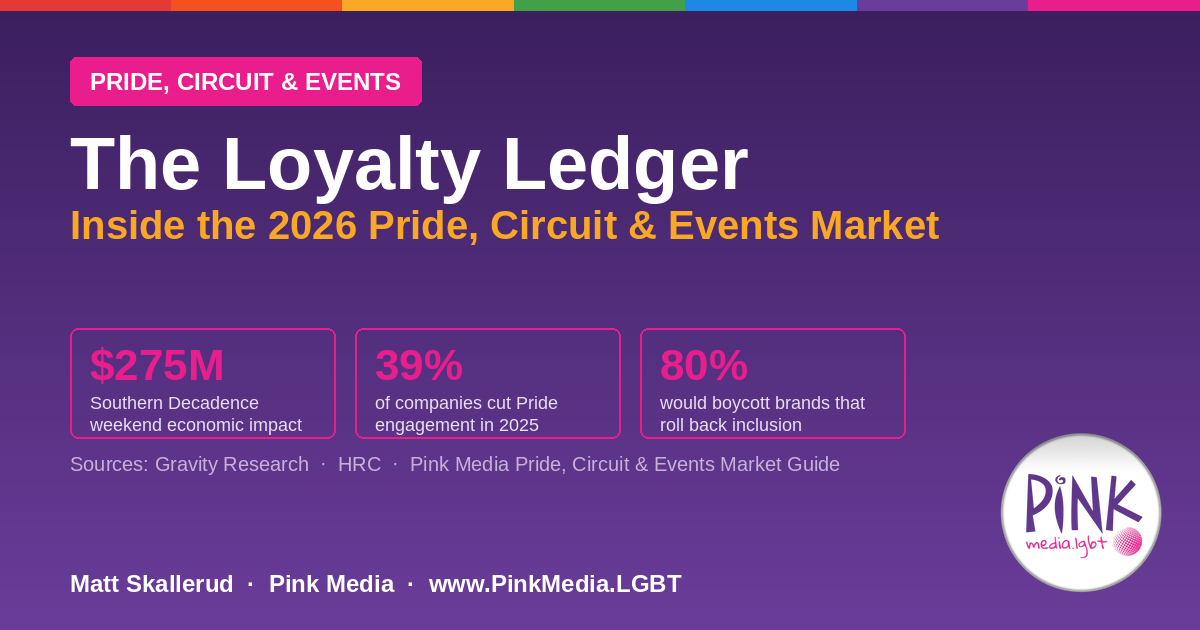
Southern Decadence brings 250,000 to 300,000 people to New Orleans and generates roughly $275 million in economic impact across a single weekend. San Francisco's three signature fairs together account for about $545 million. Peak U.S. LGBTQ+ street events run around 300,000 attendees.
Those aren't niche community gatherings. In their host cities they're among the largest recurring cultural tourism events on the calendar, full stop. And they run on sponsorship dollars that a lot of brands decided to stop writing.
What Actually Happened
Here's the sequence, because the cause and the consequence landed in different years and a lot of people only saw one of them.
The cause, 2025. Gravity Research surveyed 49 senior executives at Fortune 1000-scale companies in the spring of 2025. 39% planned to reduce Pride-related engagement — and, in the line I'd underline, not a single respondent planned to increase it. 61% named the Trump administration as the top reason for rethinking Pride strategy. What they cut was external: event sponsorships and social branding. What they largely kept was internal — ERG partnerships, workplace programming. Which tells you the retreat was about visibility, not conviction.
The consequence, 2026. Phoenix Pride filed for Chapter 11 in late May, owing roughly $432,000 to creditors, citing rising costs and shifts in sponsorship tied to the political climate. Tucson Pride shut down in January 2026 after nearly fifty years. Jackson, Michigan canceled. Organizations in New York, Salt Lake City, Louisville, St. Louis, Orlando and Pittsburgh all reported shortfalls — NYC Pride alone carrying a $750,000 gap. It hit Canada and the UK too.
"Thirty-nine percent of companies cut Pride engagement, and not one planned to increase it. A year later, a fifty-year-old Pride organization is gone and another is in bankruptcy court. Those two facts are the same fact."
And Then There's San Francisco
The counter-example is the most useful thing in this whole story, so I want to spend a minute on it.
San Francisco Pride lost about $300,000 when Comcast, Diageo and Anheuser-Busch departed. Diageo and Anheuser-Busch haven't come back. But SF Pride rebuilt anyway — long-time partners like Kaiser Permanente held, and new sponsors stepped in, including Philz Coffee and the San Francisco Opera.
Two things worth noticing there. The first is who replaced the departed multinationals: a regional coffee chain and an opera company. This is the pattern I keep writing about — when national brands leave, regional and cultural institutions take the inventory, and they take it at the top tier.
The second is the posture. SF Pride's sponsorship director described 2026 as "the year of calling in" rather than calling out, and said the outreach went better than 2024 — with the observation that large corporations are "feeling the heat from their employee base and customers." That door is genuinely open. Brands that want back in are not being made to grovel. But they are being asked.
The Loyalty Ledger
Which brings me to the concept in this guide that I think will outlive the year.
After the 2025 exodus, every segment of this audience — not the activist wing, every segment — can now tell you which brands were on the ground and which weren't. The guide calls it the loyalty ledger: presence stopped reading as marketing and started reading as character.
The supporting number is one we've cited here before, and it hits differently in an event context: 80% of LGBTQ+ consumers say they would boycott a brand that rolls back inclusion commitments (HRC). At a festival, that's not an abstraction. It's a person standing in front of your booth deciding whether to take the tote bag.
"The ledger isn't kept by activists. It's kept by the guy who noticed your banner wasn't there last year — and noticed whose was."
Five Attendees, Not One Crowd
The other reliable failure in this category is writing one piece of creative for an event that contains five different audiences.
1. The Circuit Traveler
High income, high frequency, plans a full year around mega-weekends — Winter Party, Barcelona, Decadence, Folsom. Travel, hospitality, spirits and fashion all sit directly on this segment, and they book far in advance.
2. The Hometown Pride Family
The broadest group: locals, allies, parents, first-timers. Mainstream in the best sense, and the segment most consumer brands should be built for — which is exactly why family-register creative and adult-register creative can't be the same asset.
3. The Festival & Fair Regular
Street-festival people. Market Days, Decadence, Folsom. Returns year after year, knows the layout, and notices instantly which brands are new and which have been there a decade.
4. The First-Timer & Young Queer Attendee
Gen Z, digital-native, values-driven. They film everything, they check your record before they engage, and their post-event content is worth more than your on-site impressions.
5. The Purpose-Driven Attendee
Attending as protest. Scrutinizes sponsors harder than anyone. If your activation survives this segment's read, it will survive everyone's.
Function Beats Signage
If there's one tactical shift in this guide I'd put on a wall, it's this one. Audiences now reward functional activations over passive branding.
Water. Shade. Charging stations. Medic tents. Safe rides. The brand that solves an actual problem at hour six of a street festival gets remembered; the brand that rented a step-and-repeat gets scrolled past. And the phone does the rest — event content is the richest user-generated material this community produces all year, which means a good activation keeps working for two weeks after the barricades come down.
Same logic applies one level up, at the sponsorship itself. Organizers consistently rank the unglamorous line items highest: insurance, security, staging. Nobody's naming a stage after the insurance premium, and that's precisely why funding it lands — it's the line item that proves you understand how an event actually survives.
What Stopped Working
- Step-and-repeats and passive signage
- One June activation, silence the rest of the year
- One creative execution across five segments
- Logo placement with no mission funding behind it
- Promotional tone on solemn dates
What Works in 2026
- Water, shade, charging, medics, safe rides
- Before / during / after campaign phasing
- Register matched to event — family, adult, circuit
- Funding insurance, security, staging and artist pay
- Local performers and community creators on-site
The Calendar Nobody Buys
Here's the structural inefficiency in this market. Demand for June is fierce and expensive. The rest of the year is wide open and, at several of these events, larger.
| When | What | Why It Matters to a Plan |
|---|---|---|
| February | Winter Party — Miami Beach | The circuit-traveler season opener, and a genuine philanthropic model: $4M+ reinvested into 100+ South Florida organizations since 2005. |
| June 12 | Pulse Remembrance | Presence with dignity, never promotion. The register here is the whole test. |
| June | Pride season | The biggest reach and the most crowded, most expensive competition for attention all year. |
| July 25 – Aug 8 | WorldPride Amsterdam (Canal Parade Aug 1) | Two full weeks of programming that peaks after U.S. Pride Month ends. Global, travel-heavy audience. |
| August | Circuit Festival Barcelona · Northalsted Market Days (43rd year) | Two of the largest LGBTQ+ gatherings in the world, running when almost nobody is buying. |
| September | Southern Decadence · Folsom Street Fair | $275M in one weekend, and the world's largest leather event. Distinct registers — plan the creative accordingly. |
| October | LGBTQ History Month | The most underused shoulder window on the calendar. Heritage and archive partnerships live here. |
The guide's line on this is the one I'd hand to a planner: show up before June and after August. It's the cheapest available defense against a pinkwashing read, and right now it's also just better media.
Where Were You in 2025?
You're going to get asked. If you're returning to this market after sitting out a cycle, prepare an honest answer rather than a rehearsed one.
The guide's recommendation, and mine: acknowledge it plainly, don't dress it up as a strategic pause, and lead with what you're committing to going forward — ideally something multi-year and dated. The community has an enormous amount of practice detecting the difference between a real answer and a communications answer. San Francisco's "year of calling in" framing tells you the door is open. It doesn't tell you the question won't be asked.
The buying note. Inventory that was locked up for a decade at several major events is available now, and priced accordingly. If your 2027 planning is open, this is the year to take a top-tier position you would never have been able to get at any price in 2019 — and to lock it multi-year, because the organizations that survived this cycle will remember which brands bought in while it was still uncertain.
The Takeaway
Pride and circuit events spent 2025 being abandoned and 2026 proving they'd outlast it. Some organizations didn't make it, and that's a real loss with real people behind it. The ones that did are rebuilding on a broader base — regional brands, cultural institutions, individual donors — and they're being deliberate about who they invite back in.
So the market in front of you is one where the audience is still enormous, the inventory is cheaper than it has ever been, the organizations are more receptive than they were, and the single most valuable thing a brand can say is two words long.
The full Pride, Circuit Parties & Events Market Guide goes deeper across all fifteen chapters — the history, the event economics, the five audience segments, the global calendar, the organizing bodies, the sponsorship reckoning, harm reduction, community impact, and the full marketing playbook with campaign spotlights. And the broader 2026 LGBTQ+ Marketplace Guide covers the national picture this market sits inside.
- Pride, Circuit Parties & Events Market Guide — Editorial Summary — Pink Media. All fifteen chapters: history, economics, the five audience segments, the global calendar, sponsorship trends, harm reduction and the marketing playbook.
- Corporate Approaches to Pride 2025 — Gravity Research. 39% of companies reducing engagement, none increasing; 61% of executives citing the administration. Survey of 49 Fortune 1000-scale executives, March–April 2025.
- Phoenix Pride files for bankruptcy amid nationwide financial crunch — Axios. The Chapter 11 filing, the $432K owed, and the national picture including Tucson Pride's closure.
- Phoenix Pride files for bankruptcy as corporate sponsors abandon Prides — LGBTQ Nation.
- After losing sponsors in 2025, San Francisco Pride is OK again — Mission Local. The $300K loss, who left, who returned, and the "year of calling in."
- Human Rights Campaign — the 80% boycott finding and the corporate accountability research behind it.
- InterPride · EPOA · Fierté Canada Pride · Pride Amsterdam — the organizing bodies behind the global calendar.
- Folsom Street · Southern Decadence · Northalsted Market Days · Circuit Festival Barcelona — the anchor events outside June.
- Pink Media's 2026 LGBTQ+ Marketplace Guide — the national market landscape, categories and year-round calendar.