An EMARKETER chart landed in my feed early this morning, and I haven't been able to stop thinking about it.
It breaks down what advertisers paid to reach a thousand people on Meta in the second quarter of 2026, by industry. Travel brands paid $36.00. Financial services paid $3.60. Same platform, same feeds, same scroll, and a 10x difference in what it costs to show up.
And it's not getting cheaper. Meta CPMs are reportedly up about 8% year over year.
But after more than 30 years in this business, the thing that jumped out at me wasn't the price tag. It was which categories sit at the top of that chart, and who those categories have been under-serving for a very long time.
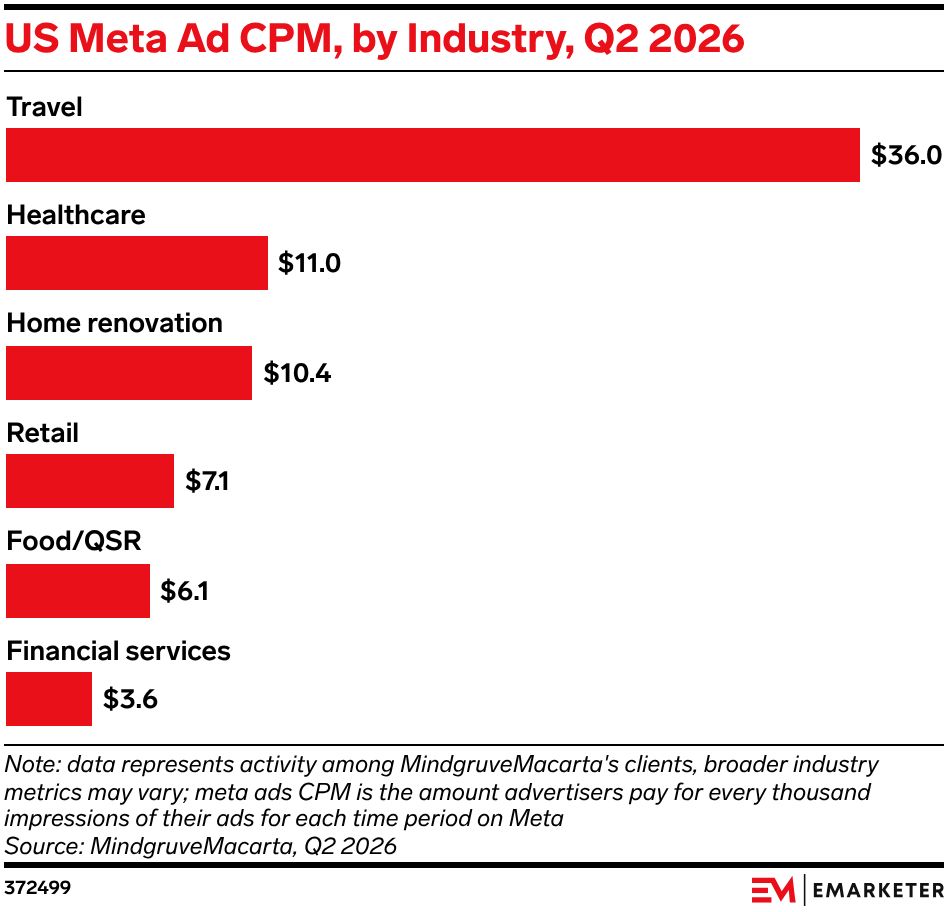
US Meta ad CPM by industry, Q2 2026. Source: EMARKETER, using MindgruveMacarta client data; broader industry figures may vary.
What the Chart Shows
Here's the full lineup for Q2 2026:
| Category | Avg. Meta CPM | What It Means |
|---|---|---|
| Travel | $36.00 | The most crowded auction on the platform. |
| Healthcare | $11.00 | Three times what financial services pays. |
| Home renovation | $10.40 | High-consideration, high-ticket, high-competition. |
| Retail | $7.10 | The middle of the pack. |
| Food / QSR | $6.10 | Volume-driven and comparatively cheap. |
| Financial services | $3.60 | The floor, at one-tenth the cost of travel. |
One fair caveat: the data comes from one agency's client base (MindgruveMacarta), so your own numbers may land somewhere else. But the shape of it rings true to everything I see in media plans. When every brand in a category bids on the same broad audiences, the auction does exactly what auctions do.
Travel: The $36 Category Has Its Best Customers in Plain Sight
Travel is the most expensive category on Meta, and it's also the one I've spent most of my career in. So this one is personal.
Arival's research found that LGBTQ+ travelers average about seven experiences per trip, versus four for non-LGBTQ+ travelers. And they spend more on each one: $213 versus $152 on attractions, $372 versus $288 on activities.
Then there's loyalty. Expedia Group found that 70% of LGBTQ+ travelers, versus 48% of travelers overall, are more likely to rebook with travel companies committed to diversity and inclusion.
Think about what that means in a $36 auction. A traveler who books more, spends more per booking, and comes back to brands that show up for them is worth more than an average impression. Every repeat booking is an impression you didn't have to buy twice. We go deeper on all of this in our LGBTQ+ Travel Market Guide.
Healthcare: An $11 CPM and a 20-Point Trust Gap
Healthcare is the second most expensive category on the chart, and the LGBTQ+ story here is a different kind of opportunity.
KFF reported in August that 58% of LGBTQ+ adults skipped or postponed needed healthcare in the past year, compared with 38% of non-LGBTQ+ adults.
That's a 20-point gap. It's a real unmet need, and it's not one a generic broad-reach ad is going to close. People put off care when they don't trust they'll be welcomed, understood or treated fairly. That trust gets built through relevance: the right message, from the right messenger, in places where the community already feels at home. The healthcare brands and providers who do that work will earn something far more durable than a click.
They're Already on the Platforms
This isn't an audience you have to go looking for. Nielsen found that LGBTQ+ audiences are 50% more likely than the general population to spend three or more hours a day on social media.
So the people with the most to gain from a better travel or healthcare message are highly engaged on the very platforms where advertisers are bidding against each other hardest. Most brands are reaching them, technically. They're just reaching them as part of an undifferentiated crowd, with a message built for someone else, at a premium price.
"The question isn't how to buy cheaper impressions. It's how to buy ones that actually mean something to the person on the other side of the screen."
Cheaper Impressions vs. Better Ones
When CPMs climb, the instinct is to chase efficiency: tighten targeting, shift to cheaper placements, squeeze the auction. Those are reasonable moves. But they're all versions of the same question, which is how to pay less for the same thing.
LGBTQ+ marketing asks a different question. What if the impression itself were worth more? Here's where that comes from:
Community media
LGBTQ+ publishers and outlets with years, sometimes decades, of earned trust. An ad in a place the community already reads carries some of that trust with it.
Creators and influencers
LGBTQ+ voices whose recommendations land as advice from someone in the community, not as one more sponsored post.
Cultural partnerships and experiential activations
Showing up at the moments, events and spaces that matter to the community, in person and year-round, not just in June.
Organizations with established credibility
Partnering with the LGBTQ+ institutions people already rely on. When they vouch for you, it means something.
Are these cheaper on a CPM basis? Not necessarily. But that's not the point. The value is relevance, authenticity, attention and trust, things an algorithm can't deliver on its own no matter how many impressions it serves.
It's not either/or. Meta and the other major platforms still matter, and a smart LGBTQ+ strategy can absolutely include them. The best plans I see use broad-reach platforms for scale and LGBTQ+ channels for relevance and trust, and they let each do what it does best.
The Line-Item Question
Every CMO I talk to right now is being asked to prove both efficiency and effectiveness. That pressure is a good reason to revisit an old habit: treating multicultural marketing, and LGBTQ+ marketing especially, as a small line item tucked at the bottom of the plan.
Look at that chart again. The categories paying the most to reach people are the same categories where LGBTQ+ consumers travel more, spend more, come back more, and need more from the brands that serve them. The opportunity isn't hidden. It's sitting right there in the data.
The Takeaway
Rising CPMs are a real problem, and nobody should pretend otherwise. But I don't think the answer is simply finding cheaper impressions. I think it's finding more meaningful ones.
Sometimes the smarter investment isn't reaching more people. It's finding better ways to reach the people who matter most.
For the full picture on the audience, our LGBTQ+ Travel Market Guide and the broader 2026 LGBTQ+ Marketplace Guide are good places to start.
- Meta Ad Cost Per Impression (CPM) · Meta CPM Growth — EMARKETER. US Meta ad CPM by industry, Q2 2026 (MindgruveMacarta client data), and year-over-year CPM trends.
- LGBTQ+ Travelers Do and Spend More on Experiences — Arival. Experiences per trip and spend per experience, LGBTQ+ vs. non-LGBTQ+ travelers.
- Inclusivity in Travel Research — Expedia Group. Rebooking intent among LGBTQ+ travelers vs. travelers overall.
- Examining LGBTQ+ Adults' Experiences With Health Care Costs and Access — KFF, August 2026.
- Reconnecting with LGBTQ+ audiences — Nielsen, 2025. Social media usage among LGBTQ+ audiences.
- Pink Media's 2026 LGBTQ+ Travel Market Guide · 2026 LGBTQ+ Marketplace Guide — the audience, the categories and the year-round calendar.