Happy Halloween from Pink Media! It feels like a fitting day for this one, because for a lot of brands, LGBTQ+ marketing is still a costume. It comes out once a year, it gets a lot of attention for a few weeks, and then it goes back in the closet until next June.
So I was glad to see this headline from the ANA Marketing Knowledge Center come across my desk last week:
"Brands Win Trust by Integrating LGBTQ+ Inclusion Across Growth Segments and Channels — Universal values and mainstream media reach allies beyond siloed campaigns."
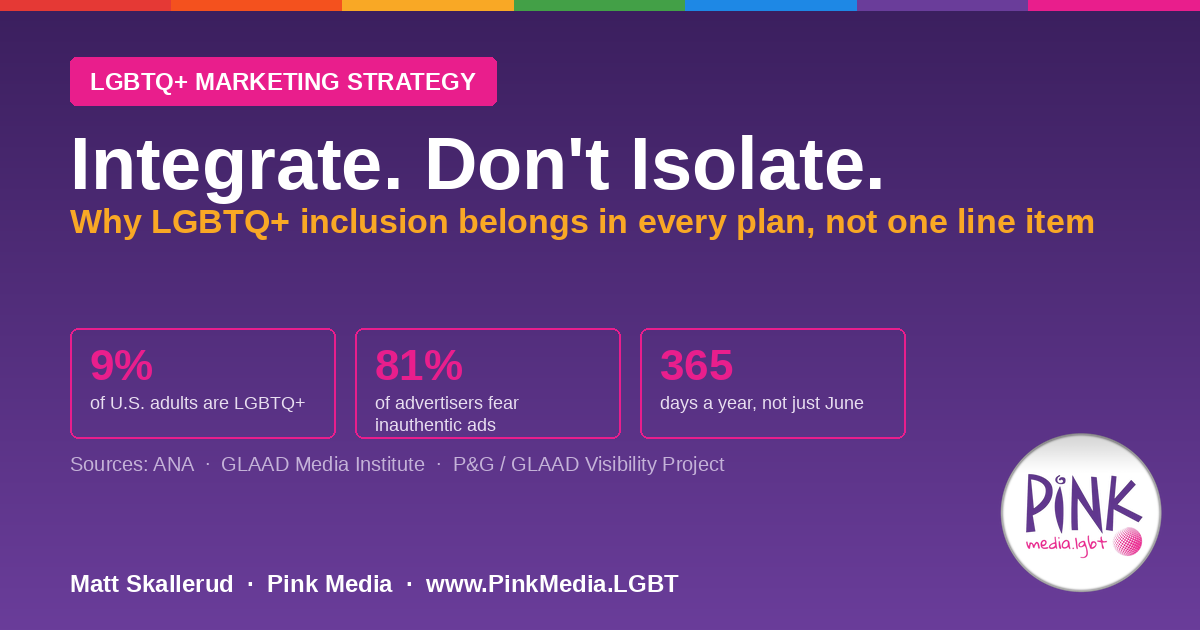
The recap, published October 23, comes from a presentation by Meghan Bartley of the GLAAD Media Institute at ANA's LGBTQ+ Inclusive Marketing Day. Its starting point is simple: LGBTQ+ adults now represent roughly 9 percent of U.S. adults, and brands that silo their inclusion campaigns are leaving scale, and trust, on the table. Integrating LGBTQ+ outreach across growth segments and mainstream channels, the argument goes, may give marketers a rare credibility advantage at a moment when institutional trust keeps eroding.
That's a conversation we've been having with clients for a long time. It's nice to see it on the ANA's letterhead.
What the Silo Looks Like
Most of us have seen some version of this. The LGBTQ+ work lives in its own campaign, with its own budget line, its own creative, sometimes its own agency, and its own window on the calendar. Meanwhile the Hispanic plan, the Black plan, the women's plan, the Gen Z plan and the general-market plan all run on their own tracks, and LGBTQ+ people rarely appear in any of them.
The trouble is that real people don't live in silos. A gay Latino dad in Phoenix is in your Hispanic plan, your parents plan and your LGBTQ+ plan all at once. A bisexual Gen Z woman is in three or four of your segments before breakfast. When the LGBTQ+ part of who they are only shows up in a separate June campaign, they notice. And so does everyone else.
Bartley's point, as the recap frames it, is that isolation costs you in two ways. You lose scale, because a standalone campaign reaches a fraction of the people it could. And you lose trust, because a brand that only shows up once a year reads as a brand that's only in it once a year.
Who the GLAAD Media Institute Is (and Why Its Model Matters)
The GLAAD Media Institute is GLAAD's training, consulting and research arm, and its whole model is built around integration rather than one-off campaigns. It works across three pillars:
Training & storytelling
Media advocacy training for grassroots advocates, global organizations and public figures, built on a personal-narrative framework of challenges, choices and outcomes that moves people toward empathy.
Consulting during production, not after
Behind-the-scenes work with film, TV, gaming and advertising teams: script reviews, casting help and corporate culture work, so authenticity is built in from day one instead of corrected after launch.
Research
Benchmark studies like Where We Are on TV and the Accelerating Acceptance study, giving brands and newsrooms hard data on representation gaps and public sentiment.
That second pillar is the one I'd underline for marketers. Catching a problem in a script review is a lot cheaper than catching it in the comments section.
The Movable Middle Lives in Mainstream Media
One of the most useful ideas in GLAAD's work is what they call the "movable middle." These are people who broadly believe in fairness and equality but may not have LGBTQ+ people in their own lives, or see accurate representation in the media they consume. GLAAD builds localized campaigns, like its "Here We Are" transgender acceptance campaign, to close that gap through simple, humanizing stories.
Here's why that matters for a media plan. The movable middle isn't reading LGBTQ+ media. They're watching network TV, scrolling the same feeds as everyone else, listening to mainstream podcasts. If the only place your brand includes LGBTQ+ people is in LGBTQ+ channels, you never reach them at all.
And allies are customers too. When a brand includes LGBTQ+ people naturally in its general-market work, it speaks to LGBTQ+ consumers, to the people who love them, and to the much larger group who simply want to buy from companies that treat everyone fairly. That's the "universal values" part of the ANA headline, and it's where the scale comes from.
Intersection Is Where the Audience Actually Lives
GLAAD doesn't just talk about intersectionality; it staffs for it. The Equity in Media and Entertainment Initiative, supported by Gilead Sciences, is a multi-year pipeline program for Black LGBTQ+ creatives and people living with HIV. Its Spanish-language and transgender media teams consult directly with Spanish-language networks and entertainment companies on cultural nuance and terminology. Its "Going Local" programs connect LGBTQ+ stories to regional and environmental issues.
That's a useful map for brands. Here's how I'd translate it into the segment plans most marketers already run:
| Growth Segment | The LGBTQ+ Layer |
|---|---|
| Hispanic / Latino | LGBTQ+ Latino families and creators in Spanish-language and bilingual creative, with culturally accurate language and terminology. |
| Black | Black LGBTQ+ voices, creators and community organizations, including health and wellness work where trust matters most. |
| Women | Lesbian, bisexual and queer women in campaigns about family, finance, health and career, not just in Pride creative. |
| Gen Z | The generation with the highest LGBTQ+ identification in Gallup's tracking. For them, inclusion is the baseline, not a bonus. |
| Travel | LGBTQ+ travelers and couples in destination and hospitality creative year-round, alongside LGBTQ+ travel media. |
| Entertainment | Authentic LGBTQ+ characters and talent, and marketing that reaches LGBTQ+ audiences where they discover what to watch, read and hear. |
None of those rows requires a separate campaign. Each one is a decision made inside a plan that already exists.
Multicultural Budget or General Market? Yes.
This is the question I get more than almost any other: does LGBTQ+ work belong in the multicultural budget or the general-market budget?
Strategically, it belongs in both. LGBTQ+ people are part of every multicultural and generational segment, so they belong in those plans. And LGBTQ+ inclusion in mainstream channels is how you reach the movable middle and the allies around them, so it belongs in general market too.
What makes it work is pairing the two:
Targeted LGBTQ+ community media for depth
LGBTQ+ publishers, creators, podcasts and local outlets with years of earned trust. This is where you show the community you know who they are, and where your message carries the credibility of the messenger.
Mainstream-channel inclusion for scale
LGBTQ+ people appearing naturally in the general-market and segment creative you're already running, so the inclusion travels as far as the rest of the plan does.
Year-round presence for trust
Showing up in October, February and August, not just June. Consistency is what turns a campaign into a reputation.
"LGBTQ+ isn't a segment that sits next to your other segments. It runs through all of them. Plan it that way and you get the scale and the trust."
Authenticity Is the Real Risk Manager
A lot of the hesitation I hear from brands isn't about whether LGBTQ+ inclusion works. It's about fear of getting it wrong.
That fear is real, and it's well documented. When P&G and GLAAD launched The Visibility Project, their research among advertisers and agencies found that 81% of advertisers and 41% of agency executives believed inauthentic portrayals would cause more backlash than not including LGBTQ+ people at all. The same study found 61% of advertisers strongly agreed that featuring LGBTQ+ people helps consumers understand and respect them.
Read those two numbers together. Marketers believe inclusion works, and they're afraid of doing it badly. The answer isn't to pull back. It's to build authenticity in early: LGBTQ+ input during creative development and casting, real people and real stories, and partners the community already trusts. That's exactly the "consult during production" model the GLAAD Media Institute uses, and it's how the Visibility Project helps brands embed inclusion into everyday business practice instead of treating it as a special project.
A note on the data. The Visibility Project figures come from a 2021 survey of 200 advertiser and agency executives. The full ANA recap of Bartley's talk is available to ANA members only, so this post works from the public summary rather than campaign-level results. The direction is clear, but every brand should still test what integration does in its own numbers.
Why Trust Is the Prize Right Now
The ANA recap makes a point I think is easy to skim past: institutional trust is eroding. People trust big organizations less than they used to, and brands are no exception.
In that environment, consistency is rare, and rare things are valuable. A brand that includes LGBTQ+ people across its plans, every month, in every segment, without making a big production of it, is a brand that looks like it means it. After the last few years of companies pulling back and going quiet, the ones that stayed steady are earning a kind of credibility that's very hard to buy with impressions alone.
Five Questions for Your 2027 Plan
- Where do LGBTQ+ people appear in your Hispanic, Black, women's, Gen Z, travel or entertainment creative outside of June?
- Is your LGBTQ+ budget a single line item, or does it show up inside each segment plan?
- Are you pairing LGBTQ+ community media with inclusive creative in mainstream channels, or only doing one?
- When does LGBTQ+ input happen — before production, or after the comments start?
- Would your LGBTQ+ customers recognize your brand as present in their lives in, say, October?
The Takeaway
The case for integration isn't new to anyone who's been doing this work for a while, but it's good to hear it said clearly in front of a room full of national advertisers. LGBTQ+ people are roughly one in ten American adults. They're in every segment you plan for, and they're surrounded by allies who are watching how you show up.
So treat LGBTQ+ as a layer, not a silo. Put it in the multicultural plan and the general-market plan. Pair trusted community media with inclusive mainstream creative. And show up all year long, not just when the costume comes out.
For more on the audience itself, our 2026 LGBTQ+ Marketplace Guide is a good place to start, and travel brands should also see our LGBTQ+ Travel Market Guide.
- Brands Win Trust by Integrating LGBTQ+ Inclusion Across Growth Segments and Channels — ANA Marketing Knowledge Center, October 23, 2026. Recap of Meghan Bartley's GLAAD Media Institute presentation at ANA's LGBTQ+ Inclusive Marketing Day (full recap for ANA members).
- GLAAD Media Institute · Consulting & Training — GLAAD. Training, consulting and research programs.
- The Visibility Project — GLAAD with Procter & Gamble.
- P&G and GLAAD Announce "The Visibility Project" and Release New Research — Procter & Gamble, 2021. Survey of 200 advertiser and agency executives.
- Equity in Media and Entertainment Initiative · Communities of Color — GLAAD.
- Where We Are on TV · GLAAD Global — GLAAD research and international programs.
- LGBTQ+ Identification in U.S. Rises — Gallup. LGBTQ+ identification by generation.
- Pink Media's 2026 LGBTQ+ Marketplace Guide · LGBTQ+ Travel Market Guide — the audience, the segments and the year-round calendar.