
When people think about the LGBTQ+ market, faith is rarely the first thing that comes to mind. For a lot of marketers, it may not come to mind at all. That's a mistake, and it's one I've seen for most of my 30 years in this business.
The truth is that a very large share of our community goes to church, temple, mosque or meditation hall. Many grew up in a faith tradition and never left it. Others left because they were told they had to, and some of them are quietly hoping to find a way back. Our new LGBTQ+ Faith & Religion Market Guide is about those people, and about how the congregations and organizations that want to welcome them can do it well.
For many LGBTQ+ people, faith is where some of their deepest hurt came from. For many of the same people, it's still home. Anyone reaching this audience has to hold both of those truths at once.
The Big Picture: 5.3 Million Faithful
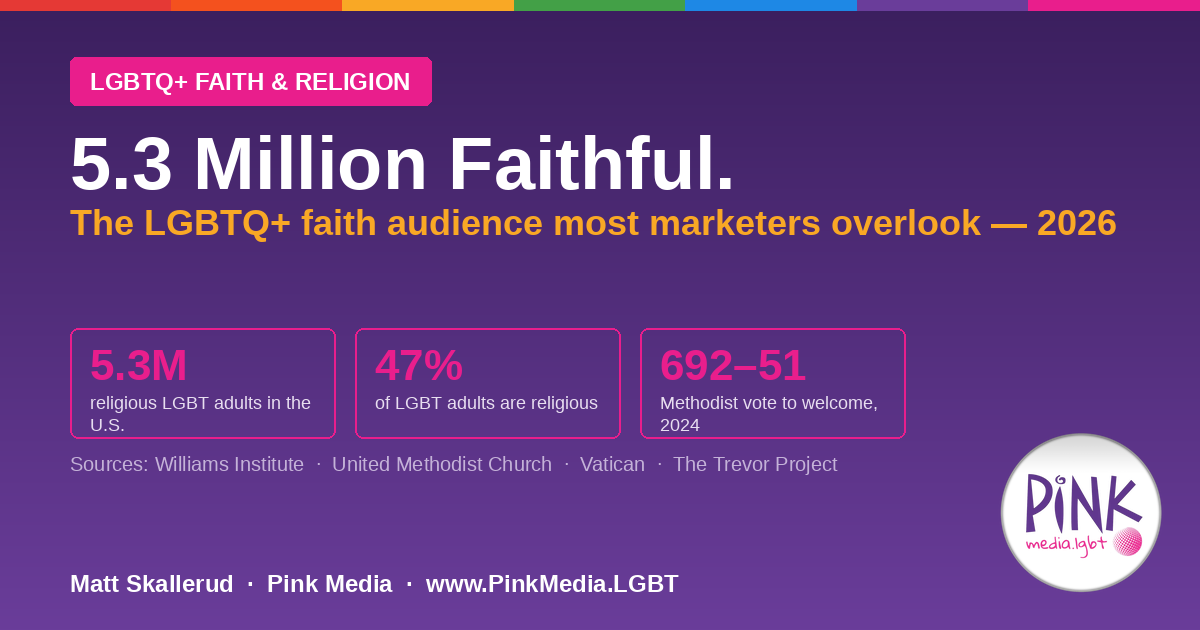
The best data we have comes from the Williams Institute at UCLA School of Law, which found that about 5.3 million LGBT adults in the U.S. are religious. That's 47% of LGBT adults, nearly half the community.
Beyond Catholics and Protestants, another 1.3 million identify with other Christian traditions, and the community includes Jewish, Mormon, Muslim, Buddhist, Hindu and other believers. This isn't a single audience with a single point of view. It's a cross-section of nearly every faith in America.
Who's Faithful: Five Segments
Our guide breaks this audience into five groups. They overlap, but each one calls for a different kind of message.
| Segment | Who They Are | What They Need to Hear |
|---|---|---|
| Devout & Affirmed | Active members of affirming congregations, for whom church is chosen family | Community, service and belonging |
| Seekers & Returners | People who left non-affirming childhood faiths and are quietly looking for a safe way back | Clear, specific assurance that they're welcome as they are |
| Culturally Faithful | Faith as heritage and family life, often strong in immigrant and diaspora communities | Respect for tradition, family and holidays |
| The Black Church Experience | For many Black LGBTQ+ people, the most central faith tradition in their lives | Recognition of the church's place in family and community |
| Spiritual, Not Religious | The largest younger group, drawn to meditation, ritual and chosen ceremony | Meaning and practice without doctrine |
A few things hold true across all five. People choose a pastor and a congregation, not a denomination's policy statement. And the major holidays (Christmas, Easter, Passover, the High Holidays, Ramadan and Eid) are when people are most likely to look for a place to belong.
The Door: The Methodist Turn
The biggest shift in recent years came from the United Methodist Church. In 2024, at its General Conference in Charlotte, delegates voted 692–51 to repeal the church's longstanding ban on LGBTQ+ clergy, and also removed its ban on clergy officiating same-sex weddings.
That vote didn't come out of nowhere. It followed decades of patient organizing by LGBTQ+ Methodists and their allies, including Reconciling Ministries Network, which certifies welcoming congregations. It's a good reminder that change inside faith communities tends to happen slowly, then all at once.
The Question: Where Catholics Stand
The Catholic picture is more complicated. In December 2023, the Vatican's declaration Fiducia Supplicans allowed priests to offer brief, non-liturgical blessings to same-sex couples, while making clear these aren't marriage blessings. In April 2026, Pope Leo XIV said the Church would keep that approach but not go further, after some German bishops moved toward formal blessing rites. The Vatican's doctrine chief had already said such blessings would remain under the new pope.
In practice, the experience of an LGBTQ+ Catholic still depends a great deal on their diocese and their parish priest. Groups like DignityUSA, New Ways Ministry and Fr. James Martin's Outreach help people find parishes where they'll be welcomed.
"LGBTQ+ people of faith don't need to be persuaded that faith matters. They need to know, specifically and believably, that there's a place for them in it."
Why Welcome Matters
This is the part of the guide I take most seriously. Religious rejection is linked to depression, anxiety and suicide risk among LGBTQ+ people, especially young people. Affirming faith is linked to the opposite.
A Trevor Project research brief found that LGBTQ+ youth who had not heard their parents use religion to say negative things about LGBTQ+ people had half the odds of attempting suicide in the past year compared with those who had. Belonging, family acceptance and an affirming community all protect. And in many Black and immigrant communities, congregations are among the most trusted messengers on health and wellbeing.
If you or someone you know needs support: The Trevor Project offers 24/7 support for LGBTQ+ young people at 1-866-488-7386 or thetrevorproject.org. In the U.S., you can also call or text 988 to reach the 988 Suicide & Crisis Lifeline.
How Congregations Can Grow Their Welcome
For churches, synagogues and other communities that want LGBTQ+ people to know they're welcome, the guide lays out six practical moves:
Be Clear
- Say it explicitly. "All are welcome" isn't enough. Say LGBTQ+ people are welcome, in those words.
- Show real people. Feature congregants, same-sex couples and your Pride participation.
- Get listed. Earn welcoming-congregation certification and appear in affirming-church directories.
Be Present
- Be findable when it matters. Holidays and life crises are when people search for a place to belong.
- Lead with the pastor's voice. People choose a pastor before they choose a church.
- Honor both truths. Acknowledge the harm religion has done, and the home it can still be.
What This Means for Brands
For brands and organizations outside the faith world, the guide's advice comes down to reverence and proof. Never mock faith. Lead with people rather than doctrine. Plan around the faith calendar, not just Pride Month. Work alongside trusted groups such as Metropolitan Community Churches, Keshet, Many Voices and Q Christian Fellowship. And remember that this audience is not only Christian: Jewish, Muslim, Buddhist and Hindu LGBTQ+ people are part of it too.
On the media side, the most effective approach is usually simple: combine faith-interest audiences with LGBTQ+ media and creators, focus it on the area a congregation actually serves, and be there when someone searches for an affirming church near them. Our Faith & Religion market page has more on how we help congregations do this, with programs starting at $500 a month.
A Personal Note
I've met a lot of LGBTQ+ people over the years who carry their faith quietly, almost as if it's something to apologize for inside our own community. It shouldn't be. Faith is part of who many of us are. The congregations that are opening their doors today are doing important work, and they deserve to be found by the people who are looking for them.
About this research. Population figures come from the Williams Institute's analysis of LGBT religiosity (released October 2020). Denominational updates come from public reporting on the 2024 United Methodist General Conference and Vatican statements through April 2026. Youth wellbeing data comes from The Trevor Project. The full 15-chapter LGBTQ+ Faith & Religion Market Guide covers history from MCC to the Methodist turn, an affirming-denomination map, global faiths, advocacy organizations, community life and rites, and detailed playbooks for congregations and marketers. For a broader view of the community, see our LGBTQ+ Marketplace Guide.
- LGBTQ+ Faith & Religion Market Guide — Editorial Summary — Pink Media.
- More than 5 million LGBT adults in the US are religious — Williams Institute, UCLA School of Law, October 8, 2020.
- Religiosity Among LGBT Adults in the US — Williams Institute (full report).
- United Methodists repeal longstanding ban on LGBTQ clergy — NPR, 2024.
- Pope Leo XIV Says the Church Will Not Expand Same-Sex Blessings — Urania Institute, April 2026.
- Gay blessings will remain under Pope Leo, Vatican doctrine chief says — National Catholic Reporter.
- Religiosity and Suicidality Among LGBTQ Youth — The Trevor Project, April 2020.
- LGBTQ+ Faith & Religion Market — Pink Media.