
I want to start with a number that should settle an argument I've been having with nervous brand teams since 2023.
For three years running, drag has been the single most legislated-against art form in the United States. Bills in dozens of statehouses. County ordinances. Protest campaigns aimed at story hours and brunches. If suppression worked the way its authors intended, we'd be looking at a category in retreat.
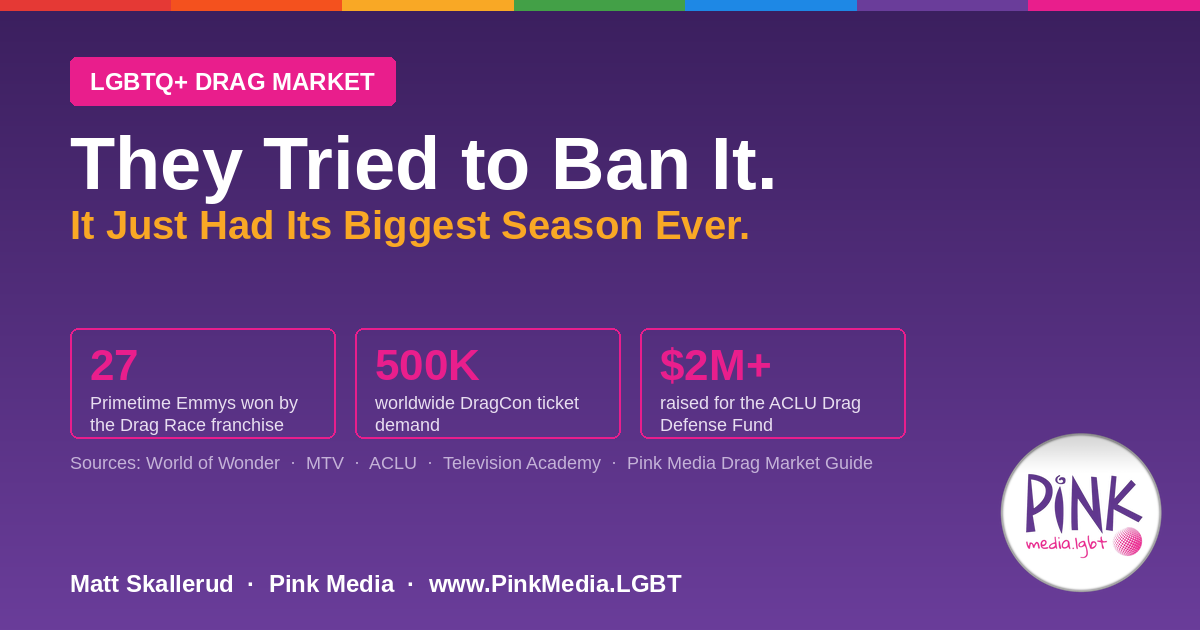
Instead: RuPaul's Drag Race Season 18 delivered the highest season premiere rating in the franchise's history, and was reported as its highest-rated season yet. It crowned Myki Meeks this April for a $200,000 prize. The franchise now holds 27 Primetime Emmys, runs four active spinoff series, and has produced editions across four continents.
Our newest market guide covers the whole category — the Drag Shows & Drag Queens Market Guide summary is here — and its central finding is the one I'd put in front of any brand still treating this as a risk category: every wave of suppression has preceded a bigger boom.
The Pattern Is Older Than the Panic
This isn't the first time. Drag got legislated against in the Prohibition-era crackdowns that followed the Pansy Craze. It got raided through the fifties and sixties under masquerade laws — the same enforcement climate that produced Stonewall. It got pushed underground, and each time it came back bigger and more commercially significant than it had been before.
What's different now is scale. The art form that spent most of a century in back rooms currently has a primetime Emmy shelf, a convention circuit, international format sales, and performers running real businesses — Trixie Mattel with a cosmetics, hospitality and media operation, Kim Chi with a mass-retail beauty line sitting on shelves in stores that a decade ago wouldn't have taken the call.
So when the suppression arrived this time, it didn't hit a subculture. It hit an industry with lawyers, distribution and an audience measured in the millions.
"Every wave of suppression has preceded a bigger boom. That's not optimism — it's the documented pattern of this art form for nearly a hundred years, and 2026 just ran the experiment again."
The Legal Risk Is Narrower Than the Headlines
This is the section I'd hand to whoever in your organization says "we love the idea, but legal is nervous."
The ban wave produced a county-by-county patchwork of restriction laws, and most of them were blocked or narrowed by courts. The one that survived is the one everyone cites: Tennessee's Adult Entertainment Act, left standing after the Supreme Court declined to hear a challenge in February 2025.
But read what actually happened rather than the headline. The appeals court narrowed the statute substantially — it reaches adult cabaret lacking artistic value, not drag as such. The ACLU of Tennessee's legal director put it plainly after the ruling: the court found that Friends of George's, an LGBTQ+ theater troupe, had no need to fear prosecution under the AEA even though its shows contain sexually explicit material — and that if their performances aren't reachable by the law, other drag performances shouldn't be either. A separate challenge involving Blount County Pride has seen enforcement temporarily blocked.
I'm not a lawyer and this isn't legal advice — venue, format and local ordinance all matter, and any brand doing a public activation should have counsel look at the specific event. But the working reality for a brand booking a drag performer for a brunch, a launch, a festival stage or a piece of content is that the exposure is dramatically smaller than the volume of noise implies. The noise is the point of the campaign. Don't let it do the work for free.
"The legislation didn't shrink the audience. It gave the audience a reason to show up — and gave brands a cheap excuse to stay home. Only one of those was ever a business decision."
Five Audiences, Not One
Here's where most drag campaigns quietly underperform. "Drag fans" gets treated as a single bucket. The guide breaks out five, and they want genuinely different things.
1. Franchise superfans
They follow the Drag Race universe week to week and know every alum's placement. They respond to franchise talent and franchise moments — premieres, finales, DragCon weekends — and they notice immediately when a brand books someone the fandom actually respects.
2. The brunch mainstream
Ally-heavy, occasion-driven: bachelorette parties, birthdays, work outings, group bookings. This is the biggest commercial surface in the category and the least-understood one — hospitality, spirits, restaurant groups and local retail all sit right on top of it.
3. Nightlife loyalists
The community core. They sustain the venues fifty-two weeks a year, not just on the good weekends, and their read on whether a brand is real carries further than any other segment's.
4. The culture-and-art audience
Ballroom, drag kings, theatrical and heritage drag. Deeply knowledgeable, historically under-booked by brands, and the segment where a thoughtful partnership earns the most credit relative to spend.
5. The solidarity audience
People who turn out for defense funds, story hours and ban-state support. They're not primarily there for entertainment — they're there because showing up is the point. They track which brands funded legal defense and which ones posted about it.
Segment two deserves a longer look, because it's where the money is and where the misunderstanding is deepest. Drag brunch is one of the most reliably sold-out recurring formats in American hospitality, and a meaningful share of its audience is straight women booking a group occasion. A brand that writes for the superfan and buys against the brunch crowd has mismatched its message to its media — and vice versa.
Book the Artist, Not the Aesthetic
The single most common failure mode I see: a brand wants the look of drag — the wigs, the camp, the color — and builds a campaign around it without hiring a single drag artist.
It reads instantly. This is a community that talks to each other constantly, and borrowing the visual language of an art form while routing the budget elsewhere gets noticed and discussed the same week. The guide's first best practice is blunt about it: book authentic performers rather than drag aesthetics alone.
The second is about money. Pay professionally — market rates, deposits up front, riders honored, travel and glam covered, and usage rights contracted separately if you intend to run the content as advertising. Drag is skilled creative labor with real costs behind it: garments, wigs, makeup, rehearsal, travel. Underpaying is the fastest available way to be talked about badly in the exact audience you were trying to reach.
And the third is about fit. Match the queen to the brief. Comedy, fashion, pageant, horror, king and ballroom performance are distinct formats with distinct audiences — booking a horror queen for a family-brand daytime activation isn't edgy, it's just a casting error that wastes the performer's strengths and your budget.
How Brands Get This Wrong
- Drag aesthetics with no drag artists hired
- Below-market fees, no deposit, riders ignored
- Franchise name parachuted in with no local talent
- Content rights assumed rather than contracted
- One June booking, then silence until next June
How Brands Get It Right
- Real performers, credited by name
- Market rate, deposit up front, rider honored
- Local queens alongside franchise alums
- Queen matched to the brief and the format
- Year-round presence plus legal-defense support
Drag Events Are Content Machines
One underrated commercial fact: a drag show generates more usable content per hour than almost any other live format a brand can sponsor. The audience films. The performers film. The venue films. The looks are built to be photographed.
So amplify the user-generated content rather than only running the polished hero spot. The room is already producing the assets — a rights-cleared amplification plan and a little paid weight behind the best of it will out-perform the studio cut nine times in ten, because it looks like what it is.
Pair that with the right timing. The category has a real calendar, and it isn't June-shaped.
| When | What | Why It Matters to a Plan |
|---|---|---|
| Premiere & finale weeks | Drag Race franchise tentpoles | The franchise superfan segment is concentrated and actively watching. Viewing-party sponsorships and venue activations convert here. |
| DragCon weekends | Los Angeles, New York and international editions | Roughly 500K in worldwide ticket demand. Activation, sampling and talent access all in one room. |
| July 16 | International Drag Day | A category-owned date with no competition from general-market Pride noise. Underused by brands. |
| Weekly | Drag brunch and local nightlife | The steady commercial base. Venue-level and geo-targeted buys against show nights outperform broad reach. |
| Year-round | Drag Story Hour · Drag Defense Fund | Where the solidarity audience is watching. Funding here buys credit no media placement can. |
Support the Defense
The clearest example of how this works commercially is the Drag Defense Fund — built by RuPaul with World of Wonder and MTV in partnership with the ACLU, and now past $2 million raised for legal work defending performers and events, with state chapters and Lambda Legal carrying cases alongside it. The Drag Story Hour network sits in the same frame: a program that absorbed enormous pressure and kept operating.
The guide's read, and mine: supporting legal defense earns deeper allyship credit than any amount of visibility spend, because it's the one form of support that costs something when it's inconvenient. The solidarity audience keeps a list. So does everyone else, quietly.
A practical note on nerves. If your team is weighing whether drag is "too risky," run the actual numbers rather than the vibes. The category posted record ratings through three years of organized opposition, the legal exposure for a standard brand booking is narrow and well-documented, and the reputational risk runs harder in the other direction — the community remembers who went quiet in 2023 far more vividly than it remembers who showed up in 2019.
The Eight Rules
Compressed to what I'd actually say on a call:
1. Book authentic performers — hire drag artists, not drag aesthetics. 2. Pay professionally — market rate, deposit, rider, travel, usage rights. 3. Mix local plus franchise talent so the booking reads credible in the market rather than airlifted in. 4. Match the queen to the brief — comedy, fashion, pageant, horror, king and ballroom are different jobs. 5. Amplify the UGC the event already produces. 6. Ride the franchise calendar — premieres, finales, DragCon, and July 16. 7. Support legal defense for the credit no media buy can purchase. 8. Stay visible past the trend cycle, because this community's memory is long and specific.
The Takeaway
Drag spent three years as the most deliberately targeted art form in the country and came out of it with record ratings, a bigger business footprint, and a more committed audience than it went in with. There isn't a cleaner demonstration anywhere in LGBTQ+ marketing of the thing I keep telling clients: pressure doesn't shrink this community's attention. It concentrates it.
Which means the brands that stayed away were managing a risk that mostly wasn't there, and passing on reach that mostly was.
The full Drag Shows & Drag Queens Market Guide goes deeper across all fifteen chapters — the history, the franchise economy, the performers building businesses, the venue and brunch landscape, kings and ballroom, the ban era and the defense infrastructure, the five audiences, and the full brand-partnership playbook. And the broader 2026 LGBTQ+ Marketplace Guide covers the national picture this market sits inside.
- Drag Shows & Drag Queens Market Guide — Editorial Summary — Pink Media. All fifteen chapters: history, the franchise economy, performers as businesses, venues and brunch, kings and ballroom, the ban era, the five audiences and the brand-partnership playbook.
- Drag Race Season 18 Sets Viewership Record — Deadline. The highest-rated season in franchise history, reported April 2026.
- Season 18 cast and $200,000 prize — GLAAD.
- RuPaul's Drag Race — Emmy Awards and Nominations — Television Academy. The franchise's full Emmy record.
- Drag Defense Fund — ACLU, with RuPaul, World of Wonder and MTV. More than $2M raised for legal defense of performers and events.
- Tennessee's drag ban is here to stay — here's why LGBTQ advocates don't mind — WKMS. How the courts narrowed the Adult Entertainment Act, and what it actually reaches.
- Supreme Court Leaves Tennessee's Drag Ban in Place — Metro Weekly, February 2025.
- Drag Story Hour · Lambda Legal — the programs and legal infrastructure that absorbed the pressure.
- Pink Media's 2026 LGBTQ+ Marketplace Guide — the national market landscape, categories and year-round calendar.