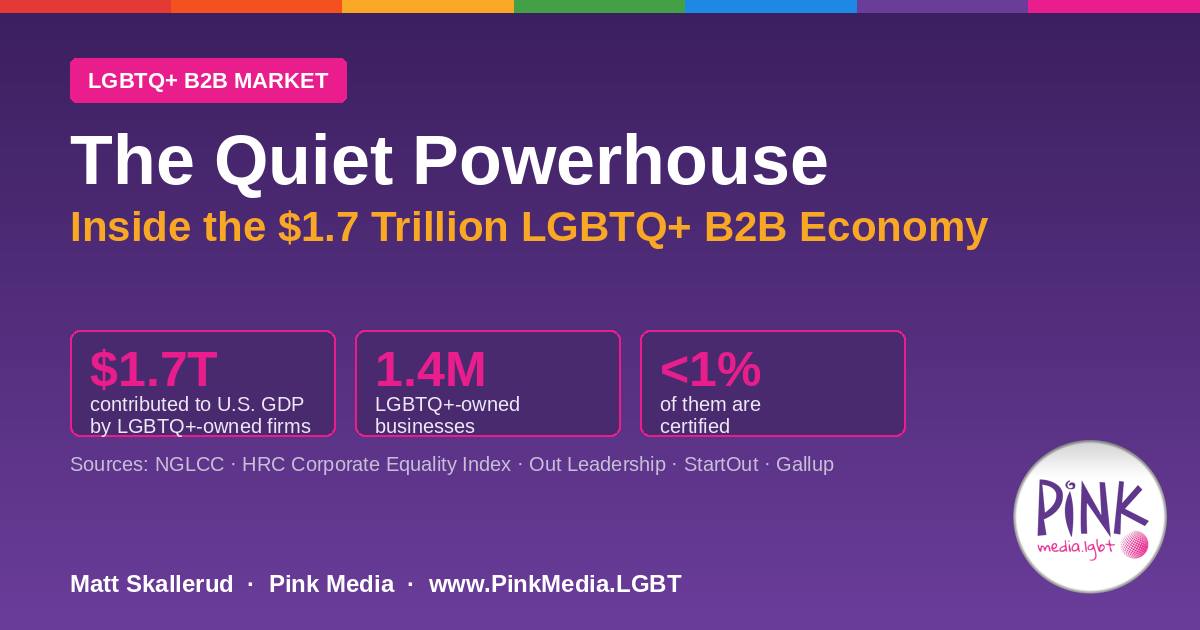
Here's a question I've been asking in rooms for thirty years now, and I still don't get a good answer: everybody in this industry can quote the LGBTQ+ consumer number — the $1.4 trillion in annual spending power — but almost nobody can quote the business number. So let me put it on the table. 1.4 million LGBTQ+-owned businesses in the United States, contributing more than $1.7 trillion to U.S. GDP.
That's the B2B side of this market, and it's the reason we built the new LGBTQ+ B2B Market Guide as a companion to our 2026 LGBTQ+ Marketplace Guide. It's the least understood corner of LGBTQ+ commerce, and in a year like this one, it's also the most resilient. Consumer Pride marketing is loud and it wobbles with the news cycle. The B2B ecosystem — the chambers, the certifications, the indices, the conference tables — is quiet and institutional, and it just kept operating.
The timing is not accidental, by the way. The NGLCC International Business & Leadership Conference opens today in San Diego and runs through Friday. If you want to see this economy in one room, that's the room.
The Numbers Marketers Keep Missing
Start with scale, because it reframes everything that follows.
Look at that middle number for a second, because it's the whole opportunity in one statistic. There are 1.4 million eligible firms and roughly 2,100 certified ones. That's not a mature, saturated supplier market — that's a pipeline that has barely been switched on. Every corporate procurement team that says "we can't find qualified diverse suppliers in this category" is looking at the certified 1% and concluding the pool is empty. The pool isn't empty. It's uncertified.
And that Gen Z number does a lot of quiet work too. When 23% of the youngest workforce cohort identifies as LGBTQ+, this stops being a niche audience question and starts being a talent, retention, and product-feedback question — which is exactly how B2B buyers think about it.
Six Audiences, Not One
The mistake I see most often is treating "LGBTQ+ B2B" as a single audience. It's six, and they buy differently, gather differently, and respond to completely different messages.
1. Certified suppliers (LGBTBEs)
The 2,100+ firms actively pursuing corporate contracts. They're motivated by access, matchmaking, and procurement relationships.
2. Uncertified LGBTQ+ business owners
The other 99% of the 1.4 million. Motivated by visibility, customers, and growth — not by procurement paperwork they've never heard of.
3. Founders and the startup ecosystem
Venture-backed entrepreneurs plus the investors around them — StartOut, Gaingels, Chasing Rainbows, and the accelerator community.
4. LGBTQ+ professionals and executives
Roughly 9% of the workforce, holding real budget authority. They're on LinkedIn, and they read who shows up.
5. ERG/BRG leaders and DEI practitioners
More than 1,400 LGBTQ+ employee groups at CEI-rated employers — internal champions with programming budgets and vendor influence.
6. Corporate buyers and institutions
400+ NGLCC partner companies plus government agencies. The demand side of the whole system.
A campaign written for a certified supplier will not land with an ERG lead, and neither one is a message for a procurement director. This is basic segmentation, but I see the entire market get collapsed into one generic "LGBTQ+ business" message constantly.
Founders Outperform — and Get Funded Least
This is the part of the guide that I think should be in front of every venture partner in the country. Research from the StartOut Index finds that LGBTQ+ founders create 36% more jobs than comparable peers, file 114% more patents, and deliver 44% more exits.
Then the other half of the sentence: they raise about 16% less capital — roughly 84 cents on the dollar — and LGBTQ+ founders have received an estimated 0.5% of U.S. venture capital over the past two decades. Better outcomes, less money. That's not a talent problem. That's a discovery-and-network problem, and discovery-and-network problems are exactly what marketing and media are for.
"More jobs, more patents, more exits — on less than one percent of the capital. When a market outperforms and stays underfunded, the gap isn't in the businesses. It's in who's looking."
Certification: What It Actually Unlocks
Since so much of this ecosystem runs on it, here's the plain version. LGBTBE certification is granted by the NGLCC to U.S.-based, for-profit businesses that are at least 51% LGBTQ+ owned, operated, and controlled. The process takes roughly 60 to 90 days through the NGLCC or one of its 50+ affiliate chambers.
What it buys you is access: corporate supplier databases, more than 400 corporate and government partners, and the matchmaking events that remain — in my experience and in the guide's research — the highest-converting B2B mechanism in this entire market. Nothing else in LGBTQ+ B2B turns a conversation into a contract at that rate.
The 2026 wrinkle is worth naming plainly. Federal executive orders this spring introduced anti-DEI contract clauses for federal contractors, effective in late April, and a number of corporations renamed, restructured, or exited their supplier-diversity programs. Some did it loudly. Many more kept the program running under a different name with less publicity. The practical effect is that certification has shifted from a procurement-target tool to a community-discovery tool — which, honestly, may end up being the more durable use of it.
Who Stayed in the Room
The workplace-equality picture in 2026 tells the same story from a different angle. Fortune 500 participation in HRC's Corporate Equality Index dropped about 65% in a single cycle — from 377 companies down to 131. That's the headline everyone ran.
Here's the headline nobody ran: 534 employers still earned a perfect Equality 100 score on the 2026 index, covering more than 22 million workers. In 2002, when the index launched, 13 companies scored perfectly. Twenty-four years later, in the hardest political climate this market has faced, it's 534.
What Pulled Back
- Fortune 500 CEI participation fell 377 → 131
- Federal contractor anti-DEI clauses took effect in April
- Several major brands exited programs entirely
- Out Leadership's index logged a 4th straight year of national decline
What Held
- 534 employers at Equality 100, covering 22M+ workers
- ~90% of the Fortune 500 still operate ERGs
- Quiet continuation: renamed programs, benefits intact
- NGLCC's 400+ partners and the chamber network kept operating
So there are really three corporate postures right now: public retreat, quiet continuation, and visible commitment. The second one is bigger than the press coverage suggests, and it's the most interesting group commercially — because those companies still want to reach this market, they just want to do it through channels that are about business rather than about a political fight.
That's a big part of what B2B media is for right now.
Where the Conversation Actually Lives
Two places, and they complement each other.
LinkedIn has become the center of gravity for the LGBTQ+ B2B conversation. That's where the professionals, the founders, the ERG leads, and the procurement people all overlap — and it's the one platform where a serious B2B post gets read rather than scrolled past. Our own LGBTQ+ Advertising & Networking group there has grown past 31,000 members, and I'll tell you what the engagement pattern shows: this audience responds to data and to positions, not to logos. Publish the number, then say what you think it means.
The other place is the calendar. Conference season peaks August through October, and each venue serves a different audience.
| 2026 Event | Dates | Where | Who's There |
|---|---|---|---|
| NGLCC International Business & Leadership Conference | Aug 18–21 | San Diego | Suppliers, procurement, chambers |
| ROMBA (Reaching Out MBA) | Oct 1–3 | Dallas | MBA and early-career talent pipeline |
| Lesbians Who Tech & Allies | Oct 5–7 | New York | Technical talent, founders, investors |
| Out & Equal Workplace Summit | Oct 12–15 | Seattle | HR, ERG leads, workplace inclusion |
| myGwork WorkPride | June | Virtual / global | Global talent and hiring |
Alongside those, the professional networks are the most precise targeting available in this market: Out Leadership at the C-suite and board level, Out & Equal for workplace inclusion, Lesbians Who Tech & Allies with 110,000+ members across 40+ cities, Out in Tech, oSTEM, NAGLREP in real estate, and the Association of LGBTQ+ Corporate Directors. Community-trusted, function-specific, and almost entirely LinkedIn-native.
"Sponsor in August and October, not just June. The B2B calendar has its own Pride season — and it's in the fall."
Message Plus Mechanism
If I had to compress the guide's best practices into what I'd actually say on a call, it's four things.
Be institutional, not seasonal. Join the chamber, get certified, sponsor the conference — before you run the campaign. In B2B, membership reads as commitment in a way that a June logo swap never will. And feature real LGBTQ+ people in real roles at your company. Stock-photo allyship gets clocked instantly by an audience that works in marketing for a living.
Treat LinkedIn as engagement, not reach. Build a two-way presence — groups, newsletters, programming, comments you actually answer. Then layer precise paid targeting by job title, industry, and company size on top of it. The reach number is not the point here; the conversation is.
Back it with operations. This is the one that separates the brands that win this market from the ones that annoy it. If you're marketing supplier inclusion, give LGBTBEs a real door: a pilot contract, a mentor-protégé program, a named person to call. If you're marketing workplace inclusion, make sure the benefits and the nondiscrimination policy match the ad.
Invest in the infrastructure. Fund the chambers, StartOut, the scholarship and accelerator programs — and report what you actually deployed. In 2026 this community reads receipts, not statements.
And if you're an LGBTQ+ business selling B2B: get certified and put the LGBTBE mark where buyers can see it, work the full calendar of events rather than one conference a year, and lead with capability first and identity proudly — in that order. Certification opens the door; the capability is what walks through it.
The Quiet Part
Every campaign spotlight in this guide has the same thing in common. IBM's four-decade record. The 534 companies that held their scores. NGLCC's matchmaking tables. StartOut's Growth Lab. Out Leadership's state-by-state CEO briefs. Every one of them works because it pairs a message with a mechanism — an actual certification, an actual contract, an actual dataset, an actual table where two people sit down.
That's the difference between consumer Pride marketing and B2B, and it's why this side of the market held up while the loud side wobbled. Business audiences don't grade you on sentiment. They grade you on whether the thing you said you'd do has a process behind it.
The full LGBTQ+ B2B Market Guide goes deeper across all of it — the 1999-to-2026 timeline of how this ecosystem was built, the six audiences, supplier diversity and certification mechanics, the global chamber network, workplace equality and ERGs, capital and entrepreneurship, the media and thought-leadership landscape, the policy environment, and the full best-practice playbook with campaign spotlights. This post is the short version.
If your brand is trying to reach LGBTQ+ business decision-makers — or you're an LGBTQ+ business trying to reach corporate buyers — we'd love to help you build something that runs all twelve months.