

Every so often a number crosses my feed that I wish I could staple to the front of every destination marketing proposal I've ever written.
Here it is. In 1996, Greater Fort Lauderdale spent $35,000 on its first campaign aimed at LGBTQ+ travellers. Today that market is worth roughly 3.4 million visitors a year and an estimated $1.35 billion in annual spending to the destination.
I saw it framed recently by Santiago Brockmann, who writes on hotel and tourism strategy, and what I appreciated was who he framed it for. Not an LGBTQ+ audience. Hotel asset managers and destination boards — people who evaluate a market on yield, seasonality and displacement, and who have never once been persuaded by a values argument in a Tuesday morning meeting.
His thesis is the right one, and it's bigger than our category: a mature destination should change the composition of its demand, not the volume. Fort Lauderdale is the proof of concept, and we've just finished a full regional guide on this market, so I want to walk through how the pivot actually happened.
First, Understand What Fort Lauderdale Was Replacing
You can't read the pivot without the thing it pivoted away from.
For twenty-five years, Fort Lauderdale was spring break. Where the Boys Are put it on the map in 1960, and by 1985 the city was absorbing more than 350,000 students in a matter of weeks. That is an enormous amount of demand by any measure.
It was also close to worthless on the metrics that matter. Low spend per head. Six people to a room. Concentrated into one short window. Enormous strain on infrastructure, law enforcement and residents' patience. And — the part destinations underrate until it's too late — brand-defining. A destination known for one thing struggles to be considered for anything else.
So the city moved against it: street reconfiguration, hard enforcement on public drinking, and a public message that the crowds were no longer welcome. It worked. The business left for Panama City Beach, Daytona and Mexico. By the mid-2000s, spring break in Fort Lauderdale was down to something like 10,000 people.
Now here's the part that usually gets lost. Ending spring break was the easy half. Plenty of destinations have shut down a segment they'd outgrown. What separates Fort Lauderdale is that it had a plan for what came next — and the plan wasn't to find 350,000 different people.
The Demand It Left Behind
- 350,000+ visitors compressed into weeks
- Minimal spend per visitor, rooms split many ways
- Single-season, weather-dependent, zero repeat value
- Heavy infrastructure and enforcement cost
- A brand identity that blocked every other segment
The Demand It Built Instead
- Higher spend per trip and longer average stays
- Travel across the full calendar, not one season
- Strong repeat visitation and word-of-mouth
- Low displacement — it fits into existing capacity
- A brand identity that opened doors rather than closing them
The $35,000 Bet
In 1995, Richard Gray took a proposal to the Greater Fort Lauderdale Convention & Visitors Bureau: market the destination, deliberately and by name, to gay travellers. They said yes. The first campaign ran in 1996 on $35,000.
I want to sit with how small that is. Thirty-five thousand dollars was not a strategic commitment in 1996 — it was a rounding error someone was willing to risk. What made it work wasn't the size of the bet. It was that nobody pulled it back.
Within five years the destination had around 30 gay-oriented resorts. Gray's role went from part-time to full-time, and the budget grew to roughly $1 million a year — at which point he was one of the only people at any convention and visitors bureau in North America whose entire job was this market. He held that post for about thirty years, retiring as Senior Vice President in January 2025.
"The $35,000 didn't produce $1.35 billion. Thirty years of not cancelling the $35,000 produced $1.35 billion."
That's the sentence I'd put on the slide. Because the failure mode I watch destinations fall into isn't refusing to fund LGBTQ+ marketing — most will fund a year of it. It's funding a year of it, seeing an unremarkable result, and reallocating. The compounding never starts.
Visit Lauderdale Didn't Just Enter This Market. It Led It.
There's a version of destination LGBTQ+ marketing that amounts to buying a few ads in June and adding a page to the website. That's not what happened here, and the difference is worth being specific about, because Visit Lauderdale has functioned as an industry leader in this category rather than a participant in it.
The clearest evidence is the transgender work, which the destination went into years before anyone else — and at a moment when there was no competitive pressure to do so and no obvious upside.
2014 — The first research, because nobody had any
The CVB commissioned Community Marketing & Insights to survey roughly 700 transgender respondents about their travel needs and preferences. Gray's stated reason was disarmingly honest: the industry knew a great deal about gay travellers and effectively nothing about transgender travellers. So they went and found out — trip frequency, hotel preferences, activities, solo travel patterns, and where people felt safe. It was the first study of its kind in tourism.
2015 onward — Winning the conference
Greater Fort Lauderdale won the Southern Comfort Transgender Conference — the longest-running transgender conference in the country — away from Atlanta, where it had been held for more than two decades, and then hosted it year after year. Booking the conference is one thing; keeping it is a statement about how attendees were actually treated.
2017 — The world's first campaign with transgender models
In January 2017, the destination launched the first mainstream travel marketing campaign anywhere to feature transgender models, running alongside straight, gay and lesbian models across print, digital, TV, radio and streaming. A Times Square billboard video premiered during the New Year's Eve ball drop. Gray's line at the time: "Using Trans models in our mainstream campaign says who we are as a destination." Note the framing — not who we're targeting. Who we are.
The through-line — "Everyone Under the Sun"
The destination's brand platform features local LGBTQ+ residents, people with disabilities and the county's genuinely global population. Inclusion isn't a campaign layered on top of the positioning. It is the positioning — which is why it didn't get quietly retired when Florida politics turned hostile.
The infrastructure and the equality record backed it up rather than contradicting it. Broward County recognised gender identity as a protected human right, and today Fort Lauderdale, Wilton Manors and Oakland Park each hold a perfect 100 on HRC's 2025 Municipal Equality Index. Marketing claims that don't survive contact with the destination don't produce repeat visitation — and repeat visitation is the entire engine here.
"We know a lot about gay travellers … but we really don't know anything about transgender travellers."
That was Gray in 2014, explaining why he was commissioning research. I've thought about that quote a lot. It's the opposite of how most brands enter a new segment — which is to assume they already understand it, run the campaign, and find out from the response that they didn't.
Why "Composition, Not Volume" Is the Right Frame
Here's why I think Brockmann's framing does more work than the usual LGBTQ+ market pitch.
The standard argument is about spending power, and it has a credibility problem — every segment claims disposable income, and any experienced asset manager has heard it a hundred times. The composition argument is different, because it's a capacity argument, and capacity is a language that room is already fluent in.
A mature destination — full beaches, constrained airlift, residents at their tolerance limit, hotel stock built out — has almost no room to grow on volume. Every incremental visitor costs something in infrastructure and goodwill. The only lever left is yield per visitor and distribution across the calendar. That's not a values conversation. That's an asset management conversation.
And on those terms, LGBTQ+ travel is unusually well-suited: higher spend per trip, longer stays, strong repeat rates, travel outside school holidays, and — this is the underrated part — almost no displacement. You're not asking the destination to build anything new or push anyone out. You're filling capacity that already exists, in windows that are already soft.
| Lever | What It Asks For | What It Delivers |
|---|---|---|
| Grow volume | New capacity, more infrastructure, resident tolerance | Marginal revenue at rising cost — and a ceiling |
| Grow rate alone | Product investment and a repositioning cycle | Slow, expensive, easily undercut by competitors |
| Change composition | Marketing focus and sustained commitment | Higher yield inside existing capacity, across more of the year |
Fort Lauderdale ran the third row for thirty years. That's the whole case study.
What Actually Transfers
Not every destination has Fort Lauderdale's advantages, and I'd be doing you a disservice if I pretended the model drops in anywhere. Broward has genuine density — Wilton Manors is second in the country for same-sex couples per household — plus a working community press, real institutions and a three-season event calendar. That took decades to build.
But the strategic moves underneath it do transfer, and here's what I'd take from it.
1. Argue composition, not spending power. Walk into the board meeting with yield, seasonality and displacement. "This demand fits in the capacity you already have, in the months you can't fill" beats any statistic about disposable income.
2. Fund it small and never stop. A modest annual commitment held for a decade will outperform a big campaign held for eighteen months. Fort Lauderdale's number is a compounding story, and compounding requires that nobody hits pause.
3. Give it a named owner. The single most replicable detail in this whole history is that one person's job was this market. Segments that belong to everybody belong to nobody, and they're the first thing cut.
4. Research the part you don't understand. Fort Lauderdale's transgender work started with an admission of ignorance and a survey. Most destinations would have started with a campaign — and it would have shown.
5. Buy the community's own media. Repeat visitation is built on credibility, and credibility in this market is built in LGBTQ+ outlets, not borrowed from general-market placements.
6. Hold the position when it gets uncomfortable. Visit Lauderdale kept inclusion as its core brand identity through the hardest stretch of Florida politics in decades. That's precisely when the market was paying attention, and it's a meaningful part of why the number is what it is.
If you present one slide: $35,000 in 1996 → roughly $1.35 billion in annual visitor spend today, in a destination that deliberately walked away from 350,000 low-yield visitors first. That is a composition strategy, not a marketing campaign — and the return came from thirty years of not reversing it.
The Takeaway
There's a reason I keep coming back to Fort Lauderdale when someone asks whether LGBTQ+ destination marketing actually pays.
It's not that the number is big. It's that the number is traceable. You can follow it from one line item, through a named person's thirty-year tenure, past a research study nobody had commissioned before, through a campaign that put transgender models in Times Square, and out the other side into a billion-dollar visitor segment that shows up all twelve months.
Very few marketing investments in any category can be traced that cleanly. Destinations sitting on mature, capacity-constrained inventory and wondering where growth comes from now have a documented answer — and the honest part of that answer is that it takes longer than one budget cycle and works best when nobody flinches.
Our LGBTQ+ Fort Lauderdale Region Guide covers the market in depth — the equality scorecards, the media landscape, the community institutions, the three-season calendar and the marketing rules that govern South Florida. The 2026 LGBTQ+ Travel Market Guide puts the demand side in national context.
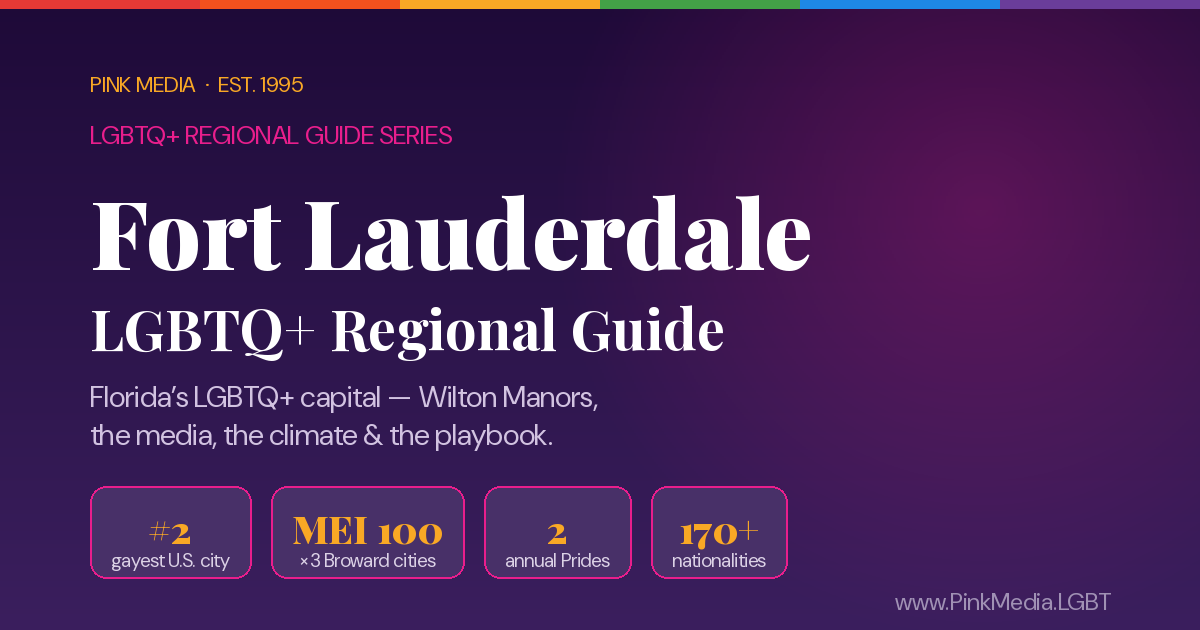
- LGBTQ+ Fort Lauderdale Region Guide — Editorial Summary — Pink Media. The full market breakdown: Visit Lauderdale's positioning, equality scorecards, media, institutions and the seven-rule playbook.
- Three Perfect Scores, One Hostile State. — Pink Media. Why Greater Fort Lauderdale is America's most misread LGBTQ+ market.
- Visit Lauderdale's Senior Vice President Retires — OutSFL. Richard Gray's thirty-year tenure, the 1996 $35,000 campaign, and the visitor and spending figures.
- Greater Fort Lauderdale CVB Launches Transgender Initiative — TravelPulse. The 2014 Community Marketing & Insights study and the Southern Comfort Transgender Conference.
- World's First Travel Marketing Campaign To Feature Transgender Models — PR Newswire, January 2017. Campaign details and Richard Gray's quote.
- Richard Gray: The Legacy of a Champion for LGBTQ+ Travel and Inclusion — Instinct Magazine. Career retrospective and program growth figures.
- From Spring Break to Higher-Value Demand: What Fort Lauderdale Can Teach — Santiago Brockmann, Hotel & Tourism Strategy. The demand-composition framing that prompted this piece.
- Municipal Equality Index — Human Rights Campaign Foundation. 2025 scores for Fort Lauderdale, Wilton Manors and Oakland Park.
- Pink Media's 2026 LGBTQ+ Travel Market Guide · 2026 LGBTQ+ Marketplace Guide