Every so often a set of numbers shows up in my feed that I know I'll be quoting for the next year. This week it came from the multicultural marketing world, not the LGBTQ+ one — which is exactly why I think it matters to us.
Carlos Santiago, who works with the ANA's cultural marketing community and the Cultural Leadership Alliance, recirculated a recap from Matt Wagner, SVP of Client Services, on the alliance's forum about culture x gender. The topic was intersectional marketing: what happens when you stop planning for culture and gender as two separate checkboxes and start planning for the people who live at the overlap.
The post didn't get a lot of engagement. The numbers in it deserve a lot more.
The Gap in One Sentence
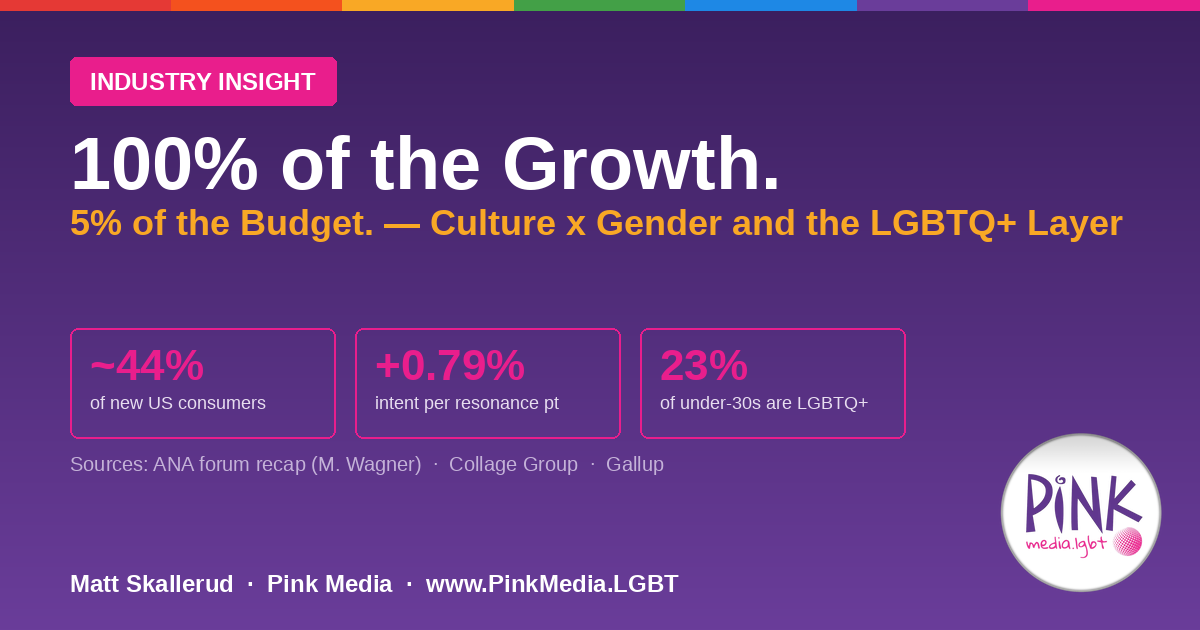
Put those first three numbers together and you get the whole argument: the audiences responsible for all of the country's population growth, and close to half of its new consumers, received about one dollar in twenty. I've spent thirty years watching LGBTQ+ budgets get set the same way — sized to how comfortable a brand feels, not to how big the audience actually is — so this pattern is very familiar.
The fourth number is the one that moves it from a fairness argument to a performance argument. According to the recap, Collage Group research found a 0.79% lift in purchase intent for every one-point gain in cultural resonance. Collage Group has said for a while that its cultural fluency measures predict favorability and purchase intent, and treats both as leading indicators of market share. In plain terms: resonance isn't a soft metric. It shows up at the register.
Every one-point gain in cultural resonance = a 0.79% lift in purchase intent. Resonance is a performance lever, not a nice-to-have.
Why "Culture x Gender" Is the Right Frame
The forum's framing is what I liked most. Not "multicultural" over here and "women" over there, but the multiplication of the two. The brand examples discussed — Desigual, Aveeno Baby, Baby Dove and Cherry Coke among them — were offered as work that lands because it speaks to a specific combination of identities rather than an average.
That's how people actually live. Nobody wakes up as a demographic. They wake up as a 27-year-old Latina, a Black dad, a Korean-American grandmother — and, for a meaningful share of them, as someone who is also LGBTQ+.
The Layer Most Intersectional Plans Still Leave Out
Here's where I'd like to add to the conversation. When the industry talks about intersectionality, culture and gender are almost always on the list. Sexual orientation and gender identity often aren't. And the data says that's a real blind spot, especially in a culture x gender conversation.
Gallup's February 2026 release puts LGBTQ+ identification at about 9% of US adults and 23% of adults aged 18–29. The gender split is the part I'd put in front of every planner at that forum: 10.5% of women identify as LGBTQ+, compared with 5.6% of men, largely because women are much more likely to identify as bisexual (7.2% versus 2.5%). Bisexual people now make up 58.6% of the LGBTQ+ population.
So if you're building a culture x gender plan for young women — which is where a lot of growth-audience work is focused — roughly one in four of the people you're trying to reach may be LGBTQ+. They're already in your target. The question is whether your creative, your casting and your media see them.
Culture x Gender x LGBTQ+: who's actually in the overlap
Young, multicultural, female and frequently bisexual. That combination sits right where the growth numbers and the LGBTQ+ numbers meet, and it rarely shows up as a named persona in a brief.
Family and life-stage brands
The baby-care examples from the forum are a good reminder: LGBTQ+ parents, especially in multicultural households, are a real and loyal audience for family brands, and they notice whether they're ever shown.
Heritage and nostalgia brands
Brands built on cultural memory can extend that resonance to LGBTQ+ consumers who share the same culture — often with very little change to the core idea, just more care in who's in the frame.
"If you're planning for culture and gender but not for who people love or how they identify, you're not doing intersectional marketing yet. You're doing two-thirds of it — and missing nearly a quarter of the under-30s you're trying to reach."
What This Means for Planners
1. Size the budget to the growth, not the comfort level. The 100%-of-growth, 5%-of-spend gap is the most portable number in this post. Use it in your next budget conversation, and ask the same question of your LGBTQ+ allocation.
2. Add sexual orientation and gender identity to the intersection. If your brief lists culture, gender, age and life stage, add LGBTQ+ as a layer inside each of them rather than a separate line that only activates in June.
3. Measure resonance, not just reach. If a one-point gain in cultural resonance is worth 0.79% in purchase intent, test your creative with LGBTQ+ respondents inside your multicultural samples, not only in a standalone LGBTQ+ study.
4. Cast the overlap. The quickest win is usually in the casting and the details: a Latina mom with her wife, a Black bisexual woman in a beauty spot, a multigenerational family that includes a gay uncle. Small, accurate choices build resonance.
5. Use partners who know the overlap. Multicultural agencies and LGBTQ+ specialists are often working the same consumer from different sides. Bring them into the same planning room.
How Segmentation Usually Works
- Multicultural, women and LGBTQ+ planned by separate teams
- Budgets sized by historical habit
- LGBTQ+ activated mostly around Pride
- Resonance tested against the general market
- Personas built on one identity at a time
How Culture x Gender x LGBTQ+ Works
- One plan built around overlapping identities
- Budgets sized to where growth actually comes from
- LGBTQ+ present year-round, inside every segment
- Resonance tested with the people in the overlap
- Personas that reflect how people really live
A note on the numbers. The population-growth, new-consumer and investment figures, and the 0.79% Collage Group finding, come from Matt Wagner's public recap of the ANA forum; we haven't seen the underlying decks. The LGBTQ+ figures come from Gallup's February 2026 release, based on 2025 interviews with more than 13,000 US adults. For a deeper look at LGBTQ+ audience size and spend, our LGBTQ+ Marketplace Guide has the full picture.
A Conversation Worth Joining
I've been doing this since we launched GayWired in 1995, and some of the best LGBTQ+ work I've seen came from people who started in multicultural marketing. They already understood that resonance beats reach, that authenticity is visible, and that budgets follow evidence. The culture x gender conversation at the ANA is a natural place for LGBTQ+ data to sit alongside everything else.
One hundred percent of the growth. Five percent of the budget. And inside both, a large and growing LGBTQ+ audience that's already part of the intersection — whether the plan names it or not.
- Carlos Santiago on the ANA Cultural Leadership Alliance forum — LinkedIn, September 29, 2026. Reply to and amplification of Matt Wagner's recap.
- Matt Wagner's culture x gender forum recap — LinkedIn, September 17, 2026. Population growth, new-consumer and investment figures; Collage Group resonance finding; brand examples.
- ANA Cultural Leadership Alliance Membership Briefing & Fall Forum Recap — ANA.
- The ANA Inclusive Marketing Practice — ANA.
- Collage Group Releases 2025 State of Brand Cultural Fluency Report — GlobeNewswire, August 21, 2025. Cultural fluency as a predictor of favorability and purchase intent.
- LGBTQ+ Identification Holds at 9% in U.S. — Gallup, February 2026. 9% of adults, 23% of 18–29s; 10.5% of women vs. 5.6% of men; bisexual 58.6% of LGBTQ+ adults.
- LGBTQ+ Marketplace Guide — Pink Media. US audience size, segments and spending.