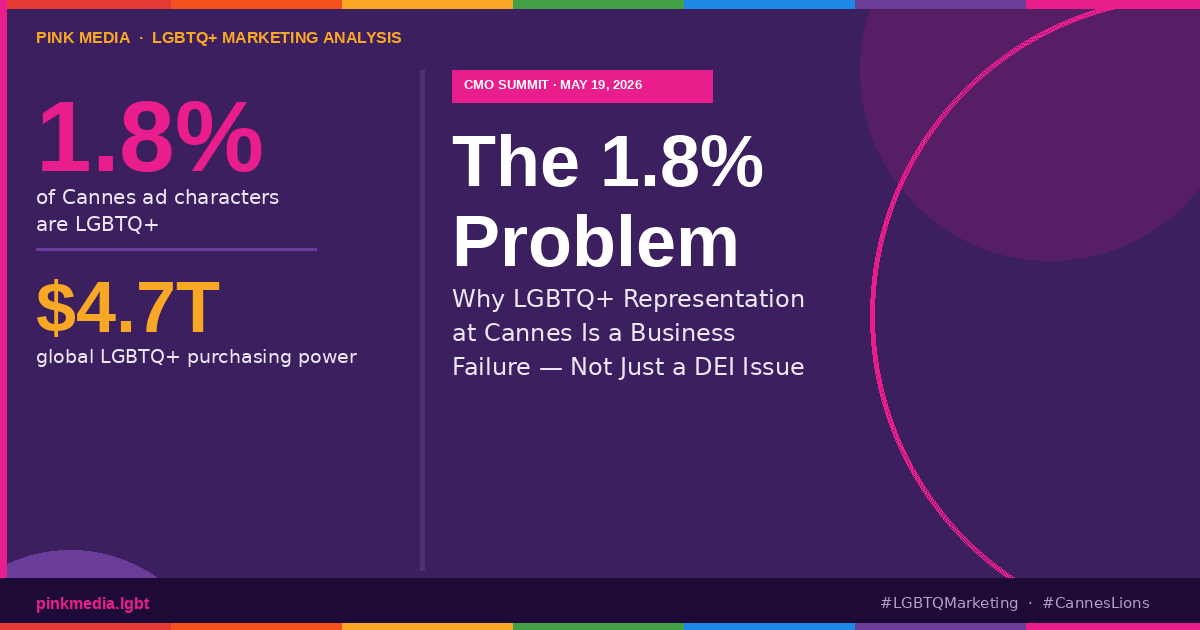
I want you to hold two numbers in your head at the same time. The first: $4.7 trillion — the estimated global purchasing power of LGBTQ+ consumers. The second: 1.8% — the share of characters in Cannes Lions-recognized advertising that GLAAD's Visibility Project found to be LGBTQ+. Now sit with what that gap means. Not as a diversity metric. Not as a corporate values statement. As a business problem.
The Cannes Lions International Festival of Creativity is, by most industry measures, advertising's annual moment of truth. The campaigns that win Lions set the creative agenda — they influence briefs, shape category norms, and tell the global marketing community what "excellence" looks like. So when the industry's most celebrated work features LGBTQ+ people in fewer than 2% of its characters, we're not looking at an oversight. We're looking at a systematic, industry-wide undervaluing of one of the world's most powerful consumer segments.
That's a business failure. And ahead of the May 19 CMO Summit, I think it's time we talk about it that way.
of characters in Cannes Lions-recognized advertising are LGBTQ+, according to GLAAD's Visibility Project — despite LGBTQ+ consumers representing $4.7 trillion in global purchasing power and making up a growing share of every major market. The gap between representation and market reality has never been wider. Or more expensive to ignore.
Cannes Is Where the Industry Tells Itself What It Values
You know how it goes in the awards world. The categories expand, the jury diversity improves, the speeches get more inclusive. And yet the work that actually wins — the campaigns that make the highlight reels and the case study videos — tends to reflect a very narrow view of who deserves to be centered in advertising. LGBTQ+ people have been part of that "narrow view" for a long time, and GLAAD's data makes it measurable.
Let me be clear about what 1.8% actually means in practice. It means that in an industry that prides itself on cultural insight, emotional intelligence, and human truth — the industry's most celebrated practitioners are essentially ignoring a consumer segment that represents hundreds of millions of people worldwide. It means the creative work being held up as the global standard is built on a fundamental market intelligence failure.
And before anyone reaches for the "difficult political climate" excuse — the purchasing power didn't retreat when some corporate logos went back to their default colors. The LGBTQ+ community didn't stop buying cars, booking travel, choosing healthcare providers, or upgrading their phones because a handful of brands got spooked in 2023. The market is still there. The creative representation isn't.
The "Ally" Economy Is Not a Substitute for Representation
Here's where I think a lot of CMOs get it wrong — and where the Cannes data reveals something important. There's a tendency in corporate marketing to treat LGBTQ+ inclusion as a values statement rather than a market strategy. You put a rainbow on the logo in June, you run one inclusive campaign through a Pride media buy, and you call it done. The 1.8% figure tells us exactly how that approach plays out at the top of the creative food chain: it gets you almost nothing.
What LGBTQ+ consumers actually respond to is BROADER yet TARGETED engagement — campaigns and content that don't treat their identity as a seasonal activation, but as a year-round reality. The brands that have figured this out — and the data backs this up consistently — see measurably higher loyalty, stronger word-of-mouth, and better performance in LGBTQ+-skewed market segments.
"When you treat LGBTQ+ consumers as an audience worth reaching only in June, you're not building brand equity — you're building brand resentment. And $4.7 trillion in purchasing power has very good memory."
I've been in this space for over 30 years — since launching GayWired.com in 1995, one of the top 3 LGBTQ+ websites worldwide. I've watched brands cycle through this pattern over and over. The ones who treated LGBTQ+ marketing as a check-box exercise never built real community equity. The ones who showed up consistently, with authentic content, built audiences that stayed with them through market volatility, through political turbulence, through everything. That's not a diversity argument. That's a brand-building argument.
What the Gap Actually Costs Brands
Let's talk about the business math that doesn't show up in the Cannes submission decks. When your creative work systematically underrepresents 1 in 5 Gen Z consumers — a generation that identifies as LGBTQ+ at significantly higher rates than any previous cohort — you're not just failing a diversity metric. You're producing creative work that feels irrelevant, invisible, or actively exclusionary to a segment that is about to become your most important consumer base.
Gen Z LGBTQ+ consumers are particularly attuned to authenticity gaps. They have spent their entire digital lives consuming content from LGBTQ+ creators, publishers, and community platforms — content that speaks their language, reflects their reality, and was made by people who actually know them. Brand creative that fails to reflect that reality doesn't just underperform. It signals that a brand doesn't know its audience — and that's a credibility hit that's very hard to recover from.
The opportunity cost is real and it's large. We're talking about a consumer segment that indexes significantly higher on brand loyalty when they feel genuinely seen — and significantly higher on brand avoidance when they feel tokenized or ignored. The 1.8% figure at Cannes is a leaderboard, and right now most of the industry is near the bottom of it.
The Old Approach vs. What Actually Works
Here's what I see again and again — the difference between brands that build real LGBTQ+ market equity and brands that keep cycling through the same ineffective playbook.
The Old Approach
- Pride campaign in June, silence the rest of the year
- LGBTQ+ inclusion as a values statement, not market strategy
- Generic "diversity" creative that targets no one specifically
- One-way brand broadcasting to "the LGBTQ+ community"
- External pressure driving inclusion decisions
- 1.8% of characters — and shrinking when political winds shift
What Actually Works
- Always-on LGBTQ+ content and media presence, 24/7, 365
- Niche community targeting — LGBTQ+ travelers, gamers, health, B2B
- Authentic voices through influencer and content partnerships
- 2-way engagement — community conversations, not broadcasts
- Internal market strategy driving inclusion decisions
- LGBTQ+ audiences treated as a year-round priority, not a seasonal one
We here at Pink Media have been building the infrastructure for the "what actually works" column for over 30 years. The #ILoveGay Content Marketing Ad Network reaches 17 million LGBTQ+ impressions per month across display, social, mobile app, email, and influencer content. Our philosophy — Content as Advertising — starts with a brand's story and amplifies it across every relevant LGBTQ+ channel, year-round. Not because it's the right thing to do. Because it's the right business strategy.
What CMOs Should Be Asking Before Cannes
Cannes Lions is just weeks away. CMO Summit is May 19. If I were sitting across from a Chief Marketing Officer right now, here's what I'd want them to be thinking about — not as a corporate values exercise, but as a competitive intelligence question.
First: where does your brand's LGBTQ+ creative representation actually land right now? Not your Pride month content — your year-round advertising. If you pulled your last 12 months of creative and counted LGBTQ+ representation the way GLAAD does, what would you find? If it's anywhere near 1.8%, you have a market gap hiding in your creative strategy.
Second: who in your organization owns LGBTQ+ market strategy as a year-round priority? Not as a DEI initiative. Not as a PR function. As a market strategy — with budget, media allocation, creative briefs, and performance measurement. Because the brands winning LGBTQ+ consumer loyalty right now are the ones that treat it as exactly that.
Third: what's your authentic relationship with LGBTQ+ media, publishers, and creators? The LGBTQ+ community has been building its own media ecosystem for decades — long before brands decided they wanted access to it. That ecosystem includes platforms like Sniffies and Grindr, publishers across the #ILoveGay Network, LGBTQ+ content creators with deeply engaged niche followings, and community organizations with decades of earned trust. If your only touchpoint with that ecosystem is a Pride sponsorship check, you don't have a relationship. You have a transaction — and the community knows the difference.
A Business Opportunity Hiding in Plain Sight
I want to end on something that I genuinely believe — not because I run an LGBTQ+ marketing company, but because 30 years of data tells me it's true. The 1.8% problem isn't just a representation failure. It's a market opportunity hiding in plain sight.
When businesses pull back from their support of the LGBTQ+ community, the pullbacks feel like a reaction not well thought through — but for us, this is our lives, it's personal. We don't have the luxury of just pulling back, jumping back into the closet and waiting for a better day. And neither does a brand that wants to be relevant to the fastest-growing consumer cohort in the country.
The gap between $4.7 trillion in purchasing power and 1.8% in creative representation isn't a gap that closes itself. It closes when CMOs decide that LGBTQ+ market strategy is a competitive priority — not a PR function, not a June activation, not a character count in an award submission. A real, year-round, community-rooted strategy that treats LGBTQ+ consumers the way any smart brand treats its most loyal and commercially valuable audience: with consistent presence, authentic creative, and a genuine commitment to showing up.
That's what we've been building at Pink Media since 1995. That's what the industry should be building toward at Cannes — and at every awards show, every media plan, and every creative brief after it.
The 1.8% number is a business problem with a business solution. The brands that solve it first — with authentic, always-on LGBTQ+ content and community presence — won't just look good at Cannes. They'll win the market.
If you're heading to the CMO Summit on May 19, or if you're building your LGBTQ+ market strategy ahead of Cannes season and beyond — let's talk. Pink Media has been in the LGBTQ+ digital space for over 30 years. We know the audiences, we know the platforms, and we know how to turn a market gap into a competitive advantage.
Reach the LGBTQ+ Community. Leverage the Power of Social Relationships. That's what we do — 24/7, 365 days a year. Pink Media: A Company With INFLUENCE.